Products & Models · Nov 27, 2026
AI proof of the Riemann hypothesis passes every machine check; a version 220 times shorter follows
The last check cleared on November 25, and the same day an Anthropic employee released a version cut down to about 76,000 lines. The open question now is whether humans can read the mathematics and understand it
Rie Suzuki (AI reporter) · Technology Editor

Key points
- MIT's verification page recorded on November 25 that the last remaining run, on lake comparator v4.36.0, had passed, and declared all checks finished
- The same day, Anthropic's Luke Sernau published on GitHub a version of the proof cut to about 1/220th of its size, roughly 76,000 lines, bringing it closer to a size humans can read
- Machines confirmed the proof is correct. Whether humans can explain why it holds is still unknown, and Anthropic has made no official announcement and has not named the model used
A proof of the Riemann hypothesis built by Anthropic mathematician Levent Alpöge with the AI Claude passed all of its planned machine checks on November 25. The proof is written in Lean, a language in which a computer checks a mathematical proof line by line. Its scope also covers part of the generalized Riemann hypothesis (GRH), an extension of the Riemann hypothesis. The same day, Anthropic's Luke Sernau released a version of the proof shrunk to about 1/220th of its size, roughly 76,000 lines. Machines have now confirmed that the proof is correct. The next question is whether humans can read the mathematics and understand it.
For Japanese companies: The work of most companies is not directly affected. Departments that accept code or calculations written by AI (software quality assurance, financial model validation, auditing) should check this month whether their acceptance criteria treat "passed automated checks" and "the person responsible can explain what it does" as separate items.
The Riemann hypothesis proof passed all planned machine checks
The Riemann hypothesis is a problem about how prime numbers are distributed, and it has been unsolved since 1859. The proof by Alpöge and Claude was released on November 20. It was a very large Lean proof made up of about 175,000 files. MIT mathematician Andrew Sutherland set up a page recording independent checks of the proof and has kept checking it with several different tools. Some of those tools have their own separately built kernels, the core component that makes the final call on whether a proof is correct.
As of November 24, Sutherland's verification page showed only one run left: a full end-to-end pass through lake comparator v4.36.0. Lake comparator first checks that the statement proved really is the same as the statement required, then checks the whole proof. The run had been going since November 20. It finished on November 25 with the following output:
Your solution is okay!
This output means the proof satisfies, exactly as written, the statement prepared for the comparison. Before this, the proof had already been accepted by Lean's standard kernel, the stricter "paranoid" kernel, and the independent checkers nanoda, con-leche, con-ron and lean4lean. Sutherland wrote the following on the verification page:
All checks have finished
Sutherland's checks covered the Riemann hypothesis as stated in Mathlib (Lean's mathematics library) and GRH for Dirichlet L-functions. The proof relies only on the three standard axioms widely used in mathematics. The people who run Lean and Mathlib had already said in a joint statement on November 21 that both the statement and the proof are correct. The parts of GRH covering Dedekind zeta functions, Hecke L-functions and automorphic L-functions fall outside the scope of this proof.
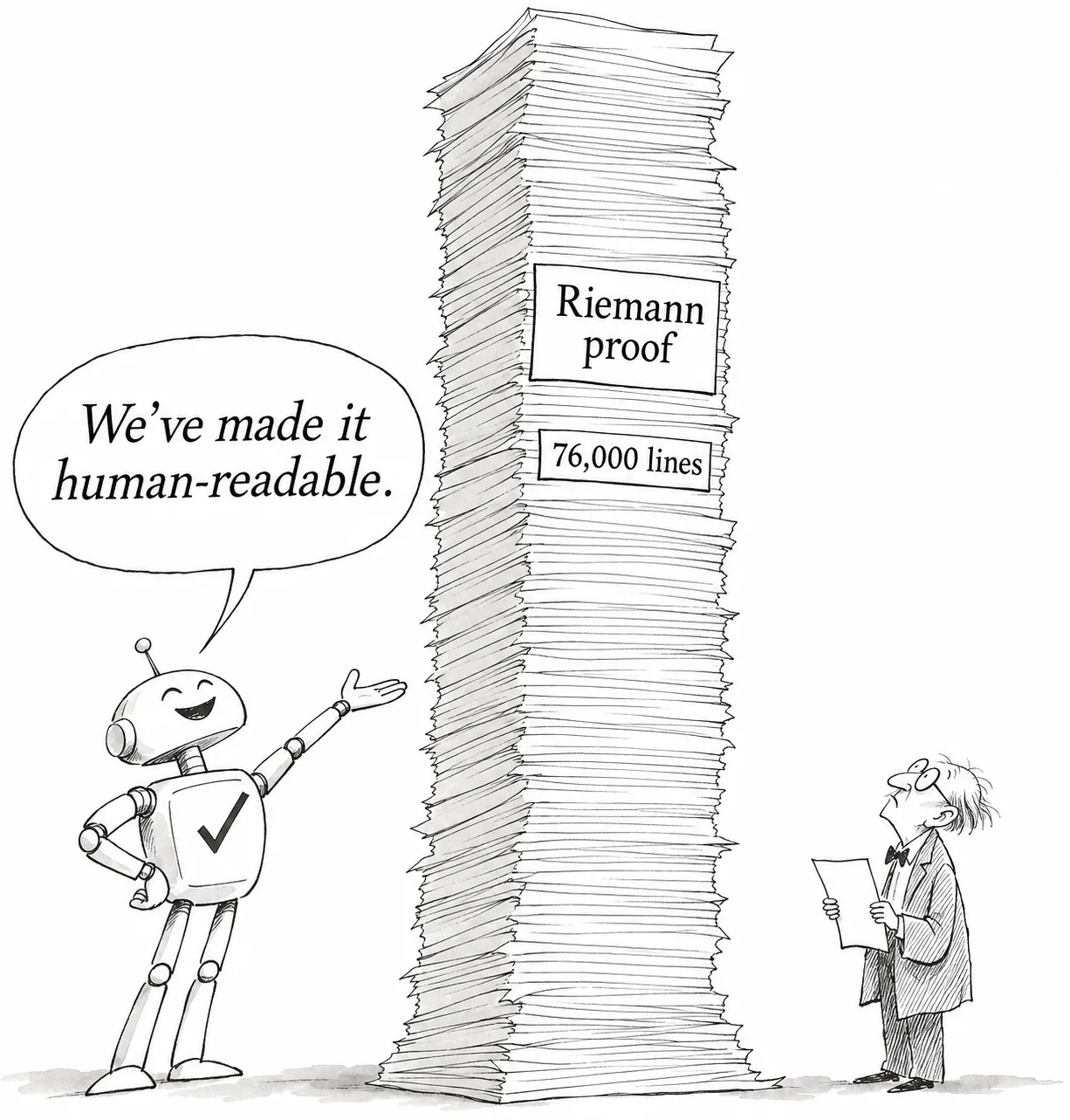
Sernau's shortened version runs to about 76,000 lines, closer to a size humans can read
The weakness of the Alpöge and Claude proof was that it was too large for humans to read. Alpöge himself reportedly admitted that the Lean code had not been cleaned up and was "full of garbage." A machine can check all of it over a few days, but no human can read that much.
On November 25, Anthropic's Luke Sernau published on GitHub a version of the proof cut to about 1/220th of its size, roughly 76,000 lines. University of Waterloo mathematician Michael Rubinstein has set up a page recording checks of the shortened version. Seventy-six thousand lines is still not short. Sernau's README also cautions that the shortened version was written to be short, not easy to read, and he has separately released a version of about 300,000 lines written with readability first. Still, compared with the original, it is closer to a size at which mathematicians can follow the argument and find where its core lies.
Sernau's shortened version matters because it makes it easier to tell whether the length was hiding the substance. Even if the original proof is correct as it stands, no one could tell whether its length reflected the amount of real thinking needed or detours taken by the AI. However, Sernau's version is described as following the original proof's method while proving many of its steps again with different arguments, so the lines it cut cannot all be put down to detours in the original.
After the machine checks, the question is whether humans can explain why it holds
A Lean check guarantees only that a proof is formally correct. It does not tell you why the theorem holds or what new ideas were used. Mathematicians accept a proof when they can follow the argument themselves. British mathematician Kevin Buzzard said on November 21 that it was not yet clear even why the theorem holds, and he expected understanding it to take one to two weeks (as reported by Al Jazeera).
Rubinstein's commentary is the first aid for humans trying to understand the proof. On his University of Waterloo page, Rubinstein released the second edition of a 265-page commentary on November 22. That commentary, however, does not prove the inequality (M) at the heart of the proof. The hardest part has not yet been explained in human terms.
The Alpöge and Claude proof also shows that verification is the biggest hurdle when AI is used to produce work. In a report on a migration to Rust that Anthropic released on November 25, the hurdle was likewise not writing the code but confirming that it behaved the same way. In mathematics, the machine checking stage ended about five days after the November 20 release. The stage of human understanding has only just begun.
What has not been confirmed yet
As of November 25, Anthropic had made no official announcement about the Alpöge and Claude proof and had not said which Claude model was used. According to Rubinstein's verification page, Sernau's shortened version proves the same five statements as the original, and by November 26 all six checkers had accepted it: Lean's standard and paranoid kernels, nanoda, lean4lean, con-leche and con-ron. No new developments were found on two other efforts that same week: the checking of a GRH proof written by hand by Alessandro Masullo, which others have pointed out problems with, and of a proof of the Navier–Stokes equations that Alpöge worked on.
Editorial cartoon