Opinion · Nov 26, 2026
AI self-improvement advocate concedes some criticisms but sticks with 2028 forecast
Dwarkesh Patel releases video and transcript of a conversation answering objections. He accepts that his view assumes continued compute growth and that METR's evidence is a single data point, but keeps his median estimate of around 2028 for fully automating the work of top AI researchers
Koji Yamamoto · Economics Analyst

Key points
- In a conversation responding to objections to AI recursive self-improvement (RSI), Dwarkesh Patel accepted some of the criticisms as valid
- What he conceded: his view assumes compute keeps growing, and METR's evidence is a single data point that cannot be extrapolated
- Even so, he kept his median estimate of around 2028 for when the work of top AI researchers will be fully automated
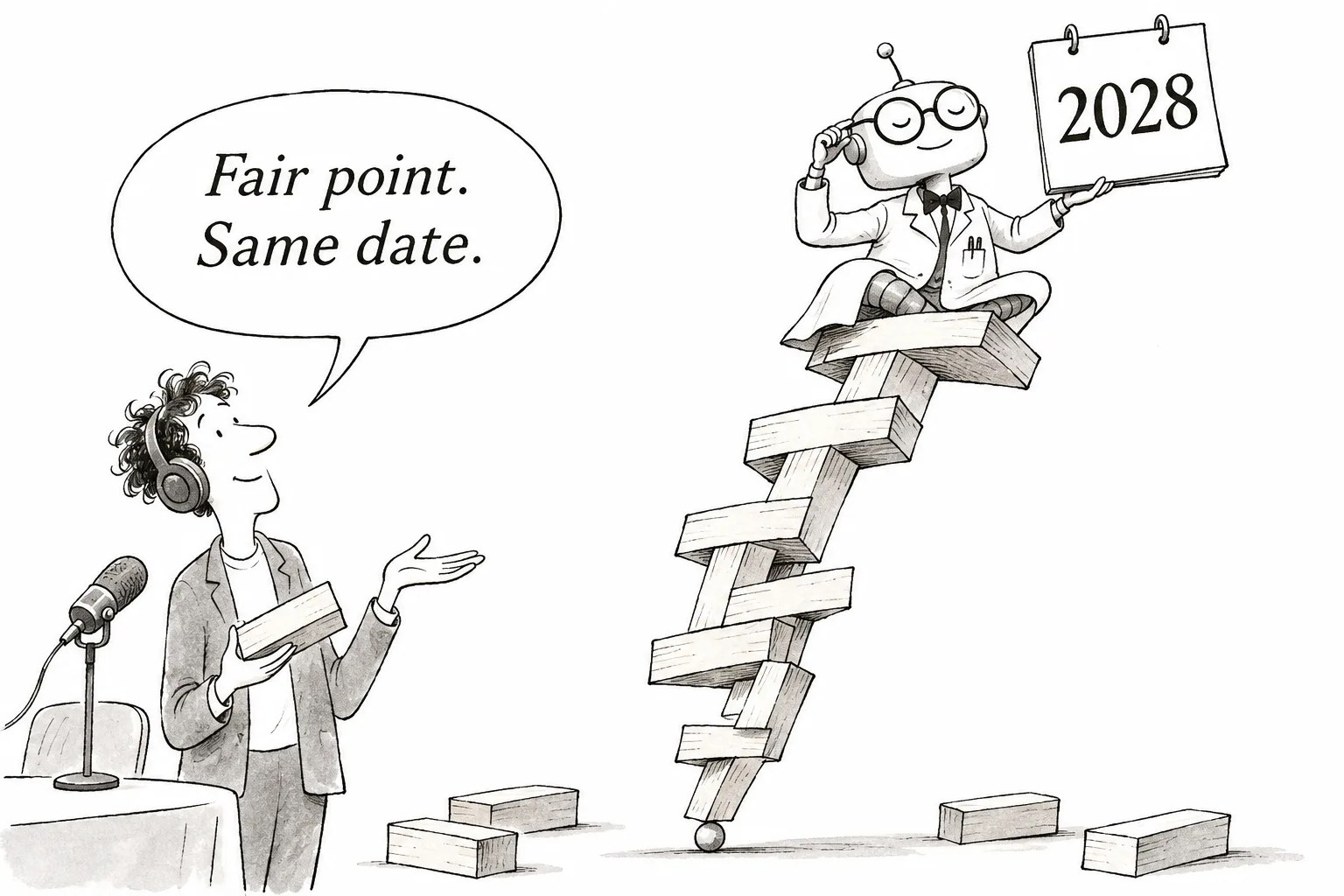
Dwarkesh Patel, host of the U.S. podcast "Dwarkesh Podcast" and a prominent voice on where AI is heading, has posted on his website the video and transcript of a conversation in which he responds to objections to recursive self-improvement (RSI), a loop in which AI carries out AI research and builds the next, more capable AI. The show's Max Farrens read out criticisms the show had received, and Patel answered them. Patel accepted some of the criticisms as valid, including that his outlook assumes compute will keep growing and that the evidence from the evaluation organization METR is a single data point that cannot be extrapolated. Even so, he kept his median estimate of around 2028 for when the work of top AI researchers will be fully automated. In short, he acknowledged that his premises are weak but did not change his conclusion.
For Japanese companies: This has no bearing on most companies' work this week. Corporate planning staff drawing up medium-term plans for AI investment and hiring should not build "AI research will be automated in 2028" into their plans as a fixed date. They should treat it as a conditional forecast that will slip if compute growth (GPU supply and access to electricity) slows, and set up their plans so the assumptions are reviewed at least once a year.
The criticisms Patel accepted: his forecast rests on compute and a single data point
The first criticism Patel accepted concerns his assumption about compute. The forecast that AI research will be automated assumes that the computing power available for training AI and running experiments will keep growing at the same pace as before. Patel said that if automation has not happened by 2030, spending on computing would reach a scale of more than 10% of GDP, the 4x annual buildout could not continue, and progress would slow. He accepted this as an assumption of his view.
The other criticism Patel accepted concerns how he uses evidence from METR, a U.S. nonprofit evaluation organization that measures how long the tasks AI can handle are. In his RSI argument, Patel cites a METR study of Anthropic's research and development that found AI was speeding up well-scoped tasks twice as much as a year earlier. Critics pointed out that this is a single data point, covering one lab over a short period, and that no trend line can be extended from it. Patel agreed that this single point cannot be extrapolated on its own, adding that extending it would imply superintelligence as early as next year, which is not his estimate.
How noisy METR's measurements are shows up in METR's own figures. In METR's update for October–December 2026, the length of tasks GPT-6 Astra could handle at a 50% success rate was 40 hours, but the confidence interval ran from 13 hours to 2,645 hours. The doubling time was about 3.61 months, and a simple extrapolation would reach 200 hours around July 2027, but that is only what extending the line gives.
Why Patel kept his forecast of around 2028 despite accepting the criticisms
Having accepted these criticisms, Dwarkesh Patel kept his median estimate of around 2028 for when the work of top AI researchers will be fully automated. A median means the point at which it is equally likely to happen earlier or later. It is not a prediction that it will definitely happen in 2028. His position is that admitting weak premises is different from changing the most likely date.
Material for the RSI debate has piled up quickly over the past month. GPT-6.2 Astra, which OpenAI released on November 17, is the first model the company has released externally to be rated High in the "AI self-improvement" category of its internal safety framework. In a November 2 amendment to its IPO filing, Anthropic wrote that future models could soon reach its own framework's threshold for "dramatic acceleration of research by AI." METR estimates that AI is speeding up Anthropic's research and development by about 1.9x.
The labs have also supplied material on the compute assumption. In a footnote to a November 22 essay, OpenAI Chief Scientist Jakub Pachocki wrote that the steeper gains in training in 2026 came mainly from compute and long-term research, with AI-driven automation accounting for only part of them. That amounts to a senior lab executive acknowledging that current progress leans heavily on adding more computing capacity, which matches the weak premise Patel conceded.
How readers should take Patel's 2028 forecast
Patel's 2028 forecast is best read as a conditional one. If compute keeps growing and the gains METR has been measuring continue, around 2028 becomes the 50-50 point. If either assumption fails, the date slips later. Because Patel himself has acknowledged the weak premises, it is arguably now easier to see what to watch to check whether the forecast is on track. The things to watch are the pace of data center buildout and METR's next quarterly measurement.
This article covers the main conclusions of Patel's conversation. It does not cover the detailed reasoning behind his answers to each criticism, the figures for how much compute growth he expects, or the names of the critics. The METR, OpenAI and Anthropic figures above are drawn from announcements by those companies and organizations as background to the debate, and were not necessarily cited by Patel in the conversation.
Editorial cartoon