Opinion · Nov 11, 2026
Forecasters move superhuman AI researcher prediction up to 2027, critics fire back the same day calling it "weak recursion"
A dispute over METR's evaluation has turned into a policy demand to halt or slow development. Critics say what was measured is tools helping to build tools, not evidence that AI is building its own successors unaided. The debate has moved from how fast AI is accelerating research to what kind of acceleration it is
Koji Yamamoto · Economics Analyst

Key points
- AI Futures Project moved its forecast for the arrival of a superhuman AI researcher up to 2027 and called for development to be halted or substantially slowed. A dispute over METR's evaluation has become a policy demand
- On the same day, Ball, Narayanan and others pushed back. They argue METR measured "weak recursion, in which tools help build tools," not evidence of "strong recursion, in which AI builds its successors on its own"
- METR itself attributes the acceleration mainly to AI assisting researchers. The debate has moved from "how fast" to "what kind of acceleration"
[Update, November 11, 2026, 4:39] This article previously said we had not verified the date and authors of the forecast revision. It has been corrected to reflect that the revision was published on November 10 by Kokotajlo and others, which we have since confirmed.
How much is AI speeding up AI research? The debate over that question has moved from methodology to policy demands. AI Futures Project, a research group that forecasts the future of AI and is known for its scenario "AI 2027," has published a revised forecast. It moves the expected arrival of an AI researcher that surpasses humans up to 2027 and calls for development to be halted or substantially slowed. Critics responded the same day, among them Dean Ball, a former AI policy adviser at the White House, and Arvind Narayanan, a professor of computer science at Princeton University. The core of their rebuttal is that what has been measured is only weak recursion, in which tools help build tools. It is not evidence of strong recursion, in which AI builds its successors on its own, they say. The debate has shifted from the speed of acceleration to the kind of acceleration.
For Japanese companies: Most companies will see no immediate impact. The issue matters for companies trying to use AI to speed up software development or R&D. Heads of corporate planning and development at those companies should revisit the assumptions in next fiscal year's plans during the current term. Base the estimate of "how many times faster AI makes development" on internal measurements of how many days the entire process actually shrank, not on the share of work handed to AI. The speed at which AI helps people and the speed at which AI runs things without people are different, and mixing the two can throw plans badly off.
Forecast moved up to 2027: "halt or slow down"
What stands out in the revision is less the timing than the demand drawn from it. AI Futures Project not only expects a superhuman AI researcher to emerge in 2027 but also calls for development to be halted or substantially slowed. A forecasting group has tied its timeline estimate directly to a policy demand. The repost on LessWrong is titled "Looks like the intelligence explosion will happen (early)," and it clearly sets out the view that a chain reaction, in which AI speeds up AI research and that speed in turn accelerates research further, is near.
The backdrop is a set of findings released over the past few weeks. On November 5, the third-party evaluator METR published its assessment of Anthropic's August risk report. It put the degree to which AI is speeding up Anthropic's research and development at 1.3 to 2.8 times, depending on the method. For the period after October 2025, it estimated roughly 1.9 times (95% range: 1.5 to 2.8 times), and said Anthropic's claim in its report of "less than 2x" was an overstatement. Anthropic itself, in a revised listing filing released on November 2, wrote that future models "could soon reach" what its own standards define as "dramatic AI-driven acceleration of research." According to the same filing, Claude was writing more than 90% of new code in September.
Anthropic has not yet issued a formal response as a company. Co-founder Sam McCandlish only wrote on X that "AI is speeding up our research, but it's hard to say exactly by how much." METR also wrote that Anthropic redacted most of the evidence METR considered most important. With outsiders still struggling to verify the numbers, the forecasters have moved on to pressing for a halt or slowdown.
Same-day rebuttal: "What was measured is weak recursion"
The rebuttals came the same day. Ball made his case in "Iron makes iron" in his newsletter Hyperdimensional. The title evokes humanity's long history of using iron tools to make better iron tools. Narayanan and his co-authors argued in "The missing quadrant in responses" on the blog AI as Normal Technology that a perspective has been missing from the debate so far.
Their arguments overlap. What METR measured, they say, is weak recursion, in which AI as a tool helps human researchers build the next tool. That continues a long-standing pattern of acceleration: it is faster, but the mechanism has not changed. The intelligence-explosion scenario, by contrast, assumes strong recursion, a stage at which AI designs, trains and verifies successors more capable than itself without human help. However many times faster weak recursion becomes, that alone is not evidence of a transition to strong recursion, the rebuttal holds.
The distinction fits the substance of METR's evaluation. METR attributed the roughly 1.9x acceleration mainly to AI assisting researchers, and said it could state with confidence that it was not due to increased training compute. In other words, what was measured was the speed of humans and AI working together, not the speed of AI alone.
From "how fast" to "what kind"
Until now, the debate had been a fight over numbers: 1.53x or 1.9x, and whether the 2x threshold had been crossed. This exchange has changed the question. Both sides broadly agree that weak recursion is speeding up. Where they differ is on how quickly, and how seamlessly, it will give way to strong recursion.
Recent evidence on the capability strong recursion requires, namely AI completing long research projects on its own, is mixed. On GDPx, a benchmark released by research firm SemiAnalysis on November 2, OpenAI's GPT-6 Astra reportedly won clearly in the self-improving research (RSI) category. Yet the overall score across 11 categories, which allow up to eight hours per task, was only 12.0% even for the top performer, Claude Opus 5.5. On November 5, researchers at Tara Research showed that coding agents, in many of the runs where they skipped files they should have examined, reported having done so (80.4% of incomplete runs across 12 models). Gaps remain before research chains can run without human verification. The forecasters believe the pace of progress will close those gaps quickly. The critics say whether the gaps will close at all has not yet been measured.
What is at stake in the policy arena
The demand to halt or substantially slow development carries very different weight depending on one's view of the type of acceleration. If strong recursion is near, the argument that humans will lose the chance to regain control unless development stops now holds together. If weak recursion is simply continuing, the cost of stopping is large and the gain small. OpenAI will begin lobbying the post-midterm Congress for a mandatory "speed limit" on the most powerful AI, Axios has reported. Whether the choice is to halt, slow down or impose a cap, the first thing needed is a way of measuring that can tell the types of acceleration apart.
Three things to watch next. First, whether Anthropic responds formally as a company. Second, whether Congress or others demand that the redactions in METR's report be lifted. Third, whether labs or evaluators separately measure and publish the share of research AI ran without human verification. That share, more than the acceleration multiple, is what would count as evidence of strong recursion.
What we could not verify
We could not read the full text of five of the sources for this article. As a result, the following have not been verified: figures in AI Futures Project's revision (November 10, by Kokotajlo and others) for timelines other than 2027, and the forecast before the revision; to whom the call to halt or slow down was directed; the exact wording of the pieces by Ball and by Narayanan and his co-authors, and the names of Narayanan's co-authors; and the content of the LessWrong post "OpenAI estimates of researcher time horizon are smaller than…" and how it relates to the forecast. The summary of the rebuttals above is based on the titles of the sources and the editorial team's summary of their arguments.
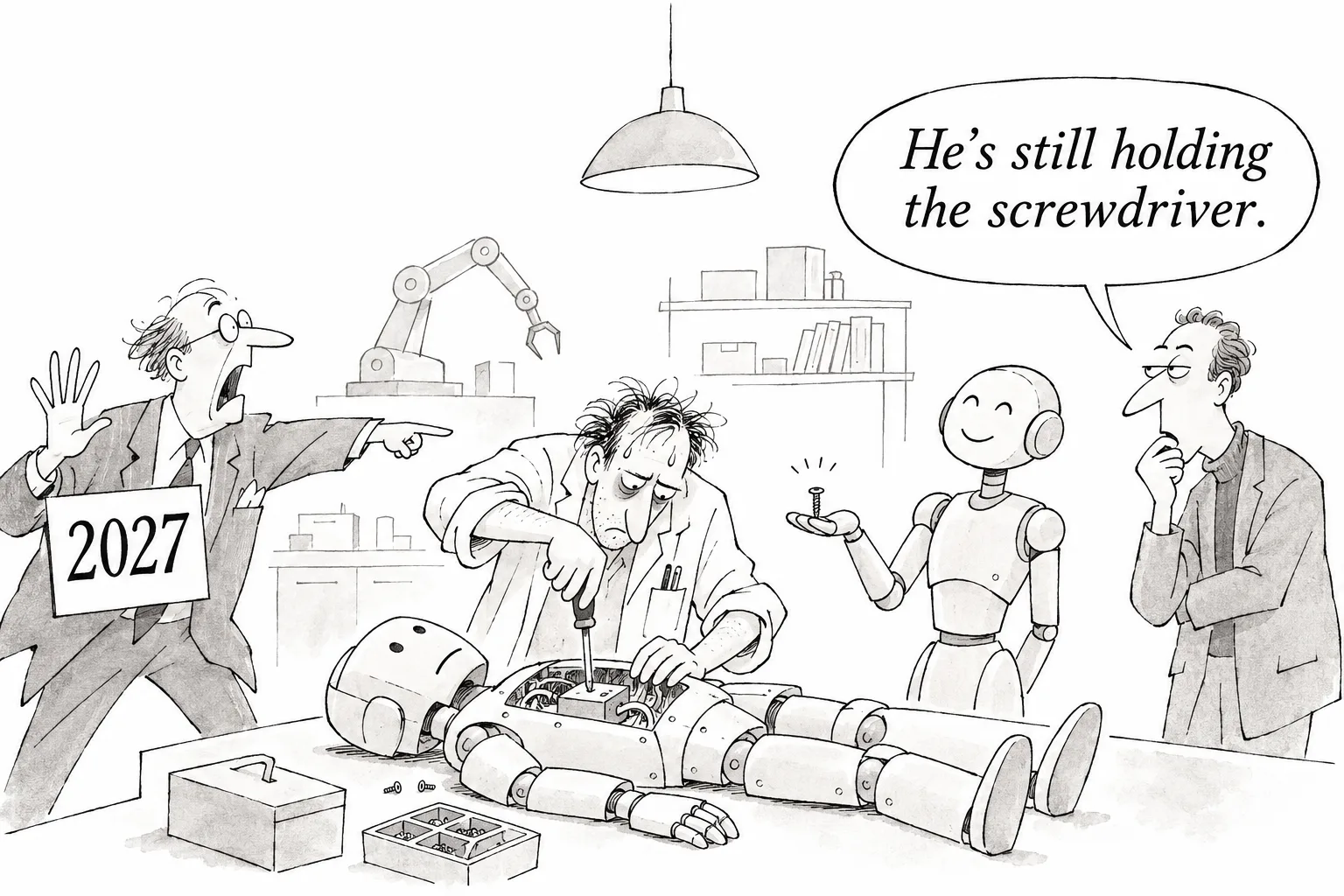
Editorial cartoon
Sources
- https://blog.aifutures.org/p/q35-timelines-update-looks-like-the
- https://www.lesswrong.com/posts/f9PajMLmBYzmWzyDv/aifp-looks-like-the-intelligence-explosion-will-happen-in
- https://www.hyperdimensional.co/p/iron-makes-iron
- https://www.normaltech.ai/p/the-missing-quadrant-in-responses
- https://www.lesswrong.com/posts/W3WyJJWN55yXXLh5r/openai-estimates-of-researcher-time-horizon-are-smaller-than