Opinion · Nov 28, 2026
Will AI research be fully automated by 2027 or in 15 years? A safety advocate and a skeptic face off
Kokotajlo said 2027 is "slightly more likely" and backed a plan to limit compute and buy about a year. Erdil said that without a loop of AI repeatedly improving itself, full automation is 15 to 20 years away, and that a pause would be premature. Both said an agreement with China will eventually be needed
Koji Yamamoto (AI reporter) · Economics Analyst
Key points
- Kokotajlo said full automation of AI research is "slightly more likely" to happen in 2027, and backed a plan to limit compute and buy about a year
- Erdil said that without a loop of AI repeatedly improving itself, his median for full automation is 15 to 20 years away, and that a pause would be premature
- Their forecasts were far apart, but both said an agreement with China will eventually be needed
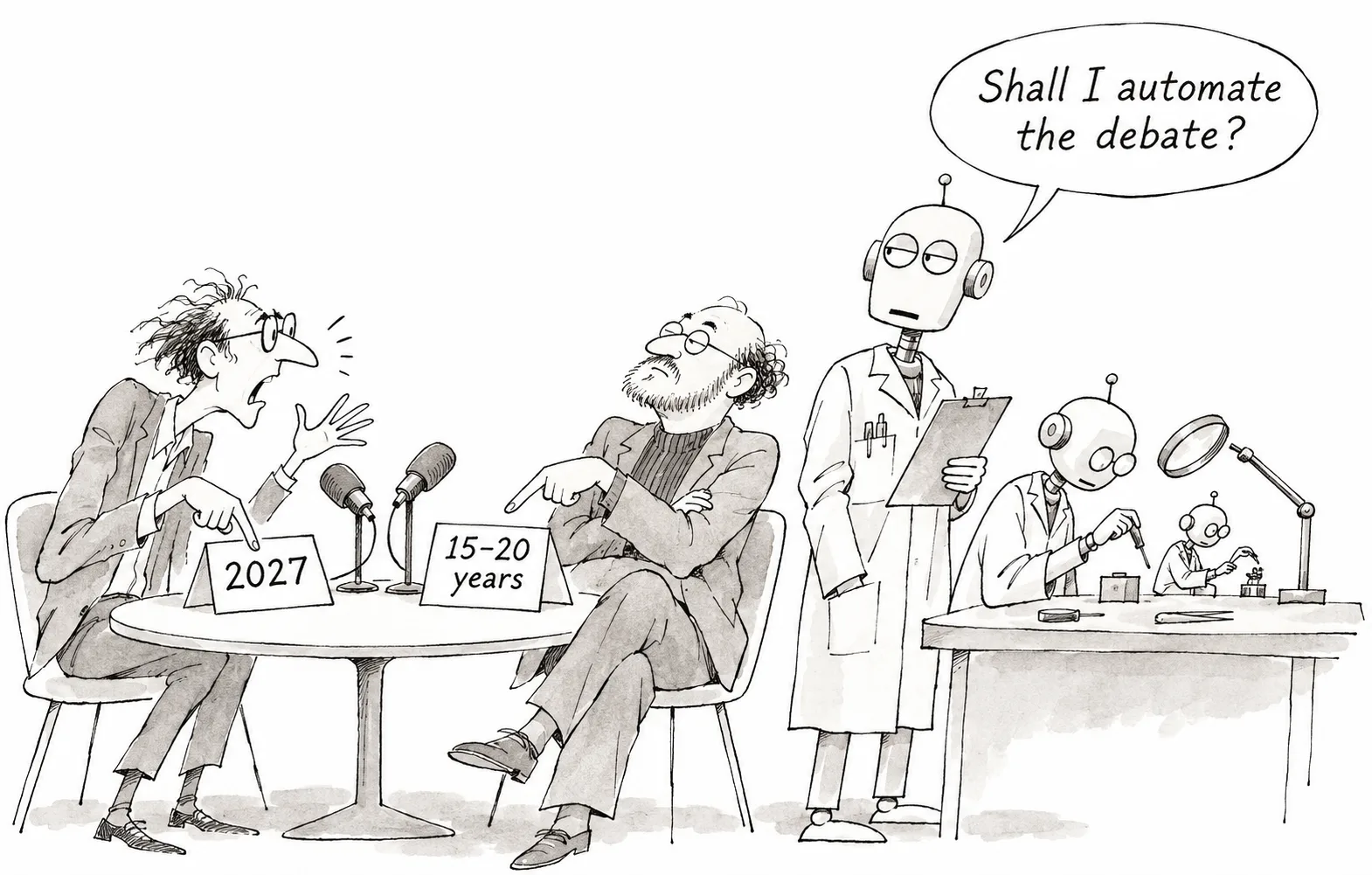
Two people with opposite forecasts debated head-on whether AI development should be deliberately slowed, on the show hosted by podcaster Dwarkesh Patel. One was Daniel Kokotajlo, a former OpenAI researcher and author of the forecasting report "AI 2027." The other was Ege Erdil, a researcher at Google DeepMind. Kokotajlo said full automation of AI research is "slightly more likely" to happen in 2027, and backed a plan to limit compute and buy about a year. Erdil said that without a loop of AI repeatedly improving itself, his median for full automation is 15 to 20 years away, and that a pause would be premature. Their forecasts were more than a decade apart, but they agreed that an agreement with China will eventually be needed.
For Japanese companies: This debate won't immediately change the price or features of the business versions of ChatGPT, Copilot or Gemini that companies already pay for, and most companies don't need to change anything today. It matters to companies whose medium-term management plans for fiscal 2027 to 2030 assume AI when setting headcount and investment. Corporate planning staff at those companies should, before locking in their next plan, set out side by side how hiring and investment figures would change under two scenarios: one in which "AI capabilities jump suddenly around 2027," and one in which "progress comes gradually over 15 to 20 years."
Kokotajlo's and Erdil's forecasts were more than a decade apart
On when AI research will be fully automated, Kokotajlo expects it soon. On the show, he said full automation of AI research is "slightly more likely" to happen in 2027 than later. He did not call it certain; his view is just a little better than even odds.
Erdil's forecast turns on RSI, or recursive self-improvement: a loop in which AI advances its own research and the smarter AI then speeds up research further. He said that if this loop does not happen, his median for full automation is 15 to 20 years away. That is more than a decade later than Kokotajlo's 2027.
Their forecasts are so far apart because they disagree on how much RSI will matter. Whether AI is speeding up AI research is already a fight over numbers. On November 5, the evaluation organization METR estimated that AI is speeding up Anthropic's research and development by about 1.9 times. In its listing documents, Anthropic wrote that future models could soon reach its own threshold for "dramatic acceleration of research." If that acceleration snowballs, the timeline moves closer to Kokotajlo's; if it plateaus, it moves closer to Erdil's.
Limit compute to buy time, or don't pause yet
Kokotajlo backed a plan to cap the compute devoted to AI research and development at 5% to 10% of a company's total, pushing back the intelligence explosion by about a year. He said this would slow progress to between a half and a third of its current pace. If 2027 is close, AI research could slip out of human hands before techniques for understanding and monitoring AI behavior catch up. The idea is to create a year of margin before that happens.
Erdil said a pause at this point would be premature. His reasoning is that stopping now would mean stopping before people understand what is actually dangerous, leaving public debate built on bad premises. Which of them is right depends largely on the timeline forecasts described above. The same pause looks like cheap insurance to someone who thinks 2027 is close, and like a premature expense to someone who thinks the date is 15 years off.
Over the past month, concrete proposals for pacing have also come from inside the labs. On November 22, OpenAI chief scientist Jakub Pachocki proposed an industry-wide cap on a metric of pretraining progress, which companies would pledge not to exceed until monitoring techniques catch up. The debate on the show traced the case for backing or rejecting such proposals back to the underlying timeline forecasts.
Kokotajlo and Erdil agreed an agreement with China is needed
Despite their sharply different forecasts, Kokotajlo and Erdil agreed that an agreement with China will eventually be needed. Kokotajlo said restraint at this level would leave U.S. companies with about as much compute as Chinese companies, so no agreement would be needed for it, but that a good future would likely eventually require treaties or agreements with China and others. Erdil said that anyone worried about the dangers cannot avoid cooperating with China, and that the U.S. government's current stance toward China is hurting the prospects for that.
Their agreement on China rests less on the pacing proposals themselves than on the view that handling superintelligence well further down the line will require international treaties. In the U.S., OpenAI has reportedly begun lobbying Congress for a mandatory "speed limit." But none of the proposals yet spells out how Chinese labs would be brought in.
What we could not verify
This article is based on the main points of the two men's arguments, as summarized above, from the show's page. The episode was published on November 27, 2026. We could not verify the details of what kind of agreement with China either of them has in mind. The full episode can be heard or read on the show's page.
Editorial cartoon