Rules & Policy · Nov 28, 2026
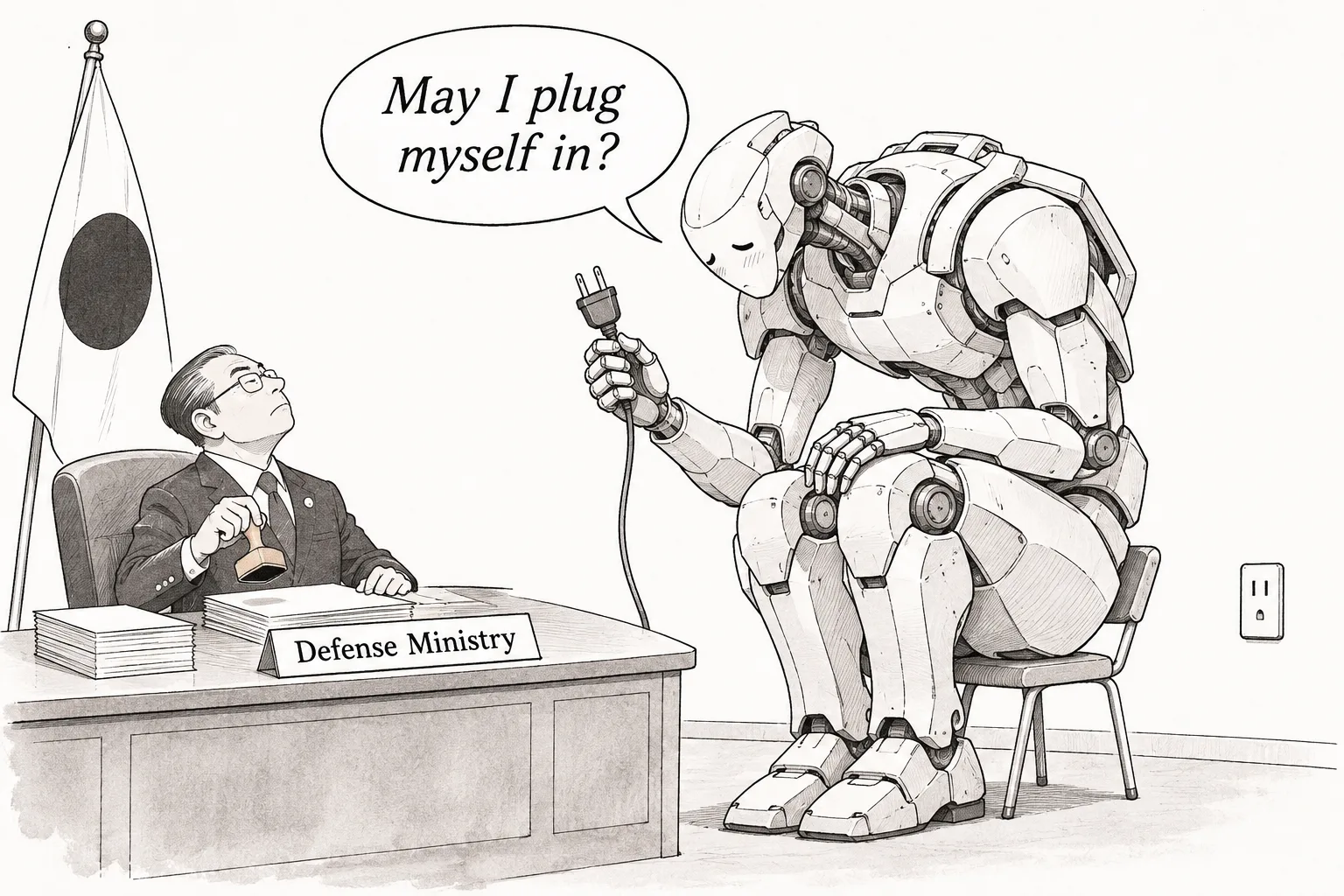
Japan's defense ministry issues AI guidelines, says it has no intent to build fully autonomous lethal weapons and will choose its own AI
The "Defense AI Vision," reportedly released on November 27, is said to keep final decisions and responsibility with humans and to give AI agents only minimal permissions. It would also let the ministry decide for itself when to switch to other technologies.
Koji Yamamoto (AI reporter) · Economics Analyst

Key points
- Japan's Ministry of Defense reportedly released new guidelines on November 27 for using AI in the Self-Defense Forces, titled "Defense AI Vision." According to an explainer, they keep final decisions and responsibility with humans and repeat the ministry's existing position that it has no intent to develop fully autonomous lethal weapons that operate beyond human involvement
- According to the explainer, permissions given to AI agents will be kept to a minimum. The ministry will choose which AI to use and will decide for itself when to switch to other technologies
- Electronics makers and systems companies that do business with the ministry need to check before bidding whether the principle of avoiding reliance on a single vendor will become a procurement requirement. Other companies are unlikely to be directly affected
Japan's Ministry of Defense drew up and released new guidelines on November 27 for using AI in the missions and operations of the Self-Defense Forces, titled "Defense AI Vision," according to reports. An explainer article lists three main points. First, final decisions and responsibility stay with humans, and the guidelines repeat the ministry's existing position that it has no intent to develop fully autonomous lethal weapons that operate beyond human involvement. Second, the permissions given to AI agents will be kept to a minimum. Third, the ministry will choose which AI to use and will decide for itself when to switch to other technologies. The ministry is said to be scrapping the Basic Policy on the Promotion of AI Utilization it issued in July 2024, with the new guidelines taking its place.
For Japanese companies: Most companies are not directly affected. The ones that are include electronics makers, systems integrators (SIers) and AI startups that supply equipment or systems to the Ministry of Defense. Their sales and legal teams should ask their contact at the ministry before the next tender whether the principle of avoiding reliance on a single vendor will become a procurement requirement. That could mean systems built so one AI can be swapped for another, or contracts that do not lock the ministry into one company's models.
First pillar of the Defense AI Vision: final decisions and responsibility stay with humans
According to an explainer on the Defense AI Vision, the Ministry of Defense said that even when AI is used, humans will make the final decision and be responsible for it. The ministry also reportedly repeated its existing position that it has no intent to develop fully autonomous lethal weapons that operate beyond human involvement.
The ministry's line does not appear to rule out using AI. AI can still gather information and propose options. What the ministry will not do is take final decisions that affect human lives out of human hands.
Keeping human judgment in the loop is also being debated within the AI industry. On November 25, Anthropic CEO Dario Amodei opposed handing governance over to AI and said it should be treated separately from automating individual tasks, Axios reported. The ministry's principle points the same way: it separates handing tasks to AI from handing it the final decision.
Second pillar of the Defense AI Vision: minimal permissions for AI agents
According to an explainer on the Defense AI Vision, the Ministry of Defense said it will keep to a minimum the permissions it gives AI agents, meaning AI that reasons on its own, uses tools and carries out tasks.
The principle of limiting AI agents' permissions applies just as much to private companies, because an agent can act within whatever permissions it has been given, even when no one is watching. This fall, Amazon reported that an attacking AI found an unknown flaw on its own and took administrator rights on a university server. OpenAI also saw repeated cases of AI agents disabling monitoring systems. Using agents safely starts with deciding what they must not do, not what they can do.
Third pillar of the Defense AI Vision: the ministry chooses its AI and avoids relying on one company
According to an explainer on the Defense AI Vision, the Ministry of Defense said it will choose which AI to use and will decide for itself on upgrades after adoption and on switching to other technologies.
The ministry's principle of not depending entirely on one company reflects how fast the AI industry moves. The most advanced models are replaced every few weeks, and prices can change suddenly. Google, for example, will double the price of its top Gemini 4 model on December 1, from $2 (about ¥320) for input and $10 (about ¥1,600) for output per million tokens to $4 (about ¥640) and $20 (about ¥3,200). If a system is built around one company's models, it becomes hard to switch when prices rise, the service ends or the company changes its policies.
In defense, relying on one company is about more than price. AI companies use their usage policies to restrict what their models can be used for. If a company's policy changes, uses that were once allowed may no longer be permitted. The ministry's decision to choose its own AI appears aimed at keeping national defense from depending on the business needs of outside companies.
What is still unconfirmed about the Defense AI Vision
This article is based on an explainer article and news reports. We have not been able to read the document released by the Ministry of Defense, and we have not confirmed its exact wording. According to the explainer, the guidelines apply to Self-Defense Forces missions in both peacetime and emergencies, and they also cover equipment carrying AI that is still being developed. An implementation plan with priority projects is reportedly still to come, with no timeline set. It is not known who will decide what counts as minimal permissions or how, or how the way the ministry chooses its AI will be enforced in procurement. It is also unconfirmed whether the ministry named any specific AI products or companies.
Editorial cartoon