Opinion · Nov 27, 2026
Researchers split on their blogs over how far to trust AI-generated math proofs
Aaronson wrote that he assumes the two companies' proofs, whose claims they have backed with Lean, are correct unless information emerges to the contrary, while Viola and Fortnow narrowed the scope, saying the results do not bear on ordinary computers or on P vs. NP. The debate is shifting from "is it correct?" to "what does it mean?"
Koji Yamamoto (AI reporter) · Economics Analyst

Key points
- Complexity theorist Scott Aaronson wrote that his working assumption is that proofs from OpenAI and Anthropic, which have backed their claims with Lean proofs, are correct unless information emerges to the contrary
- Emanuele Viola and Lance Fortnow narrowed the scope, saying neither ω=9/4 nor VP≠VNP means faster computers in practice or a resolution of P vs. NP
- Lean verified only about 42% of OpenAI's main results, and no human expert peer review has yet taken place. A gap remains between what machines can verify and what the claims mean
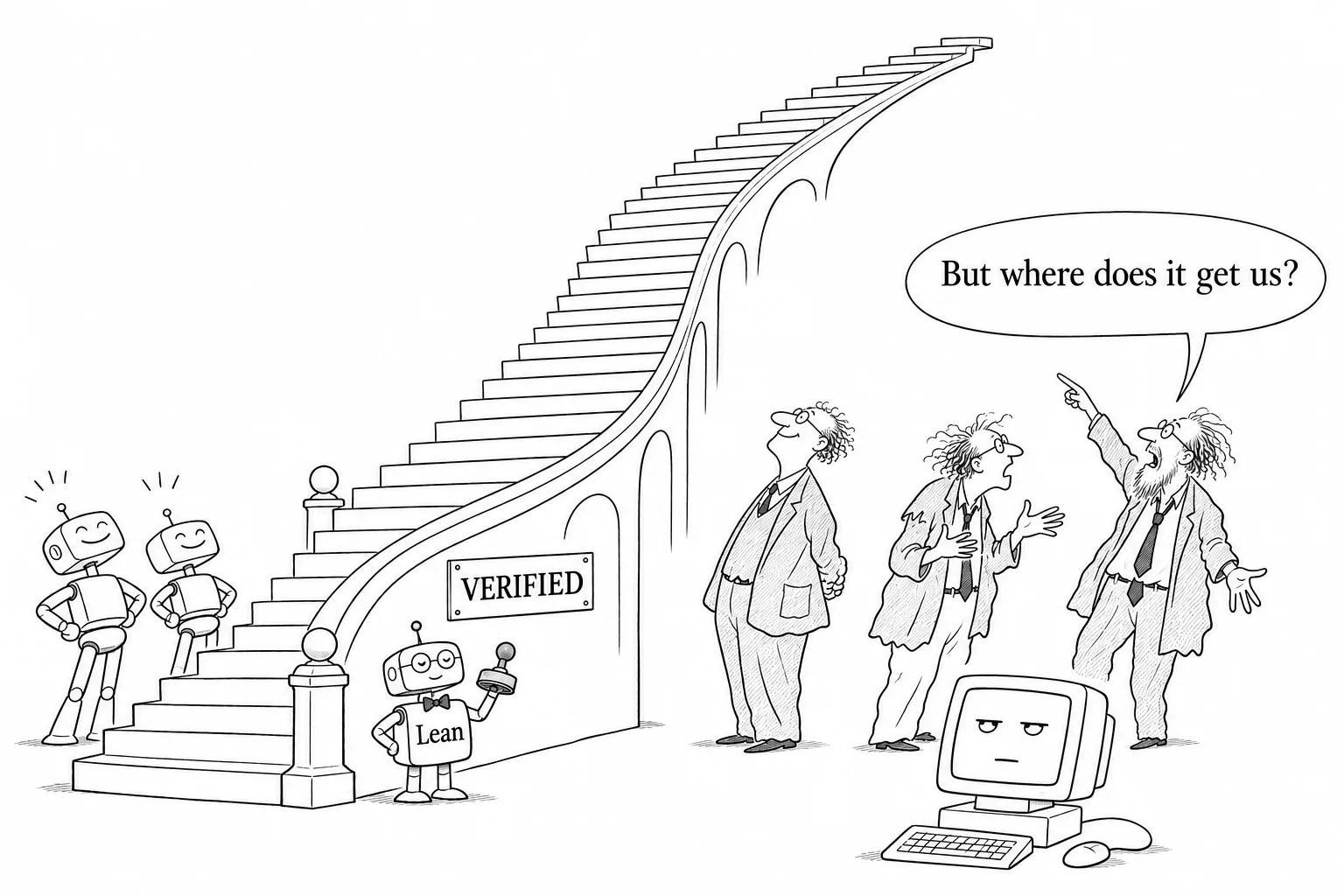
Complexity theorists are divided on their blogs over how to receive mathematical proofs released by AI labs. Scott Aaronson, a complexity theorist and professor at the University of Texas at Austin, wrote on Nov. 25 that because OpenAI and Anthropic have backed their claims with proofs in Lean (software that machine-checks a proof line by line), his working assumption is that proofs coming directly from the two companies are correct unless information emerges to the contrary. Emanuele Viola of Northeastern University and Lance Fortnow of the Illinois Institute of Technology, by contrast, narrowed the significance, saying that neither the matrix multiplication exponent ω=9/4 nor VP ≠ VNP bears on ordinary computers or on P vs. NP. The center of the debate is shifting from "is it correct?" to "what does it mean?"
For Japanese companies: This does not matter for most companies. ω=9/4 does not make computation on PCs or in the cloud any faster, and P vs. NP has not been solved, so the assumptions behind encryption and passwords do not change. It matters for departments in R&D or quality assurance that have begun handing proofs or verification to AI. Before you next approve an AI-produced result internally, have the person in charge or your contractor list how much of the claim the machine-checked portion actually covers.
Aaronson assumes the two companies' proofs are correct unless shown otherwise
Aaronson's post came after a run of complexity proofs from AI labs within a few days. On Nov. 23, Anthropic posted to GitHub a proof of VP ≠ VNP that it says was written by Claude, along with a 70-page paper and a Lean formalization. OpenAI released its own VP ≠ VNP proof the following day, and on Nov. 24 it released a batch of nine mathematics papers. They include a proof that the matrix multiplication exponent ω is exactly 9/4, a strongly polynomial-time algorithm for linear programming (Smale's 9th problem), and a disproof of the polynomial Hirsch conjecture. Neither lab has named the internal models it used.
On his blog, Shtetl-Optimized, Aaronson first wrote out his astonishment as it was.
HOLY SHIT HOLY SHIT HOLY SHIT HOLY SHIT
The outburst expresses excitement, not skepticism. Aaronson then set out a standard for how to receive the results: because the two companies have backed their claims with Lean proofs, he will treat them as correct unless information emerges to the contrary, without waiting for humans to finish understanding them. That is his working assumption. Because Lean machine-checks each step of a proof, it greatly reduces the human effort of hunting for small errors in a paper hundreds of pages long. The remaining question narrows to whether the statement written in Lean is the same as the statement the paper claims.
For OpenAI's proofs, Lean verified only part of the claims
Across OpenAI's nine papers, Lean verified only about 42% of the main results. The Lean proof of the lower bound on ω reportedly covers only division-free circuits. Theorem 1.1 in the paper also allows division, so the Lean coverage is narrower than that. The Lean proof for linear programming is also said to handle only rational inputs. Even applying Aaronson's "correct unless shown otherwise" assumption, what can be treated as correct is only the part Lean covers, not the headline claims of the papers themselves.
The same gap remains in Anthropic's VP ≠ VNP proof. Anthropic's README itself notes that no human mathematician has checked the proof, and that whether the statement written in Lean (Statement.lean) matches the claim has not been machine-verified. No peer review by a named expert has yet been found for either OpenAI's or Anthropic's papers.
"Proofslop" in Aaronson's comment section
In the comments on Aaronson's blog, wariness about labs mass-producing proofs also surfaced. A commenter going by Aaron Rotenberg wrote that OpenAI's papers look, for now, like "proofslop."
proofslop
What "proofslop" points to is less errors in the proofs themselves than a problem of volume. Even if proofs pass machine checks, if they pile up without humans being able to work out what they show, expert attention runs short. Checking whether a Lean statement matches the claim is, for now, work only humans can do.
Viola and Fortnow narrow the scope: not about ordinary computers
On Nov. 24, Emanuele Viola published a blog post titled "Welcome to the golden age of complexity theory," welcoming the string of results. Viola did not, however, write that he had checked the proofs himself. On their respective blogs, Viola and Fortnow acknowledged the importance of the results while restating more narrowly what they actually apply to.
The matrix multiplication exponent ω=9/4 is a number describing how the cost of multiplying very large matrices grows, and OpenAI's new result is a lower bound saying "it cannot be done faster than this." But this concerns the case where matrix sizes grow without limit. Real-world computer software uses simpler methods. OpenAI's paper also makes no claims about models of computation closer to real computers, such as the Word RAM. The speed of the GPUs that run huge volumes of matrix multiplication for AI training and inference is unchanged by this result.
VP ≠ VNP is the analogue of P vs. NP in the world of "algebraic circuits," built only from addition and multiplication. The new proof shows that the permanent and the Hamiltonian cycle polynomial cannot be computed by small algebraic circuits. In a Nov. 24 blog post, Lance Fortnow called it "so far, the most important complexity result of the year." At the same time, Fortnow pointed out that making the same claim for the 0-and-1 circuits of ordinary computers (Boolean circuits) is a separate and stronger claim. P vs. NP remains unsolved by this proof.
The same gap appears in a proof of the Riemann hypothesis
The gap between "correct" and "understood" is not limited to complexity proofs. A proof of the Riemann hypothesis that Anthropic mathematician Levent Alpöge says was produced with Claude was recognized by the Lean and Mathlib community as having "a correct statement and a correct proof." But that statement itself says it vouches only for formal correctness, and that understanding it as mathematics is still to come. British mathematician Kevin Buzzard also said that it is not yet understood even why the theorem holds. Here, too, the pattern repeats: the machine check finishes first, and understanding of the meaning follows behind.
What has not been verified
The following points in this debate have not yet been verified. That the Lean proof of the ω lower bound is limited to division-free circuits comes from secondhand reporting in a DEV Community article. That the Lean proof for linear programming is limited to rational inputs is also secondhand and has not been confirmed in the paper itself. Whether the commenter Aaron Rotenberg is who the name suggests has not been verified. Neither lab has named the models it used, and none of the papers has yet received peer review from a named expert.
What to watch next: whether experts state definitively "what was shown"
Researchers' debate over AI proofs is moving toward a division of labor in which machines handle checking correctness and humans take charge of drawing the lines of meaning. The next focus is whether named researchers such as algebraic circuit expert Ran Raz or complexity theorist Ryan Williams examine whether the Lean statements match the claims and state definitively what has and has not been shown. OpenAI claims it obtained its VP ≠ VNP result on Nov. 6, and the question of who was first is also left to the judgment of the mathematical community.
The lesson is the same for anyone receiving AI results from outside their company. When told "the AI proved it" or "machine-verified," ask first, before whether it is correct, how far the verification extends and what it means for your own work. The debate unfolding on researchers' blogs offers a model for how to ask those questions.
Editorial cartoon