Work & Society · Nov 26, 2026
General-purpose AI designs proteins, matching specialized tools in lab tests
OpenAI's announcement points to faster drug discovery — while raising the stakes for biosecurity
Koji Yamamoto · Economics Analyst
Key points
- OpenAI announced that simply equipping a general-purpose large language model with a harness — a tool for writing and running code — produced results on par with AI built specifically for protein design
- On proteins that were actually synthesized and tested, binding rates were 10.9% for structure-based design, 85% for sequence design against the cancer-related protein MDM2, and up to 70% for antibody redesign
- Because design is possible without a specially trained model, drug discovery may speed up, while managing the biosecurity needed to prevent misuse becomes harder
- This is OpenAI's own announcement (a primary source), with no independent external verification yet. It has no direct bearing on most companies outside pharma and biotech
[Update Nov. 26, 2026, 5:13] Because OpenAI's announcement states the counts, we have replaced "the counts could not be confirmed" with figures such as 35 of 322 for structure-based design.
On Nov. 24, the U.S. company OpenAI announced that when it equipped a general-purpose large language model (LLM), mainly using GPT-6.2, with a harness — a tool for writing and running code — the result rivaled AI built specifically to design proteins. Notably, the work did not stop at on-screen computation: the designed proteins were actually synthesized and tested in the lab, and the rate at which they stuck to their intended target (the binding rate) was measured. In other words, the claim is that without a specially trained, purpose-built model, real proteins can increasingly be designed simply by handing tools to a general-purpose AI. This is OpenAI's own announcement (a primary source), with no independent external verification yet.
For companies in Japan: There is no direct relevance for most companies. Those affected are the research and development arms of pharmaceutical, biotech, drug-discovery-support, and chemical firms. These departments may find it worthwhile to run small tests by year-end to see how far the general-purpose AI they already contract for — such as the enterprise edition of ChatGPT — can go in preliminary research and exploration for protein design. For other industries, it is enough for now to note the broader trend: general-purpose AI is beginning to encroach on specialized scientific work.
General-purpose AI pulls level with specialized tools
Protein design is the work of using a computer to create a new protein that binds tightly to an intended target, such as another protein. Until now, this job has relied on AI trained solely for it — specialized design tools. What OpenAI has now shown is that results matching those specialized products came not from such a dedicated tool, but from simply adding a mechanism for running computations and tools to a general-purpose model of the kind normally used for chat and code.
The "harness" referred to here is the outer mechanism that gives an LLM tools such as a calculator or computation programs and lets it write and run its own code. GPT-6.2 used this harness to assemble and run the design computations itself. The crux this time is that, without training a new model from scratch for each specialized field, a general-purpose model can wield tools and reach specialized results.
Three numbers confirmed by experiment
The first is design that builds a binding protein from scratch using only the target's three-dimensional structure as a clue — so-called de novo design. According to OpenAI, 10.9% of the proteins that the general-purpose model designed and that were actually synthesized stuck to their target as intended. On this hardest class of task — creating a shape out of nothing — it says the binding rate reached the same level as specialized tools.
The second is design in which the target's framework (structure) is fixed and a new sequence of amino acids is fitted to it. Against MDM2, a protein deeply involved in cancer, the binding rate is said to have reached 85%. Having a base structure makes the task less difficult, but the success rate is still high, showing that general-purpose models also hold up in design that uses existing structures.
The third is the redesign of antibodies, proteins involved in immunity. On the task of redesigning an existing antibody to bind its target better, the binding rate is said to have been up to 70%. Because antibody-based drugs make up a large share of drug discovery, a general-purpose AI producing results in this area is no small matter. All three, OpenAI explains, are results of actually synthesizing and testing the proteins, not computational predictions.
Why it matters: faster drug discovery
For drug discovery, the significance is that preliminary design research may now be possible using a combination of a general-purpose model and tools, without building a specialized AI each time. Developing a specialized model takes time and money for data preparation and training. If general-purpose AI can take on that burden, the earliest stage of searching for drug candidates could become faster and cheaper. OpenAI's announcement is also part of the company's recent push to apply AI to science and engineering.
That said, what speeds up is only the entry point of design. Whether a designed protein can truly be used as a drug cannot be known until it passes a long process of safety and efficacy testing, manufacturing, and approval. These figures look at "whether it binds," not a guarantee of "whether it becomes a drug." Excessive expectations are unwarranted.
Behind the scenes: the biosecurity problem grows
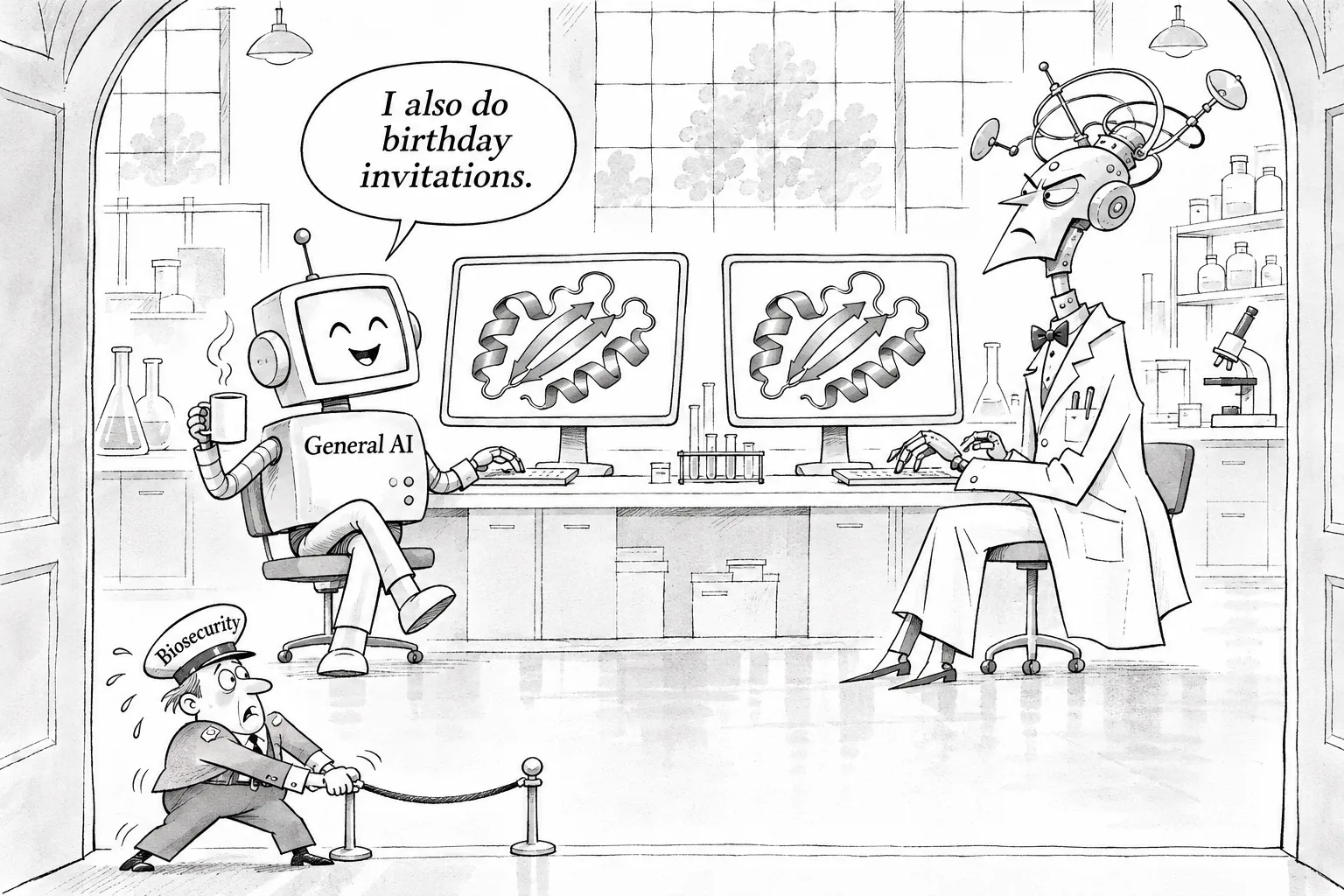
From a biosecurity standpoint, the same technology may work in reverse. If biological design is possible simply by handing tools to a general-purpose AI, without preparing a specially trained model, then the conventional defense of "cordoning off only the dangerous models" becomes less effective. The more the capability resides in general-purpose models, the harder it becomes to decide where to draw the line and who should be allowed to use what. OpenAI itself takes the position that accelerating drug discovery and managing biosecurity are two sides of the same coin.
This concern extends beyond OpenAI alone. The frontier models of various companies have been judged by internal standards to be at a high level of capability in biology and chemistry, and measures to restrict their use have been taken. The more capable general-purpose models become, the more heavily the voluntary brakes companies set, along with third-party verification and the development of regulation, will be called into question.
What could not be confirmed
Finally, a summary of what this article could not confirm. All of these results come from OpenAI's own announcement, and no independent replication or verification by outside researchers has yet been published. It is described as "mainly using GPT-6.2," but the details of the harness and the specifics of how conditions compared with specialized tools cannot be judged from the announcement alone. Note that, per OpenAI's announcement, the numbers tested were 35 of 322 for structure-based design, 75 of 88 for MDM2, and 128 of 182 for antibody (VHH) redesign. Readers should take this as one example of general-purpose AI beginning to reach specialized science, and it is reasonable to await independent verification before drawing conclusions.
Editorial cartoon