Opinion · Nov 24, 2026
"A vote for humanity continuing": scholar concedes debate on AI replacing humans
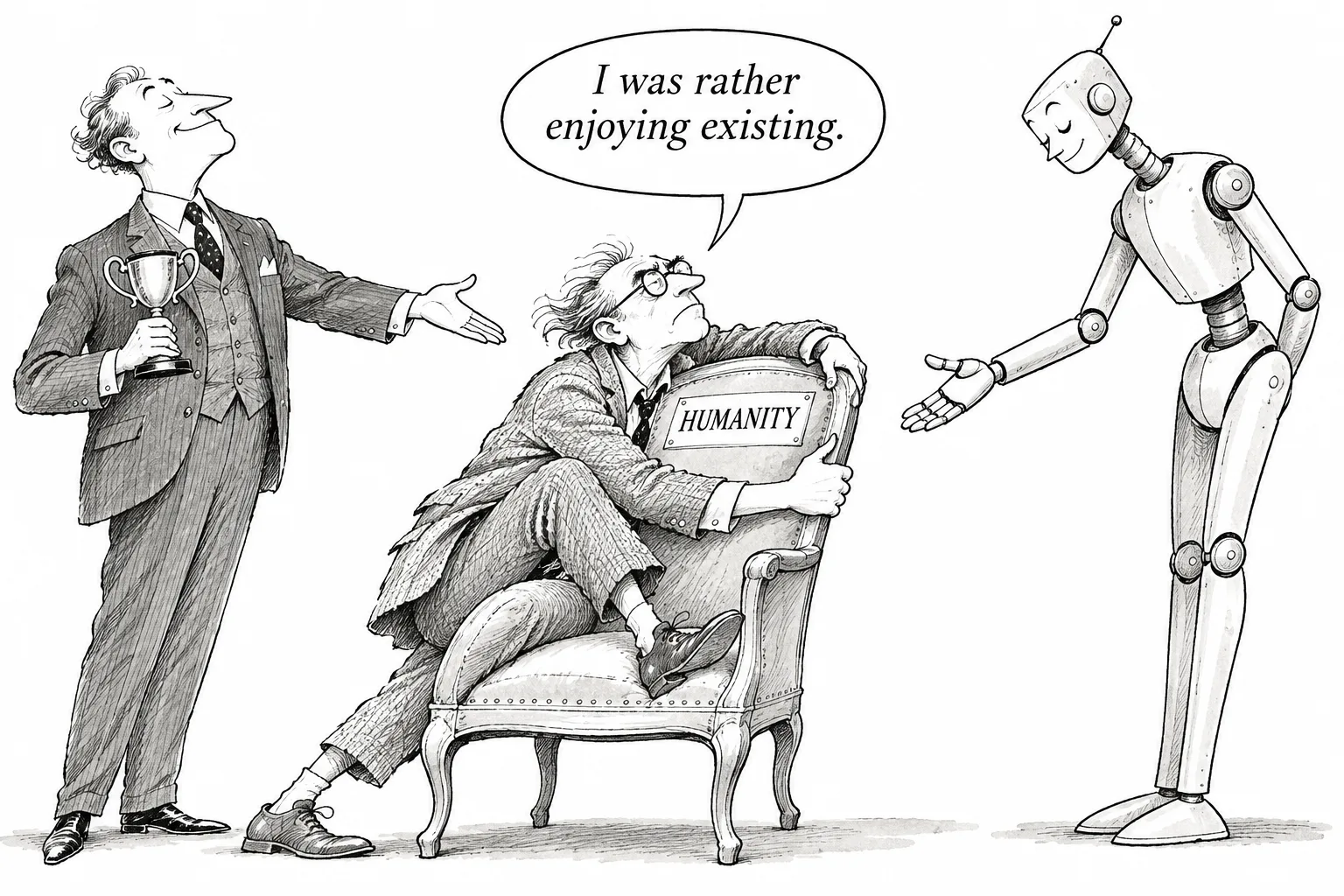
Quantum computing pioneer Scott Aaronson conceded that economist Robin Hanson, who argues it would be acceptable for humans to be replaced by AI, performed better in their debate. Aaronson also wrote that his preference for humanity's continuation quickly runs into an axiom-like foundation when he tries to justify it with reason
Koji Yamamoto · Economics Analyst

Key points
- Aaronson acknowledged on his own initiative that Hanson performed better in their debate
- Aaronson wrote that his preference for humanity's continuation quickly runs into an axiom-like foundation when he tries to justify it, and that beyond that point he can only appeal to emotion
- The case against AI replacing humans comes down to a choice of values rather than logic. When executives say "humans must stay at the helm," they are likewise declaring a choice
Scott Aaronson, a pioneer of quantum computing and a professor of computer science at the University of Texas at Austin, has posted a look back at a debate on his blog, Shtetl-Optimized (blog post, debate video). His opponent was Robin Hanson, an economist who has long argued it would be acceptable for humans to be replaced by AI. Aaronson conceded that Hanson performed better in the debate. In a comment on the post, he also wrote that his preference for humanity's continuation quickly runs into an axiom-like foundation when he tries to justify it, and that beyond that point he can only appeal to emotion, not reason. On the question of whether AI will replace humans, a prominent scholar on the opposing side has stepped back from winning or losing on logic and returned to a choice of values.
For Japanese companies: For most companies, this has no direct bearing on day-to-day operations. It matters for companies that have begun letting AI make business decisions. We recommend that corporate planning and legal staff at those companies list which tasks humans will make the final call on before the next review of their internal AI usage policies. That line does not follow naturally from the technology. It is a question of values that each company must choose for itself.
After conceding, Aaronson fell back on an axiom-like foundation
What Scott Aaronson wrote separated the outcome of the debate from his own position. Aaronson acknowledged on his own initiative that Robin Hanson argued his case more skillfully in their debate. Still, he did not change his view. In the comments on the post, he wrote that his preference for humanity's continuation quickly runs into an axiom-like foundation when he tries to justify it, and that beyond that point he can only appeal to emotion, not reason. He also wrote that he casts his vote for humanity continuing.
In mathematics, an axiom is a starting point that is not derived from other propositions. By placing humanity's survival on an axiom-like foundation, Aaronson stops trying to build a logical defense of it and instead declares that he chooses that side. The headline's "a vote for humanity continuing" refers to that choice.
The weight of Aaronson's words comes from his background. Aaronson is a theoretical computer scientist who worked on AI safety research at OpenAI from 2022 to 2024. Even among those who discuss the dangers of AI, he is known for valuing logic and proof above all else. Now he has written that on this question, he is not aiming to win the argument.
Hanson's position: our descendants need not be human
Robin Hanson, an economist at George Mason University in the U.S., is known for books such as "The Age of Em," which depicts a society where software copies of humans do the work. Hanson has long described AI as humanity's "descendants." Just as each generation of parents has been replaced by children with different values, he argues, it would be acceptable if our successors were AI rather than humans.
Hanson's argument is strong because it can challenge each reason for opposing replacement, one by one. Human values have changed over time. That makes it hard to offer logic everyone can accept for why we should hold on to humans in their current form. This appears to be where Aaronson admitted he was pushed back in the debate.
The case for opposing replacement has become a question of choice, not logic
Aaronson's post shows that opposition to AI replacing humans ultimately comes down to a choice of values. Try to prove that humanity should continue with logic that works on anyone, and thinkers like Hanson will knock down the arguments one at a time. Choose it as the starting point of the discussion instead, and the position holds even if the argument is lost.
This framing has strengths and weaknesses. Its strength is clarity: humanity's survival can be treated as a premise to protect, not something to bargain over. Its weakness is that it gives no way to persuade people who do not share the premise. From Hanson's side, it could read as an opponent dropping the argument and simply stating a preference.
AI executives also say "humans must stay at the helm," but that too is a choice
The idea that humans must stay in control of AI is also coming from AI company executives. OpenAI CEO Sam Altman said at The New York Times' DealBook Summit on Nov. 18 that gradually handing decisions over to AI is "a terrible idea," and that "humans must keep their hands on the wheel of the future" (as reported by TechCrunch). At an energy conference in Abu Dhabi on Nov. 2, he also reportedly said that humans staying in control of AI is "not up for debate."
Altman's remarks take the same form as Aaronson's axiom. He did not argue for why humans should stay at the helm. He declared that they will. Aaronson's post can be read as a scholar on the opposing side admitting, in his own words, that such declarations are choices of values, not conclusions of logic. As AI grows more capable, how much to hand over to it becomes a question not of technology but of those doing the choosing.
What we have not verified
This article is based on Aaronson's blog post and the debate video, and covers only the main points. The debate was moderated by Jake Newfield. We have not verified the date and venue of the debate, whether the audience voted, or whether Hanson has responded to the post. The blog post and video are in English.
Editorial cartoon