Infrastructure & Security · Nov 22, 2026
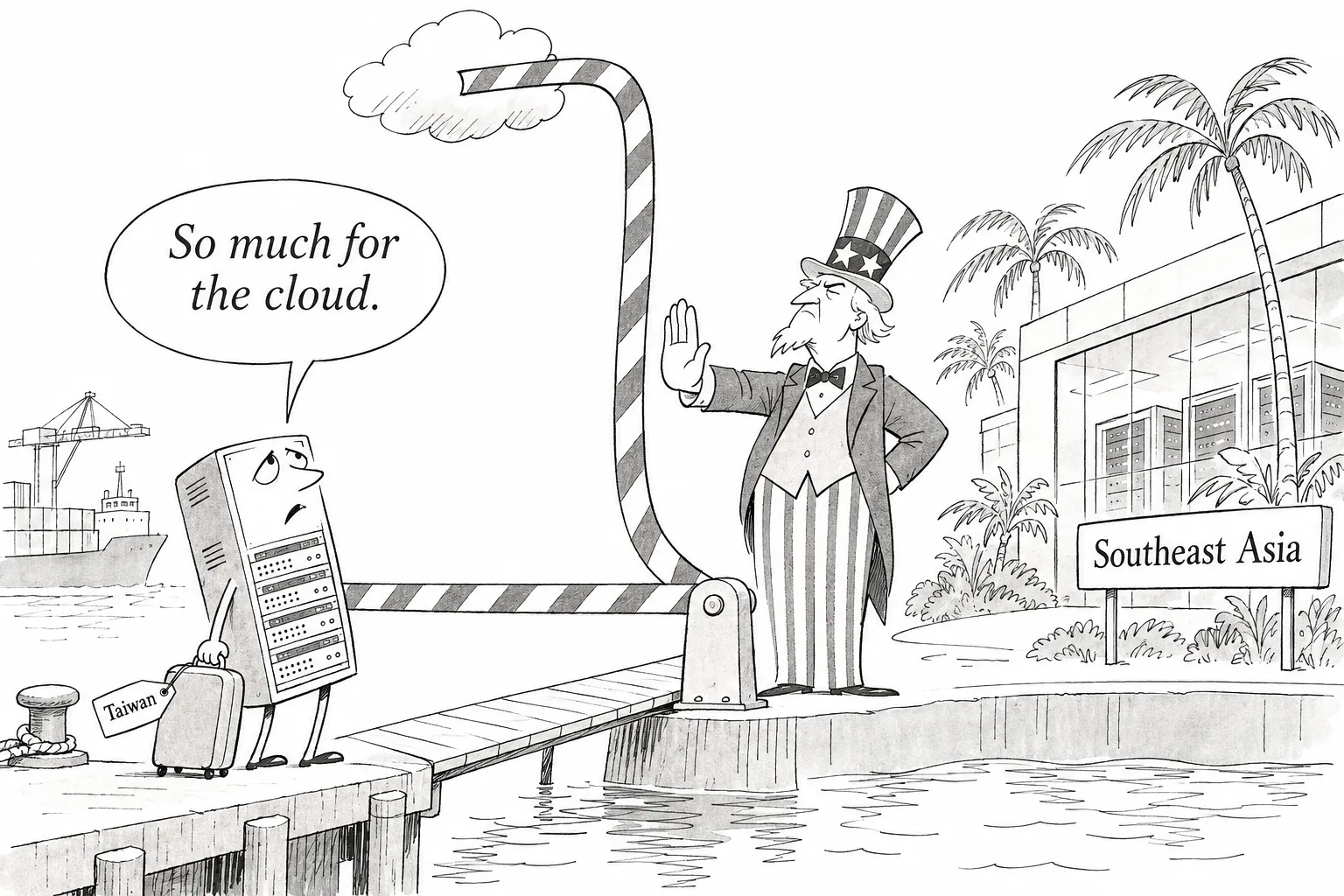
Taiwanese manufacturers reportedly halt AI server shipments to Southeast Asia over US rules
At least two companies that build NVIDIA servers are said to have stopped. The impact of US controls is starting to reach hubs outside China, in Singapore and Malaysia
Seiichi Tanaka · Editor-in-Chief

Key points
- At least two Taiwanese companies that build NVIDIA servers have reportedly stopped shipping to customers in Southeast Asia
- The US rule restricts access through overseas data centers, and its transition period is scheduled to end on December 21
- The impact has started to reach routes outside China, namely Singapore and Malaysia, which are at the center of NVIDIA's investigations
At least two Taiwanese companies that build NVIDIA AI servers have stopped shipping to customers in Southeast Asia, Nikkei Asia reported. The move was reportedly triggered by a rule issued by the United States. The rule restricts Chinese companies from remotely using advanced US semiconductors through overseas data centers. Until now, US export controls have focused mainly on direct shipments to China. The report suggests the impact of the controls has begun to spread to hubs outside China, particularly routes passing through Singapore and Malaysia, which are at the center of NVIDIA's investigations.
For Japanese companies: Most companies are not directly affected. The ones that are affected plan to buy or rent GPU servers in data centers in Singapore or Malaysia. IT and procurement staff at these companies may want to check with their server resellers and cloud providers this week on two points: whether deliveries are delayed, and whether contract terms will change to comply with the US rule. The rule's transition period is scheduled to end on December 21.
Taiwanese server makers reportedly halt shipments to Southeast Asia
According to Nikkei Asia, at least two Taiwanese companies that assemble AI servers built around NVIDIA chips have stopped shipping to customers in Southeast Asia. NVIDIA makes the chips, but Taiwanese contract manufacturers assemble most of the server units that go into data centers and deliver them to customers. The key point is that the manufacturers made the halt. It shows that flows to Southeast Asia can shrink at the server stage, without the chipmaker being involved.
The report cites the US rule as the reason AI server shipments to Southeast Asia stopped. The manufacturers appear to have halted on their own, out of fear of being held responsible later for selling to customers who violated the rule. Manufacturers have trouble seeing who their customers ultimately rent computing power to. It has not been confirmed, however, whether the companies gave that explanation.
US remote-access rule targets routes through overseas data centers
The remote-access rule from the Bureau of Industry and Security (BIS), the US Commerce Department agency that handles export controls, restricts a practice in which Chinese companies don't own the chips themselves but rent servers in third-country data centers over the internet. The aim is to close a loophole that lets China use the computing power without the physical chips ever being shipped there.
The BIS remote-access rule sets several deadlines. A transition period that lets existing transactions continue is scheduled to end on December 21. The deadline for public comment on the rule is January 19, and the deadline for obtaining licenses is said to be around February 17. The server makers' decision to stop shipping to Southeast Asia can be read as a move to wind down risky transactions before these deadlines.
Singapore and Malaysia are at the center of NVIDIA's investigations
AI data centers have grown rapidly in Singapore and Malaysia in recent years. At the same time, the two countries have been suspected of serving as transit routes for advanced US semiconductors to reach China. NVIDIA's own investigations also center on these two countries. The reported halt in shipments to Southeast Asian customers makes clear that the focus of the controls is widening from China itself to hubs outside China.
The scrutiny of hubs outside China also stems in part from analysis of Chinese AI models. In November, Unemployment Labs, run by former OpenAI researcher Will DePue, published an analysis claiming that six Chinese open models were trained on NVIDIA's Blackwell chips, which are banned from export to China. It estimates that five training runs used about 12,000 chips in total. The author notes, however, that the analysis does not show where the chips were located or how they were obtained. DeepSeek, Moonshot, NVIDIA and others have not responded. The US remote-access rule directly targets the possibility that Chinese companies trained models by renting overseas data centers.
US chip controls are also spreading to other routes. TSMC and Samsung halting shipments bound for China has already been reported, and how far that will extend has yet to be determined. The server makers' move shows that the controls now reach beyond the chips themselves to server assembly and data centers in Southeast Asia.
What has not been confirmed
This article is based on Nikkei Asia's report, and we were unable to read the full text of the original article. As a result, the following have not been confirmed: the names of the Taiwanese companies that halted shipments, the countries and names of the affected customers, the volume or value of the shipments, comments from the companies and NVIDIA, and how long the halt will last. The report was published on November 21, 2026. We also found no announcements from the companies themselves saying they had halted shipments.
What to watch next
Three issues are next in focus around the US remote-access rule. The first is whether other Taiwanese server makers will also stop shipping to Southeast Asia after the transition period ends on December 21. The second is how the governments of countries that have courted data centers, such as Malaysia, Thailand and Brazil, respond. The third is whether China will take countermeasures. For Japanese companies that rely on Southeast Asian data centers, the practical question is whether delivery times and contract terms will be affected.
Editorial cartoon