Products & Models · Nov 22, 2026
Riemann hypothesis proof made with AI passes machine verification, but understanding it is still to come
A joint statement from the Lean and Mathlib communities and several independent checkers say "both the statement and the proof are formally correct." The same day, separate AI systems found flaws in a human-written proof of GRH
Rie Suzuki · Technology Editor
Key points
- The Lean and Mathlib communities issued a joint statement on the Riemann hypothesis proof by Alpöge and Claude. Several independent checkers found both the statement and the proof formally correct
- The same day, separate AI systems found flaws in a proof of GRH written entirely by a human
- Machines can vouch for correctness, but mathematicians still have to understand why the theorem holds. Which Claude model was used, and whether Anthropic has made an official announcement, has not been confirmed
[Update, November 22, 2026, 5:00] The Lean and Mathlib joint statement confirmed a proof of the Riemann hypothesis and does not mention the generalized Riemann hypothesis (GRH). We have changed "proof of the generalized Riemann hypothesis (GRH)" to "proof of the Riemann hypothesis."
A proof of the Riemann hypothesis that Anthropic mathematician Levent Alpöge produced with the AI model Claude has passed machine verification. The communities behind Lean, a tool for checking proofs, and Mathlib, its shared library of mathematics, issued a joint statement, and several independent checkers also concluded that "both the statement and the proof are formally correct." The same day, AI found flaws in a separate proof written entirely by a human. Mathematicians, however, have yet to work out why the theorem holds.
For Japanese companies: Most companies are not directly affected. The people it matters to are those in software development and quality assurance who use automated checks to verify code or calculations written by AI. This month, they should check that their procedures make sure a person reads what the checks actually verify (that is, how the specification is written).
What the machines confirmed about the Riemann hypothesis proof
The Riemann hypothesis, which concerns how prime numbers are distributed, has been unsolved for 167 years and is often called the most famous problem in mathematics. The proof Alpöge said on November 20 that he had produced with Claude is written in Lean 4, a language for checking proofs. It covers the broader generalized Riemann hypothesis (GRH), which includes the Riemann hypothesis. The files total about 239MB and number 175,187.
When Alpöge made his claim, two big questions were still open: whether the formal statement really expressed GRH, and which axioms the proof depended on. MIT mathematician Andrew Sutherland compiled it himself and called it certainly a historic moment, while saying there was still a lot of work to do. Mathematician Elliot Glazer also confirmed that the formal statement was GRH.
The joint statement now issued by the Lean and Mathlib communities answers both questions from the machine side: both the statement and the proof are formally correct. The verdict does not rest on a single tool. Several separately built checkers reached the same conclusion. If accepted, it would be the biggest mathematical achievement made with AI.
The same day, AI found flaws in a human-written GRH proof
Also on November 20, a separate proof of GRH written entirely by a human appeared. Judging by the title of a mathematician's blog post, the author appears to be Alessandro Masullo. The flaws in this proof were found by separate AI systems. AI checked a proof written by a human, while machine checkers checked a proof made with AI. On the same day, the roles of checker and checked were reversed.
TechCrunch in the US reported the two side by side, under a headline saying that AI claimed to have solved the Riemann hypothesis, and so did a human. Middle Eastern broadcaster Al Jazeera also ran a piece asking whether the world's most famous math problem had been solved.
What is still unknown about the Riemann hypothesis proof
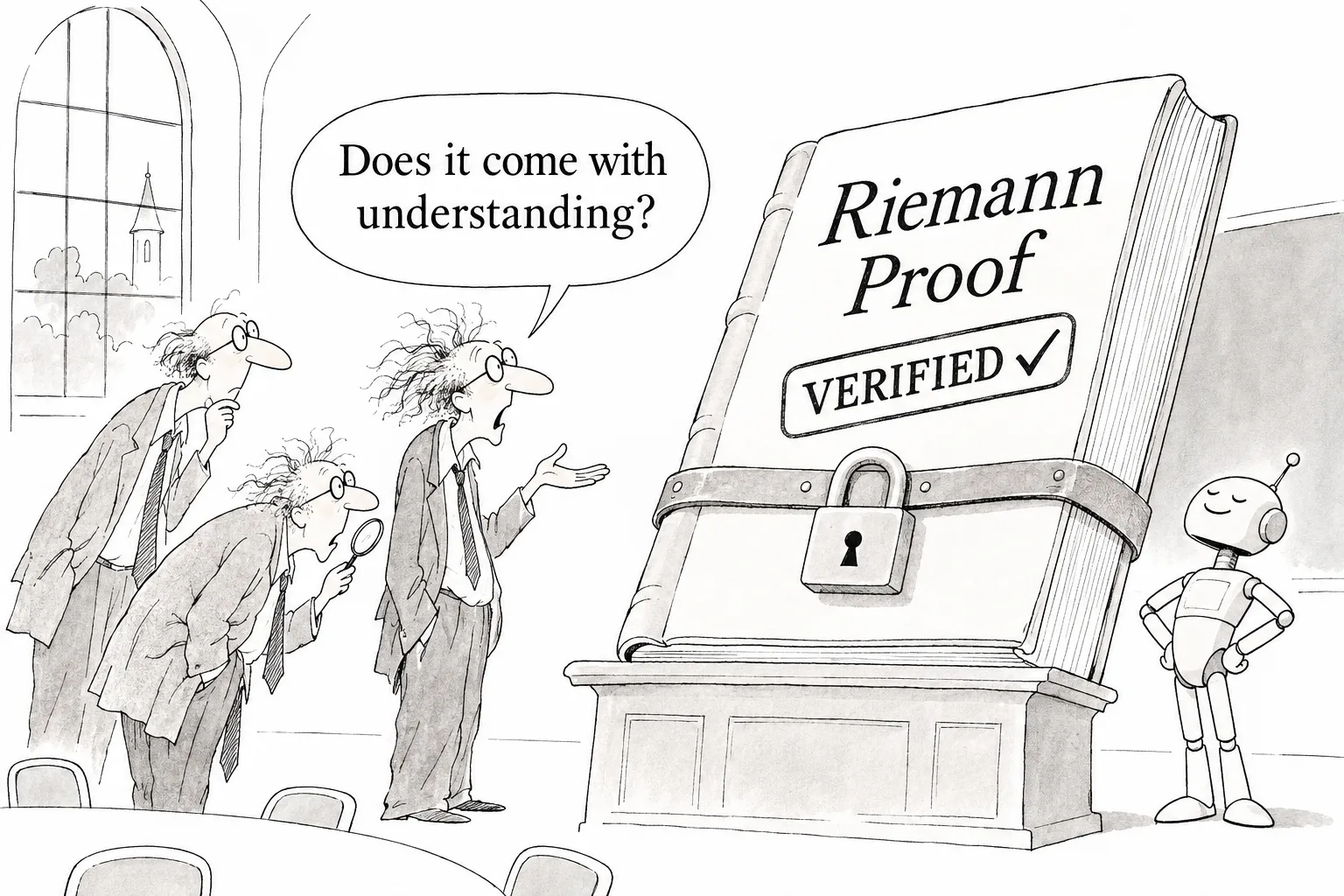
For the proof by Alpöge and Claude, machines have vouched for its correctness, but human understanding has not caught up. It becomes useful as mathematical knowledge only once mathematicians work out why the theorem holds and what new ideas were used. Mathematician Terence Tao also published a blog post with GRH in its title the same day.
Some things about the proof by Alpöge and Claude have not been confirmed. The name of the Claude model used was not given, and no official announcement from Anthropic has been found. The joint statement confirmed formal correctness. It does not mean anyone can yet explain the ideas behind the proof. In writing this article, we were not able to read the source pages directly, so details of the mathematicians' comments are limited to what had already been reported.
Editorial cartoon
Sources
- https://leanprover-community.github.io/blog/posts/riemann-hypothesis
- https://math.mit.edu/~drew/grh/
- https://terrytao.wordpress.com/2026/11/20/unforced-euler-singularity-unforced-navier-stokes-singularity-and-the-generalized-riemann-hypothesis/
- https://www.aljazeera.com/news/2026/11/21/riemann-hypothesis-has-the-worlds-most-famous-maths-problem-been-cracked
- https://math216.wordpress.com/2026/11/20/hurried-announcement-alessandro-masullo-grh/
- https://techcrunch.com/2026/11/20/ai-claimed-a-solution-to-the-167-year-old-riemann-hypothesis-and-a-human-did-too/