Products & Models · Nov 21, 2026
Mathematician claims AI-assisted proof of the Riemann hypothesis; expert verification has yet to begin
An Anthropic mathematician working with Claude has reportedly proved the generalized Riemann hypothesis in a form that can be checked by machine. An MIT mathematician got the proof to compile, but checks of its definitions and axioms are not finished
Rie Suzuki · Technology Editor

Key points
- An Anthropic mathematician working with Claude has reportedly claimed a proof in Lean 4 of the generalized Riemann hypothesis, which includes the Riemann hypothesis
- MIT's Sutherland reportedly compiled the proof himself. Whether the formalized statement really refers to the Riemann hypothesis has reportedly not yet been checked
- No one has yet confirmed that the claim's definitions say what they are meant to say, or which axioms the proof depends on. If confirmed, it would be the biggest result yet in AI-assisted mathematics, but for now it is still only a claim
A mathematician at Anthropic says he has proved the "generalized Riemann hypothesis (GRH)" with the help of the company's AI, Claude, according to reports by Scientific American and Interesting Engineering. The GRH includes the Riemann hypothesis, the most famous unsolved problem in mathematics. The proof is reportedly written in Lean 4, a language in which a computer checks every line for correctness. MIT mathematician Sutherland has reportedly compiled it (checked it by machine) on his own setup. Three things have not yet been checked: whether the formalized statement really refers to the Riemann hypothesis, whether its definitions capture what mathematicians actually mean, and which axioms the proof depends on. If confirmed, it would be the biggest result yet in AI-assisted mathematics. For now, though, it is still only a claim.
For Japanese companies: For most companies, this has no direct impact. It does matter to R&D, quality assurance and software safety teams that rely on results labeled "verified" by AI or software tools. Before your next order or contract renewal, ask vendors to state in writing which specification their "verified" label covers and what assumptions the check relies on.
What the Anthropic mathematician claims to have proved
The mathematician's claim is reportedly a proof of the generalized Riemann hypothesis, which is broader than the Riemann hypothesis itself. The Riemann hypothesis concerns how the prime numbers are distributed. It was posed in 1859 and has gone unsolved for 167 years. It is also one of seven problems for which the Clay Mathematics Institute in the US offers a $1 million prize. The generalized Riemann hypothesis asks the same question about a much wider family of functions; if it holds, the Riemann hypothesis holds too. Many results in mathematics are built on the assumption that "GRH is true," so a proof would affect the whole of number theory.
Many papers have claimed to prove the Riemann hypothesis over the years, and experts have accepted none of them. What sets this claim apart, according to the reports, is that the proof is presented as Lean 4 code rather than written up in prose by a person. In a Lean 4 proof, a checking program verifies every logical step mechanically, so there is less risk of human reviewers missing details.
What has already been confirmed about the claimed proof
Two things are said to have been confirmed so far. First, MIT mathematician Sutherland compiled the published Lean 4 code on his own setup and confirmed that it passed the check. That means an outside expert reproduced the result on his own machine, rather than Anthropic simply saying internally that it "passed." Second, according to Interesting Engineering, an independent verification project confirmed that the distributed files match the repository the mathematician published, and that the statement of the main theorem compiles against Mathlib, Lean's standard mathematics library. Whether that statement actually refers to the generalized Riemann hypothesis has not yet been confirmed.
What has not yet been confirmed about the claimed proof
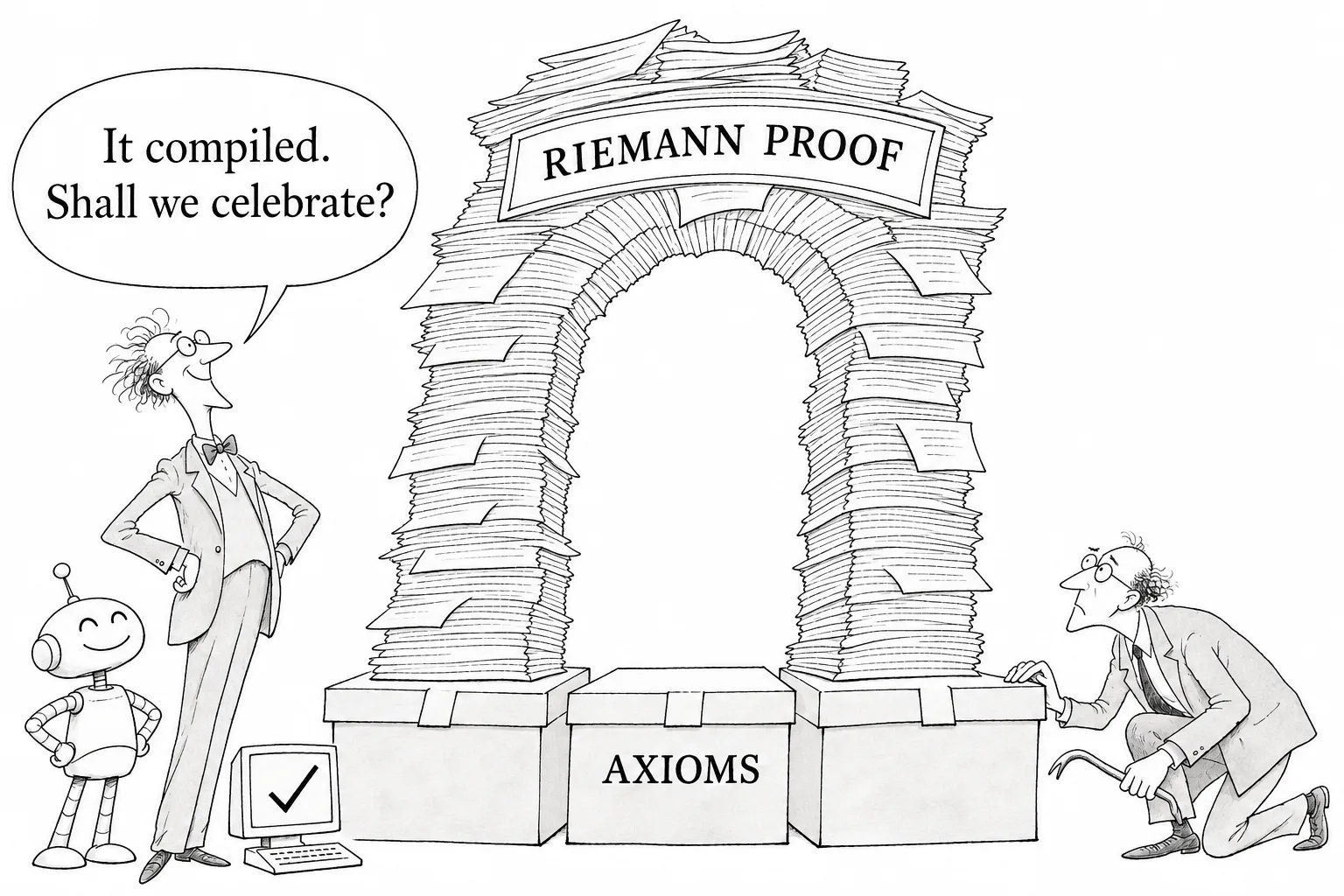
Passing Lean 4's checks does not yet mean the proof of the Riemann hypothesis is correct, for two reasons. The first is whether the claim states what it is meant to state. Lean 4's checker only confirms that the written statement has been proved in code; it does not check whether that statement matches what the mathematician meant. If the definitions of the functions or numbers used in the statement are even slightly off, the code can pass the check and still prove a different, far easier statement. Getting the code to compile is one task. Confirming that the statement refers to the generalized Riemann hypothesis, with definitions that are exactly as intended, is a separate one.
The second is which axioms the proof depends on. In Lean 4, extra axioms ("assume this is true") can be added partway through a proof. If an added axiom is nearly the same as the result being proved, or contains a contradiction, the proof can pass the check while proving nothing. In formalized mathematics, it is standard to show that a proof uses only the three standard axioms. Whether this proof does so has reportedly not yet been confirmed.
There were other details about the claim that could not be confirmed. The mathematician is Levent Alpöge, who works at Anthropic. According to Interesting Engineering, the Lean proof runs to about 175,187 files totaling about 239MB, and Alpöge wrote that Claude moved things forward quickly in the final stage. The two articles do not say which Claude model was used, how long the work took or how much computing power it needed. We have also not confirmed how Anthropic as a company views the claim.
Why AI-generated math proofs are treated with caution
In recent weeks, AI-assisted proofs have run into exactly this kind of gap between what is claimed and what is defined. In October, OpenAI and Anthropic announced that they had disproved ETH, a hypothesis in computational complexity theory. Complexity theorist Lance Fortnow then pointed out that OpenAI's Lean statement was slightly weaker than the result described in its paper. The code passed the check, but what it proved was not quite what the paper said. Separately, one manuscript in a batch of math papers released by OpenAI was withdrawn after mathematicians reviewed it.
Large formalization projects have also turned up discrepancies with the existing literature. In October, a company called Axiom formalized the entire classification theorem for finite simple groups in Lean 4, showed that it relies only on the three standard axioms, and recorded 34 points where it departs from the existing literature. Such cases show that machine checking is a powerful tool, but that no conclusion can be drawn until people check what the machine was asked to check. That check has not yet been done, which is why the Riemann hypothesis result remains a claim.
What would change if the proof is confirmed
If the proof of the generalized Riemann hypothesis survives checks of its definitions and axioms, it would be the biggest result yet in AI-assisted mathematics. In November, Anthropic published a report saying Claude Fable 5.2 had solved two open problems in black hole physics, and reports of AI producing results at the frontier of research are becoming more common. Even so, solving a problem that has stood for 167 years would be on another scale entirely.
Several steps remain before a proof of the Riemann hypothesis could be accepted. The Clay Mathematics Institute's prize requires that the result be published in a peer-reviewed journal and still be accepted by mathematicians two years later. For now, the question is whether number theorists other than Sutherland will confirm that the definitions in the Lean 4 proof are as intended and that the proof relies only on the standard axioms.
Sources: Scientific American, Interesting Engineering
Editorial cartoon