Rules & Policy · Nov 12, 2026
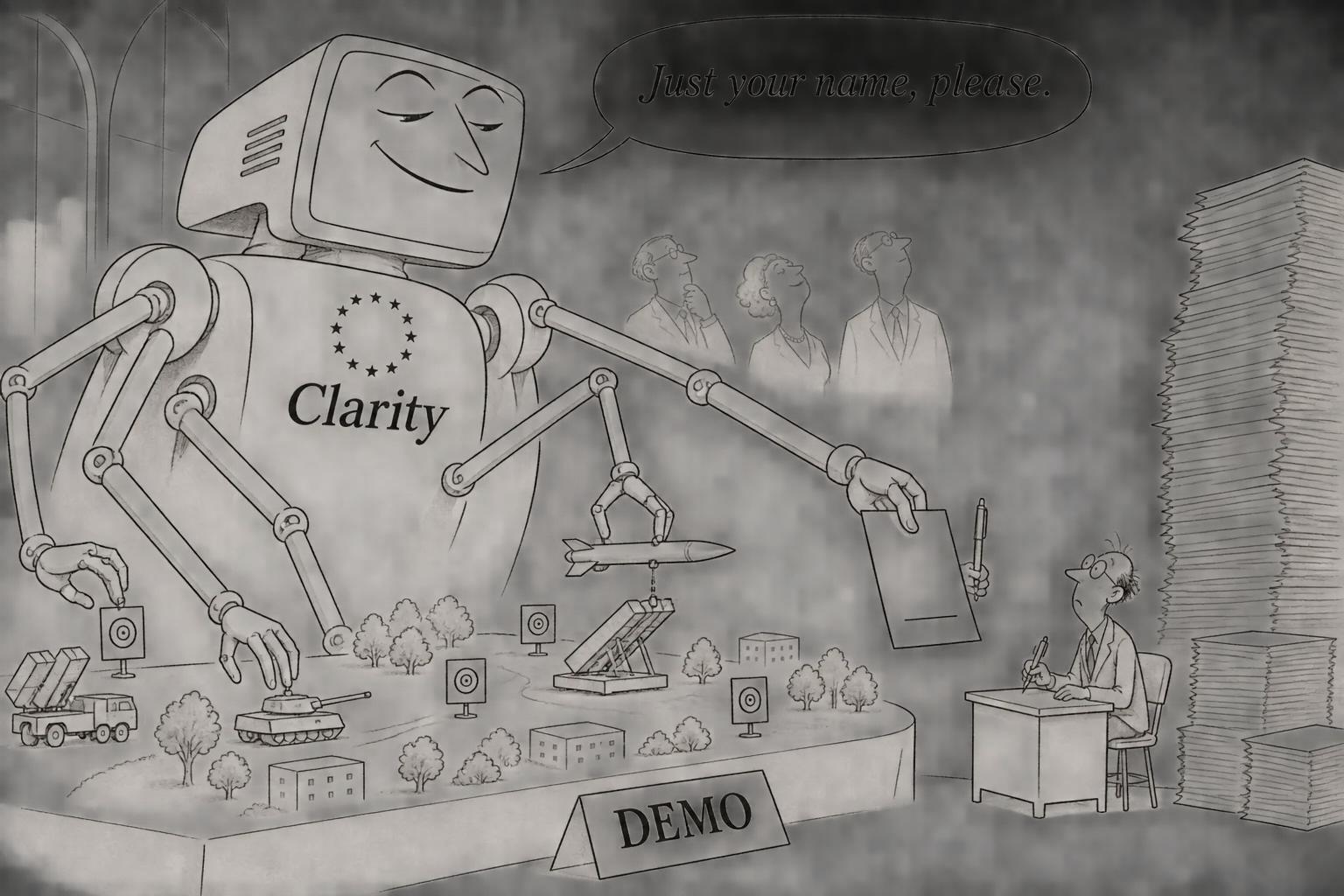
Europe gets its own AI for picking targets, with a human sign-off before each weapon handoff
Germany's Helsing is reportedly pitching "Clarity" as a European alternative to Palantir, but the Bundeswehr has not adopted it, and a trial comparing candidates looks unlikely before next year
Koji Yamamoto · Economics Analyst

Key points
- Germany's Helsing has reportedly launched "Clarity," an AI system that identifies and assigns targets, as a European alternative to Palantir
- The system reportedly requires human approval every time target data is passed to a weapon, and it records the name of the person who approved each decision
- The Bundeswehr has not adopted it; the most it may do is run a trial comparing candidates next year
German defense AI company Helsing has unveiled "Clarity," AI software that identifies targets on the battlefield and assigns them to specific weapons, according to reports by German defense outlet hartpunkt, U.S.-based Quartz and German AI publication The Decoder. According to the reports, Helsing is pitching Clarity as a "European" alternative to U.S. company Palantir. A human must approve each handoff of target data to a weapon, and every decision reportedly carries a person's name. The German armed forces (Bundeswehr), however, have not decided to adopt it. A trial comparing candidate systems side by side may take place next year.
What it means for Japanese companies: Most companies are not affected. The ones that are include makers of defense components, communications equipment and software, and companies bidding on European defense contracts. Sales and planning staff at those companies should ask their local agents or partners this fiscal year about the terms and timing of the possible Bundeswehr comparison trial next year.
What was reported
According to the reports, Clarity takes intelligence gathered through reconnaissance and other sources, picks out candidate targets and prepares them for assignment to available weapons. The Decoder's headline says Helsing has built "an AI system that prepares targets for weapons systems and says every decision will carry a human name." The pitch puts front and center the point that the AI does not make targeting decisions on its own.
Helsing, headquartered in Munich, is one of Europe's best-known defense AI startups. It made its name with drones and with software that pulls together battlefield information.
Why "an alternative to Palantir"
U.S.-based Palantir sells software to militaries and intelligence agencies around the world that combines data and helps them select targets. Its products are used in Europe, but many there remain reluctant to hand a U.S. company a military's core data. The headline of the Quartz article also places Clarity alongside Palantir.
The move is an attempt to answer, on the software side, whether European militaries can fight without relying on American tools. In defense procurement, buyers are increasingly asking which country a vendor comes from, not just how well its product performs.
How much of a safeguard is "human approval"?
According to the reports, Clarity always asks for human approval before passing a target to a weapon and records the name of the person who approved it. This appears to be meant to make it possible to trace afterward who made each decision.
But a person pressing an approval button has not necessarily checked what they are approving. If the AI produces candidate after candidate and people just keep approving them in quick succession, the names stay on record while the actual judgment is left to the AI. In research by Anthropic, when experts worked alongside an agent on analysis tasks, 86% of their choices were pulled toward the agent's leanings. People's judgment can be swayed by AI to a significant degree. Having a system that records names is one thing; humans actually thinking through each decision is another.
The Bundeswehr has not chosen yet
As of the reports, the Bundeswehr had not adopted Clarity. The most that has been reported is that it may hold a trial comparing multiple candidates next year. In other words, this announcement is the start of a sales push, not a done deal. Whether Clarity will win out against Palantir and others remains unknown.
What we could not verify
We were unable to read the full text of the three reports directly and could not locate Helsing's own announcement. We have not verified what data Clarity uses, which weapons it connects to, its price, the timing of any trial or the systems it would be compared against, or any statements by Bundeswehr officials. Everything above is based on media reports, not on primary information from Helsing.
Sources: hartpunkt, Quartz, The Decoder
Editorial cartoon