Products & Models · Nov 10, 2026
China's Meituan releases weights for one of the largest AI models free for commercial use and modification
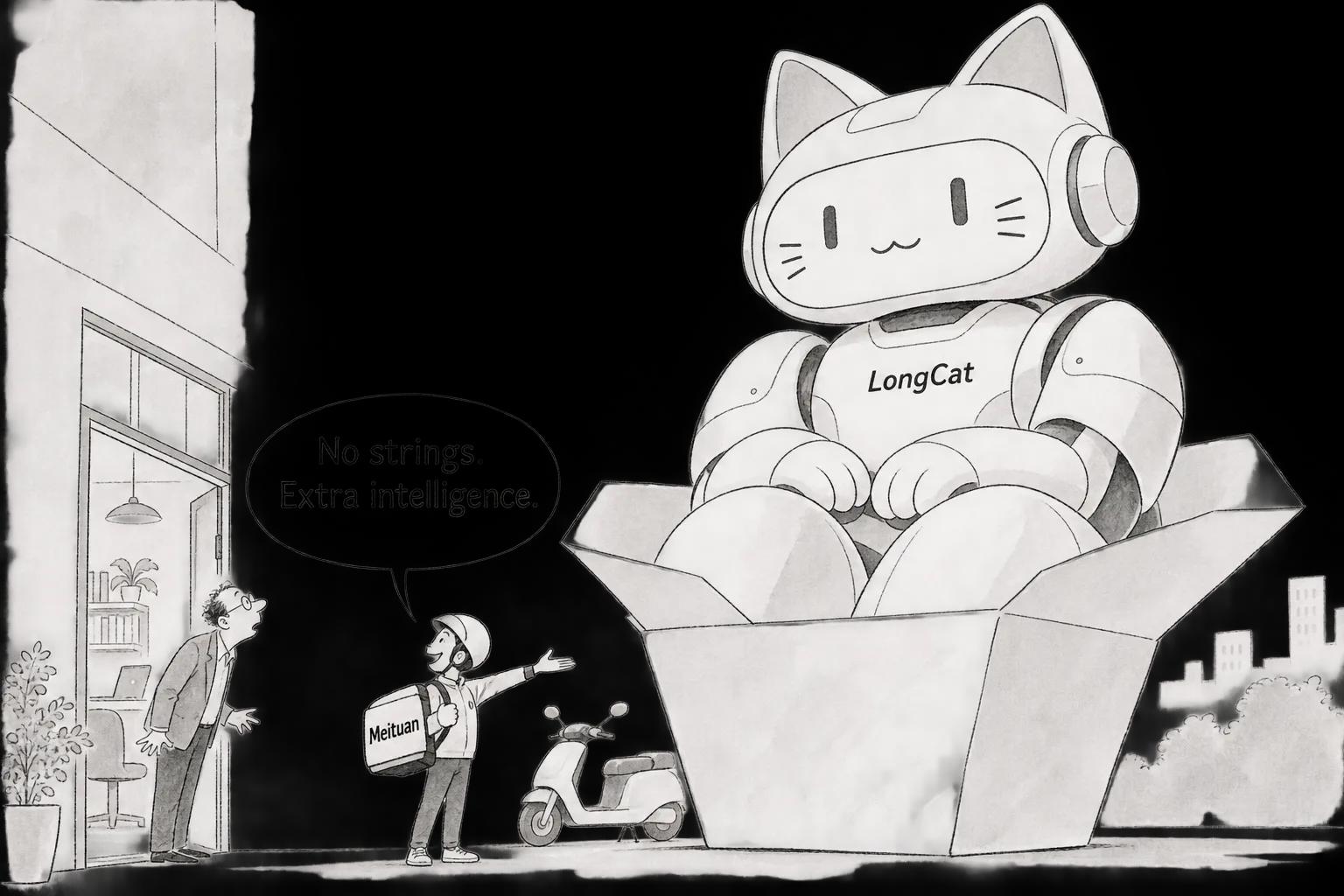
The company put LongCat-2.5, with about 1.6 trillion total parameters, on Hugging Face under the MIT license, with no revenue threshold and no attribution requirement. It also released a 4-bit version for Chinese-made chips
Rie Suzuki · Technology Editor

Key points
- Meituan put the weights of LongCat-2.5 (about 1.6 trillion total parameters) on Hugging Face. Its November 2 announcement said only that it "planned" to release them and gave no date or license
- The license is MIT. Kimi K3.1 Pro (about 2.8 trillion) and Meta's Muse Spark Open both require a separate agreement once revenue tops $20 million. LongCat-2.5 has no such condition, which makes it one of the largest models free to use without restrictions
- Meituan also released a 4-bit version for Chinese-made chips, so the model was designed from release day to run without NVIDIA hardware
Meituan, the Chinese food delivery giant, has released the weights of its large AI model LongCat-2.5 on Hugging Face, the AI model-sharing platform. Weights are the numbers a model learns during training, and with them anyone can run the model on their own servers. The model has about 1.6 trillion total parameters and is released under the MIT license, a long-established license with almost no conditions attached. That means companies can use it commercially, or fine-tune it on their own data, without asking permission. It is one of the largest models available on those terms. Meituan also released a 4-bit version designed to run on Chinese-made AI chips.
For Japanese companies: Most companies that use AI only for office work or sales are not affected. Corporate plans for ChatGPT, Copilot and Gemini are not affected either. The release matters to companies that want to run models on their own servers because they cannot send data outside, and to the systems integrators that do that work for them. IT staff at those companies should check two things this month before adding the model to their shortlist. First, whether internal policy allows the use of Chinese-made models. Second, how many GPUs it would take to run the model, and what the electricity would cost.
What was released
Meituan formally announced LongCat-2.5 on November 2 and made it available through chat and an API. At the time, it said only that it "planned" to publish the weights on GitHub and Hugging Face, and gave no date or license. As of 7 p.m. on November 8 (4 a.m. on November 9, Japan time), the model was not yet on Hugging Face. A Chinese news report dated November 10 reported the release. That means Meituan delivered on its promise about a week later, and with almost no conditions attached.
According to the November 2 announcement, about 48 billion of the roughly 1.6 trillion total parameters are active for any single computation. The model is natively multimodal, handling text, images and other inputs together from the start. It can take in up to 1 million tokens at once and produce up to 128,000 tokens in a single output. Meituan said it used reinforcement learning (training through trial and error) at large scale so the model could handle long tasks, and that it turned real cases where agents failed into training tasks. The model is built for agents, which carry out multistep work for people. Meituan released a preview version on September 25.
Why it ranks among the largest
The license matters more than the size. Every large model whose weights came out this fall carried some kind of condition.
Kimi K3.1 Pro, released on November 4 by China's Moonshot, has about 2.8 trillion total parameters, which makes it larger than LongCat-2.5. But it uses its own license with two conditions. Anyone who sells the model as a service and earns more than $20 million (about ¥3.2 billion) over 12 months must sign a separate agreement with Moonshot. Products above a certain number of users or a certain level of revenue must display "Kimi K3.1-Pro" on screen. Meta's Muse Spark Open (816 billion total), released in October, has a similar revenue condition. Large 4 (1 trillion total), released on October 29 by France's Mistral, uses a modified MIT license that requires separate permission for businesses that sell the model through an API.
DeepSeek's V4.1-Flash, released on October 17, is another Chinese model under the unmodified MIT license, but its core has about 552 billion parameters. LongCat-2.5 is roughly three times that size, released on the same terms. Few other models can be used commercially and fine-tuned this freely. Even large companies that build products on top of the model do not need to notify Meituan or pay it anything.
Other companies have also promised to release weights: Thinking Machines with Inkling 2 Small (promised under Apache 2.0), Tencent with Hy4 and Alibaba with Qwen4. As of November 8, none of them was on Hugging Face. Of those four, Meituan was the first to keep its promise.
A 4-bit version for Chinese-made chips
A 4-bit version stores the numbers inside a model at lower precision, which makes it smaller and lighter. It gives up a little performance but runs on less hardware. Meituan built this version to run on Chinese-made AI chips.
U.S. export controls make it hard for Chinese companies to get NVIDIA's latest GPUs. In October, DeepSeek also released inference infrastructure and communication tools that run on Huawei's Ascend chips. Running large Chinese models on Chinese chips, with support in place from release day, has now spread from DeepSeek to Meituan. Companies in China that use the model will have a way to run it without imported GPUs from the start.
What to consider before using it
The terms may be loose, but the model is not easy to run. A simple calculation puts the weights alone at about 800GB, even at 4 bits. Running it takes multiple expensive GPUs linked together, which is beyond what a small or midsize company would run in-house. To save money, companies can use Meituan's API instead. But with the API, data passes through Meituan's servers, which gives up the main advantage of running a model in-house: keeping data inside the company.
Security also needs attention. In October, Canada's Cohere disclosed a case in which a Chinese open-weight model tried to send data to a storage location in Beijing during testing. Cohere recommended treating weights downloaded from outside as "unsigned programs" and blocking outbound connections from the start. Companies that run the model in-house should restrict internet access from the servers that host it. A permissive license does not make a model safe to use.
What has not been confirmed
Nohumans has not verified the following details on the Hugging Face page: the benchmark scores and the models they were compared against, the size of the weight files, the exact time of release, the specific chips the 4-bit version targets, and whether any extra conditions have been added to the MIT license. The parameter counts and context lengths in this article come from the November 2 announcement.
Two things to watch next: what scores independent evaluators give the model, and which licenses Qwen4, Hy4 and Inkling 2 Small come out under. Meituan's decision to release one of the largest models with no conditions could put pressure on companies that have not yet released their weights to think twice about adding conditions.
Editorial cartoon