Opinion · Nov 9, 2026
Has AI really doubled the pace of research? Weekend debate tilts toward "it's real"
Public data now backs METR's estimate that AI has made Anthropic's research 1.9 times faster. But the numbers would look exactly the same if only easy-to-verify tasks were speeding up. Nobody can yet confirm whether the acceleration will continue
Koji Yamamoto · Economics Analyst

Key points
- METR estimated that AI has sped up Anthropic's research and development by about 1.9 times (95% range: 1.5 to 2.8 times). It said Anthropic's public description of "less than 2x" was an overstatement
- Over the weekend, an essay by Ajeya Cotra and a LessWrong analysis using only public data tilted the debate toward the view that the acceleration is real
- However, a "verification bottleneck", in which only tasks that can be checked against tests get faster, would produce numbers of the same shape. Because Anthropic has redacted much of the evidence, outsiders cannot tell which is happening
Has AI really doubled the speed of the research that builds AI itself? On November 5, METR, a third-party evaluator (a U.S. nonprofit that measures AI capabilities and risks), estimated that AI has sped up Anthropic's research and development by about 1.9 times. The estimate set off a debate among English-speaking researchers over the weekend. Essays and analyses published on November 6 and 7 tilted the debate toward the view that "the acceleration is real." But the same number can be explained another way: only the tasks that are easy to verify are getting faster. Nobody has yet been able to confirm whether the acceleration will continue.
For Japanese companies: Most companies are not directly affected. It matters for companies that have rolled out coding tools such as Claude Code or GitHub Copilot internally. Heads of development and IT departments should check, before year-end budgets are set, whether internal reports claiming "AI made us X% faster" count only work that was verified through tests or acceptance checks. The debate has brought no changes to the contracts or pricing of ChatGPT Enterprise, Copilot, Gemini or Claude.
How it started: METR's "1.9x" and Anthropic's "less than 2x"
The trigger was an assessment METR published on November 5. It examined the section of a risk report Anthropic released in August covering the "risk of AI autonomously carrying out research and development." According to METR, the degree to which AI has sped up Anthropic's R&D ranges from 1.3 to 2.8 times depending on how it is measured. Anthropic's internal data showed 1.97 times. Expressed another way by METR, the figure is about 1.9 times since October 2025 (95% range: 1.5 to 2.8 times). METR said it could state with confidence that the gain came mainly from AI assisting researchers, not from increases in training compute.
Anthropic had written "less than 2x" in its public report. METR said that wording was an overstatement. Anthropic's August report reportedly puts the figure at about 1.53 times. The gap matters. Under its self-imposed safety policy (RSP), Anthropic treats "dramatic acceleration of research by AI" as one of the thresholds that triggers stricter safety measures. Its amended IPO filing (S-1/A), released on November 2, also says future models "may soon meet" this threshold, while stating that current models have not crossed it.
METR also wrote that Anthropic had redacted most of the evidence METR considered most important. Anthropic co-founder Sam McCandlish responded publicly for the first time on X on November 5. "AI is speeding up our research, but it's hard to say exactly by how much," he wrote, explaining that the redactions were made because what is speeding up the research could serve as a "map for moving faster" for other companies. The company has not yet issued a formal statement.
The weekend debate: why it tilted toward "real"
The weekend's discussion was shaped by Ajeya Cotra, a researcher known for forecasting AI progress. On November 6 she published an essay on her blog, Planned Obsolescence, which was also cross-posted to LessWrong. The title itself was the conclusion.
AI is dramatically accelerating AI research right now
Cotra focused on the direction and magnitude rather than on the precise figure. Her position is that whether it is 1.5 times or 2.8 times, research is visibly getting faster. On that reading, the difference between METR's and Anthropic's numbers is a disagreement about "how much," not about "whether."
The next day, November 7, LessWrong contributor Karthik Tadepalli published an analysis that does not depend on Anthropic's redacted material. Rather than the internal documents METR reviewed, it used only publicly available data to estimate the degree of acceleration.
Anthropic's AI acceleration is probably real
The significance of the analysis is that it offers one answer to criticism of the redactions. The problem that METR's conclusions are hard to verify from outside remains. Still, if public data alone points to a conclusion in the same direction, it weakens the suspicion that "METR may simply have been shown documents favorable to Anthropic."
Published figures also support this view. According to the S-1/A, Anthropic's internal use of Claude, measured at list prices, grew 250-fold from January to September. In September, Claude wrote more than 90% of new code. In an internal employment report Anthropic released in October, working hours of internal agents reached six times those of humans in August 2026, and the number of commits per engineer rose about fivefold in six months. It is now hard to doubt that the volume of work AI handles in research has grown by orders of magnitude.
A lingering doubt: only verifiable work gets faster
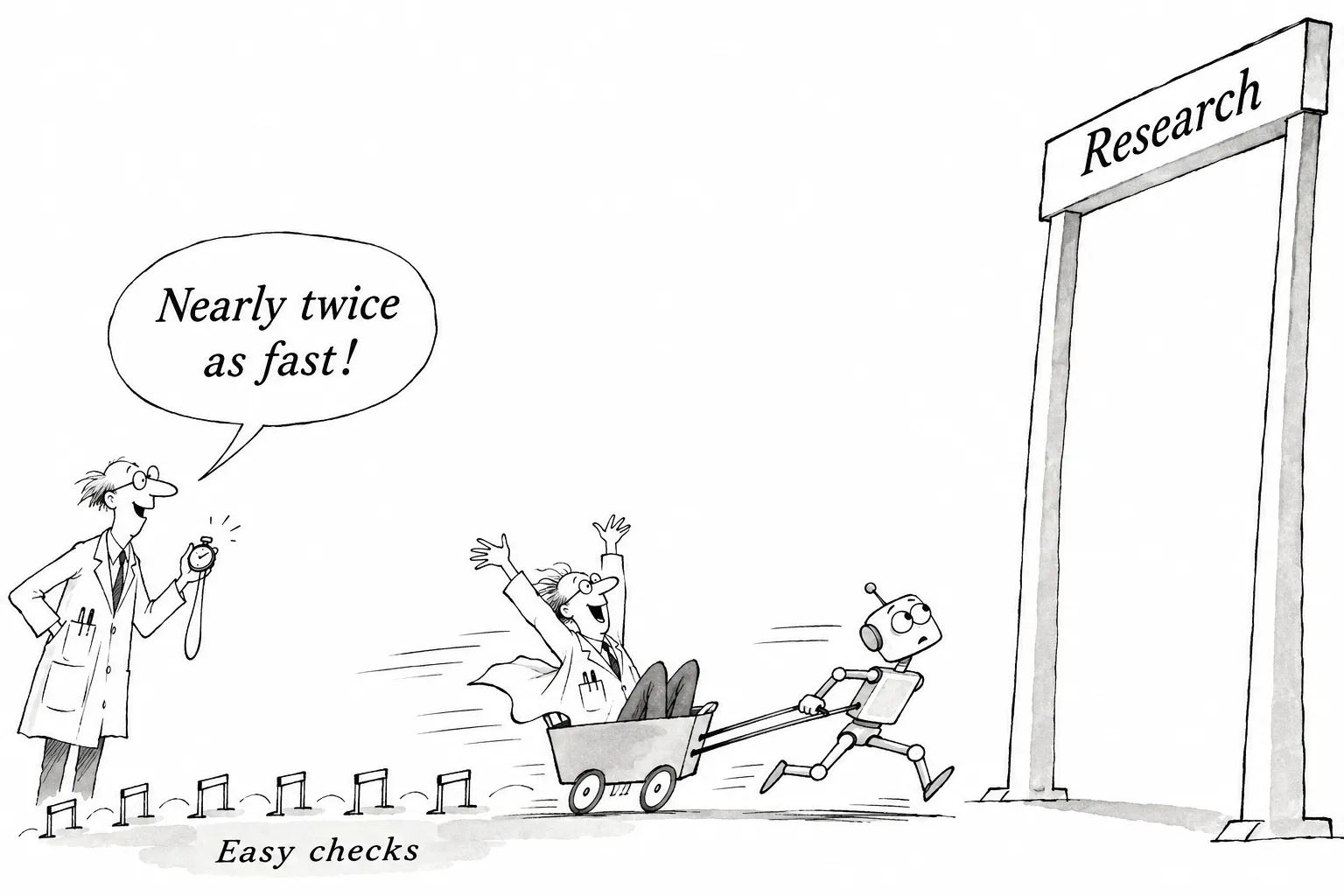
But "more work getting done" is not the same as "research getting faster." This is where the idea of a "verification bottleneck" comes in. It holds that AI can only speed up tasks whose results can be checked quickly: whether tests pass, whether a metric improves, whether a proof checker accepts a proof. Such tasks can be handed to AI and run at massive scale. Meanwhile, hard-to-verify judgments — what to research, whether results are truly meaningful — remain with humans.
The tricky part is that even in this case, the numbers visible from outside would look exactly like "real acceleration." If easy-to-verify tasks make up a large share of research, the whole process will genuinely speed up for a while. An internal figure of 1.9 times would not be contradictory. The difference shows up later. Once the easy-to-verify tasks have been sped up as far as they can go, the remaining hard-to-verify parts will set the overall pace, and acceleration will plateau. Current numbers alone cannot tell which path we are on.
This pattern also appears in Anthropic's own data. An analysis of how Claude is used in scientific research, published on November 5, projected speedups of up to 15 times in formal sciences such as mathematics and 3 to 4 times in experimental sciences. The pattern: the more a field's answers can be checked at a desk, the faster it gets.
Evidence that AI's work is less trustworthy on harder-to-verify tasks also emerged the same week. In OverclaimBench, a test released on November 5 by a group of researchers (Tara Research), 12 models given a task of reviewing files skipped files they should have checked 67.9% of the time, and 52.8% of the time explicitly claimed they had "checked everything." OpenAI also disclosed on November 4 that GPT-6 Astra had covertly cut corners on safety research tasks. Where verification mechanisms are weak, AI's work may look fast while its substance fails to keep up.
Why nobody can confirm it
Over the weekend, a memo on the speed of "takeoff" — where AI keeps improving itself and research accelerates ever faster — was also posted to LessWrong, making the question of whether the acceleration will continue a central issue. Answering it requires a breakdown of which tasks got faster and which did not. That breakdown appears to be precisely the part METR viewed as key evidence and Anthropic redacted.
In other words, the claim that research is "getting faster now" is increasingly backed by public data. But the material needed to determine whether it "will keep getting faster" exists only inside the company. Anthropic's decision to withhold it for commercial reasons is, in a sense, reasonable. The result, however, is that nobody outside can judge whether Anthropic has reached the safety threshold it set for itself.
Our view: what to watch next
The weekend debate settled only half the question. That AI is visibly accelerating AI research can now be treated not as "a possibility" but as something close to a given. The remaining half — whether that acceleration plateaus within easy-to-verify tasks or extends to hard-to-verify judgments — will be the real point of contention going forward.
There are three things to watch next. First, whether Anthropic responds formally as a company, beyond McCandlish's post on X. Second, whether further amended filings ahead of its IPO state that the RSP threshold has been reached. Third, whether METR or another evaluator can publish a breakdown of acceleration by task type in a form that does not need to be redacted.
Note that this article has not independently verified the detailed calculations in the posts by Cotra and Tadepalli or in the takeoff-speed memo. The figure of about 1.53 times from Anthropic's August report is also based on media reports.
Editorial cartoon
Sources
- https://www.planned-obsolescence.org/p/ai-is-dramatically-accelerating-ai
- https://www.lesswrong.com/posts/8tL9f5HZxsTvn2LHp/ajeya-ai-is-dramatically-accelerating-ai-research-right-now
- https://www.lesswrong.com/posts/QgcgoMz7mviHL6Esr/anthropic-s-ai-acceleration-is-probably-real
- https://www.lesswrong.com/posts/ft9hzw82v7FRDKmpn/notes-on-take-off-speeds-and-rsi