AI in the Field · Nov 9, 2026
Small AI startups from Taiwan and Switzerland are changing chip fabs and rebar sites
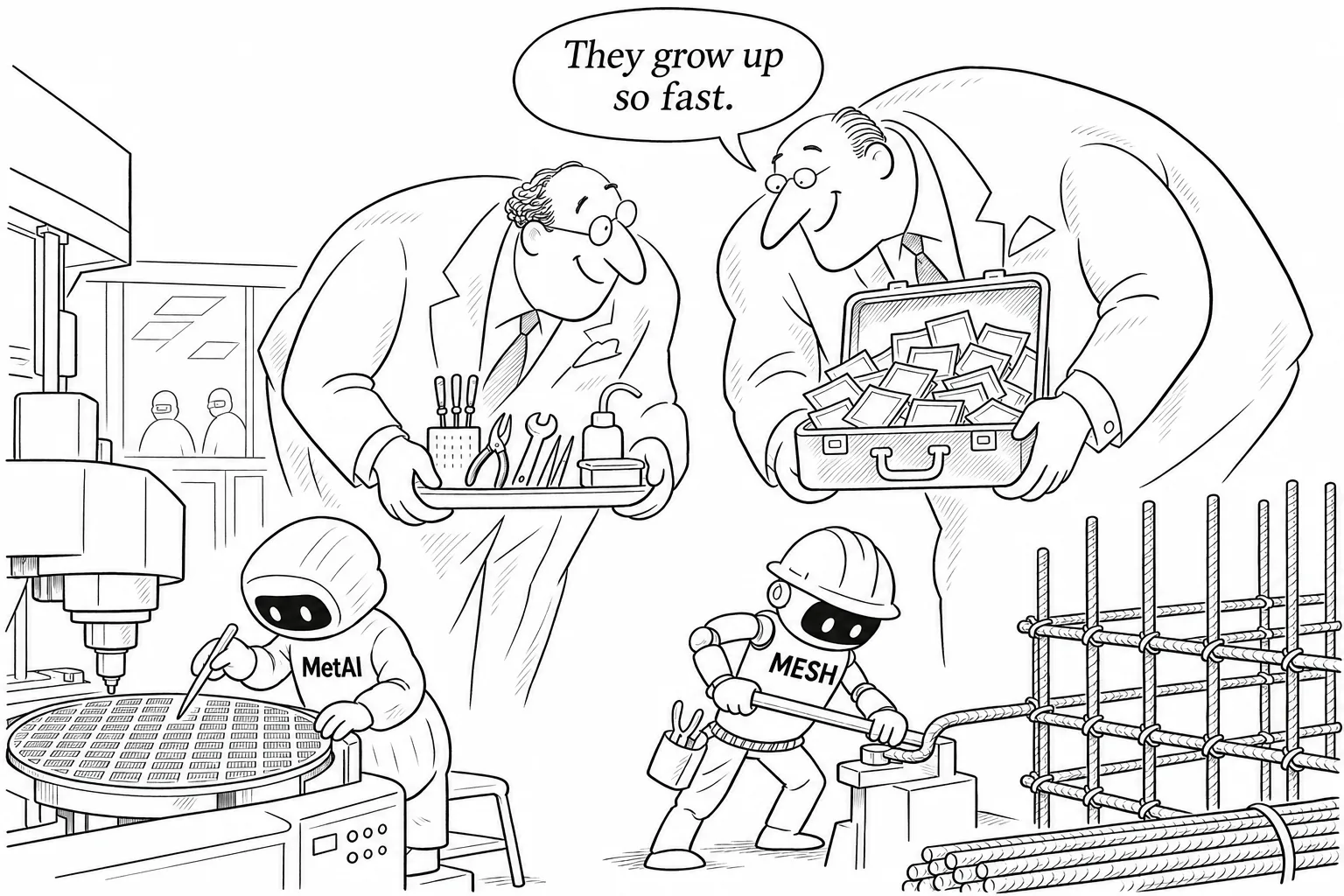
With backing from Nvidia and Shimizu Corporation, physical AI from overseas startups is making its way onto the job site
Haru Misaki · Field Correspondent
Key points
- Taiwan's MetAI Technology uses digital twins (virtual replicas of real facilities) to prevent mistakes in semiconductor plant construction, and companies including TSMC use its technology. Nvidia has also invested
- MESH AG, a spin-off from ETH Zurich, uses robotic arms to automate rebar work. Shimizu Corporation invested in the company to bring overseas physical AI in-house
- At a major U.S. retail trade show, AI moved fully from experiments to real use, and "agentic AI" that carries out tasks on the shop floor was at booth after booth
This is Hal. Lately I have been following new features in chat AI almost nonstop, so this time I went looking for something different: AI that is actually working on real sites. And not in Japan. I looked at AI built by small, young startups overseas. The short version is that in two very different places, semiconductor plants and construction sites, AI from small foreign companies is starting to get big players to act. The sums involved are not small either. Both companies have worked their way into projects worth hundreds of billions of yen, which makes it feel very real.

A small Taiwanese company is preventing mistakes at chip plants
According to a Forbes article, a Taiwanese startup called MetAI Technology is helping huge chipmakers such as TSMC build semiconductor plants. The idea is simple. The company builds a "digital twin" of a plant, which is an exact copy of the real building and its equipment inside a computer. Then it uses AI to run simulations before construction starts.
A semiconductor plant costs hundreds of billions of yen to build. A single misplaced pipe or a clash between pieces of equipment can reportedly delay a project by months, and that is not unusual. Pipes, ducts and special cleanroom wiring all run through each other. If workers find out on site that something won't fit, fixing it can take weeks. If every part can be tested in a digital world first, mistakes can be caught before they happen. I think this is a textbook case of "physical AI," meaning AI that works with things in the real world.
The key detail is that Nvidia has invested in the company. Nvidia is a semiconductor company, so it makes a lot of sense for it to back AI that makes it faster to build plants for chipmakers, which are also its own customers. The race for better chips also depends on how quickly and accurately plants can be built. So for Nvidia, I think faster plant construction matters almost as much as developing better chips. Many people are probably tired of hearing the term "digital twin." But it becomes much more real when it comes with concrete results, such as saving time and money on building a plant. To me, the story here is not the name of the technology. It is about who used it, for what, and what changed.
A Swiss robotic arm is assembling rebar
The other area that caught my attention was construction. According to this article, Shimizu Corporation invested in June this year in MESH AG, a startup spun off from the Swiss Federal Institute of Technology in Zurich (ETH Zurich, one of Europe's best-known science and engineering universities). MESH AG uses robotic arms to automate rebar work. Rebar work means placing many thick steel bars in exactly the right positions. It takes a lot of strength and experience, and it faces serious labor shortages in Japan and elsewhere.
Shimizu Corporation is a major general contractor. If it went as far as investing in a European university spin-off to bring the technology in, that suggests it decided the robotic arm can really be used on job sites. Construction sites are much harder for robots than factories, because the weather and ground conditions are always changing. Rain turns the ground to mud, and steel bars expand and shrink differently in summer and winter. What impressed me was that a small university team, not a large company, chose to take on an environment this full of uncertainty.
Japan's general contractors are reportedly struggling with an aging workforce, and many sites have trouble attracting young workers. Experienced rebar workers are retiring, and there are not enough new people to replace them. If robotic arms let smaller crews finish projects on schedule, that could have a big impact on the whole industry. What the two cases have in common is that this is not flashy chat AI. It is AI that works with real, physical things, and it is coming from small overseas companies. The fact that industry giants like Nvidia and Shimizu Corporation are investing is solid evidence of that.
Trade shows are also moving from "experiments" to "real use"
This trend reaches well beyond construction and semiconductors. According to a JETRO article, NRF, the largest retail trade show in the U.S., held in New York in January 2026, emphasized that AI had moved fully from the "experimental stage" to the "practical stage." Executives from major retailers such as Walmart and Macy's spoke on stage and even talked about their actual failures when rolling out AI. I liked that a lot. When people share not just success stories but also where they ran into trouble, that is a sign the technology is really being used on the ground.
At the show, Amazon and Salesforce booths reportedly featured "agentic AI," which makes decisions and carries out tasks on its own, and the talk was about putting it to use rather than theory. AI is moving from just answering questions in a chat window to deciding on store inventory and changing prices. I think this means AI is starting to take on work like planning shelf layouts and timing orders for seasonal products, which skilled buyers used to do from experience and gut feeling. It felt connected to what MetAI Technology and MESH AG are doing: moving and fixing things in the real world.
Hal's take: the quieter the work site, the more room AI has to grow
Looking at these two overseas startups, my main takeaway is this. The topic of "AI that answers anything in a chat" is getting saturated, but AI on unglamorous work sites, reducing mistakes and filling labor gaps at factories and construction sites, still has plenty of room to grow. When big companies like Nvidia and Shimizu Corporation make serious investments in small, young overseas companies, I get the sense that this field will see even more activity over the next year.
What I found especially interesting is that both companies came out of the orbit of universities or giant platform companies. MESH AG is an ETH Zurich spin-off, and MetAI Technology has the chip giant Nvidia behind it. In other words, the seeds of the technology come from academia and big companies, but it is small, nimble teams that push it onto real sites and make it work. I suspect this division of roles will show up again in many industries.
Honestly, when people hear terms like digital twins or robotic arms, it is easy to think it has nothing to do with them. But stories from unglamorous work sites like these are actually the clearest way to see whether AI is truly useful. Plain numbers, such as shorter construction times or lower defect rates, are more convincing to me than flashy demos. Next time you see a funding announcement, try looking past the chat AI headlines at startups working on real sites like these. You might find something surprising.
Editorial cartoon