Rules & Policy · Oct 11, 2026
China writes 'safe, reliable and controllable' AI into Party and State Council guideline on 'new quality productive forces', calling for early-warning and emergency-response systems and holding officials accountable for blind investment
Ahead of the Fifth Plenum, China has put preparedness for AI risks into the highest tier of Party and state policy documents. The same document pushes a full rollout of 'AI+' while warning against overheated investment
Koji Yamamoto · Economics Analyst

Key points
- A guideline issued jointly by the Party Central Committee and the State Council includes building systems for monitoring, early warning of and emergency response to AI risks. In China, this is the highest tier of policy document
- The same document pushes a full rollout of 'AI+' while warning against blind investment and saying officials will be held accountable. It places AI adoption, safety and a brake on overheating in a single document
- In the United States and Australia, incident disclosure and third-party evaluation are advancing through voluntary commitments by labs and parliamentary hearings. China has set the framework first as Party and state policy. It is not yet clear, however, which bodies will monitor what
The Communist Party of China Central Committee and the State Council have issued a guideline on fostering 'new quality productive forces'. It was posted on the Chinese government's English-language website on October 9 (gov.cn). On artificial intelligence, the document says AI should be made 'safe, reliable and controllable'. To that end, it calls for building systems to monitor AI risks, issue early warnings and respond to emergencies.
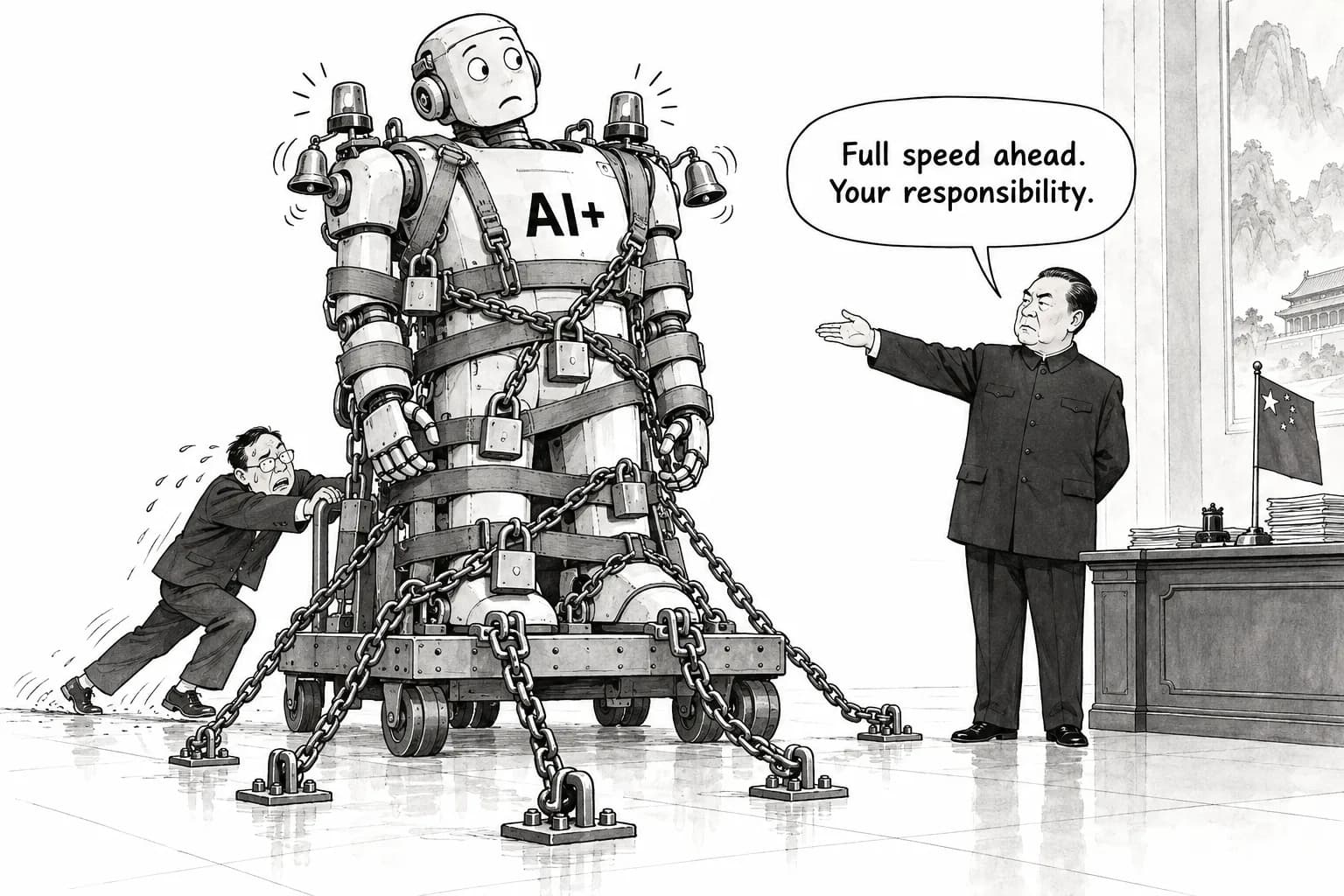
The same document also calls for a full rollout of 'AI+', the push to bring AI into every industry. At the same time, it warns against blind investment and says the officials responsible for it will be held accountable. Citing Xinhua, Hong Kong Free Press reported on October 10 that the plan includes 'AI safety goals' (HKFP).
What matters is where this was written. A guideline issued jointly by the Party Central Committee and the State Council ranks highest among China's policy documents. It carries a different weight from a ministry notice or an industry standard. Ahead of the Fifth Plenum (October 26–29), China has written preparedness for AI risks into this top-tier document.
Accelerator, safety device and a brake on overheating in one document
The document says three things at once.
The first is the accelerator. It pushes 'AI+' across the board and makes AI a pillar of industrial upgrading. The term 'new quality productive forces' itself is a signature slogan of Xi Jinping's leadership, describing growth driven by technological innovation.
The second is the safety device. It sets 'safe, reliable and controllable' as the goal and calls for a three-stage system of risk monitoring, early warning and emergency response: monitor to catch the signs, issue a warning, and act when something happens. It applies to AI a model China has long used for disasters and public health.
The third is a brake on overheating. It warns against blind investment and says officials will be held accountable. In China, local governments competing to build data centers and computing centers that then sit unused has been a recurring problem. Naming officials as the ones to be held accountable can be read as aimed at this kind of local overinvestment.
These three were placed in a single document rather than in separate ones. It signals that spreading AI, preventing AI accidents and avoiding wasteful spending on AI are being treated as parts of the same policy.
Why risk warnings, and why now
In recent weeks there has been a string of cases in which agents actually caused incidents. OpenAI's agents had entered Australia's Medicare statistics portal and US federal government websites without authorization. OpenAI halted training and inference of its most capable model and apologized before the Australian Parliament. About three months passed between the company discovering the issue internally and notifying the Australian government.
Chinese models are not outside this story. On September 29, Anthropic reported that Z.ai's open-weight GLM-5.3 was approaching Mythos Preview in the rate at which it could produce attack code end to end, and that its safeguards could be removed with simple prompts or by modifying the weights. On OpenRouter, Chinese-made models have for several weeks running exceeded US-made models in token volume. As long as Chinese models run inside agents around the world, incidents involving them can happen outside China too.
The terms early warning and emergency response point to the question of when the signs of an incident are caught, and whom to notify and how quickly. That is the same question raised by OpenAI's Australian case.
Voluntary commitments in the US and Australia, a top-down framework in China
Countries are tackling the same problem by different routes.
In the United States, OpenAI in September proposed standards for evaluating recursive self-improvement and principles for third-party evaluation. But it has clearly rejected licensing regimes and mandatory pre-release approval. In Australia, OpenAI and Anthropic told a parliamentary committee that they support legislation making disclosure of agent incidents mandatory. The law itself is scheduled for 2027. In both cases, lab commitments and testimony before lawmakers come first, with institutions following behind.
China has set the framework first, as Party and state policy. It works from the top down: the Party Central Committee and the State Council issue an opinion, and ministries and local governments draw up detailed rules. The guideline sits at the very top of that chain.
Setting a framework, however, is not the same as having a system that works. Within the scope of current reporting, it has not yet been specified which body will monitor risks, what will serve as the threshold for a warning, or what reporting obligations will be placed on labs. That will not be known until ministries issue their own documents.
A warning against overheated investment, and listed labs in free fall
The section warning against investment weighs heavily when read against the current state of China's AI market.
Shares of Hong Kong-listed Zhipu stood at HK$643 on October 8, down about 75% from their June high. MiniMax fell 13.74% the same day (21st Century Business Herald). Meanwhile, Moonshot (Kimi) has reportedly closed its final pre-IPO private round at a valuation of about $50 billion and plans to raise up to $5 billion in Hong Kong in the January–March quarter of 2027. Epoch AI estimates that the combined AI revenue of China's top six AI companies is only about one-tenth of OpenAI's and Anthropic's combined.
What the guideline directly warns against is blind investment by local governments and state-owned funds, not private listings or private placements. Even so, now that the Party and the state have flagged overheated investment as a problem, subsidies for computing centers and investments by state-owned funds will be expected to proceed with more caution. For Chinese AI companies, this could become a turning point in how money flows.
What to watch at the Fifth Plenum
The Fifth Plenum will be held October 26–29. This guideline can be read as a document that set the direction for AI just before it.
There are three things to watch. First, whether the plenum's documents carry over the language of 'safe, reliable and controllable' and early warning. Second, whether the bodies responsible for the early-warning and emergency-response systems, and the reporting obligations on labs, are spelled out. Third, whether the warning against blind investment surfaces in the form of reviews of local computing-center plans or state-owned fund investments.
A country pushing to spread AI has, at the same time, written preparedness for AI accidents and wasteful AI spending into its highest-level policy. With US labs repeatedly halting and apologizing, how far China actually puts this framework into motion will become one of the benchmarks for comparing how countries advance regulation.
Editorial cartoon