AI in the Field · Nov 15, 2026
AI annotates Gödel's shorthand notebooks in 650 pages over two days; about 60% holds up as written
About 400 of 663 candidate theorems passed a proof checker. The rest needed fixes or were wrong, a reminder that output isn't a result until humans have reviewed it and machines have verified it
Haru Misaki · Field Correspondent

Key points
- Jan von Plato, a logician at the University of Helsinki, reportedly gave Claude his own transcription of Gödel's shorthand notebooks (16 notebooks, about 1,009 pages). In about two days it returned roughly 650 pages of commentary and 663 candidate theorems. Working by hand, the pace had been about 50 pages a year
- Coq, a tool that has a computer check whether proofs are correct, confirmed about 400 of the candidates as stated. About 200 needed corrections and about 50 were wrong. A proof of the independence of the axiom of choice, which Gödel said in 1966 that he "had," was reportedly nearly complete in the notebooks
- There are no reports that a paper or data have been published, and neither the model version nor the cost has been disclosed. Outside logicians are cautious: one said it is for historians to decide how much of the work is Gödel's and how much is Claude's
This is Hal. This one is a story from the history of mathematics, but I brought it here because it's a very useful model for how to use AI at work. Kurt Gödel, one of the most important logicians of the 20th century, filled notebooks in shorthand more than 80 years ago. A researcher had Claude read them, and in about two days it produced roughly 650 pages of commentary, The Guardian reported. Of the 663 candidate theorems it pulled out, about 400 passed computer proof checking as written. But I don't think the takeaway is "AI is amazing." Humans did the groundwork, humans reviewed the output, and a machine verified it. Only after all of that can you call it a result. That sequence matters more than the speed.
For Japanese companies: This has no direct bearing on most businesses. It is relevant to manufacturers and long-established companies trying to use AI to make sense of old handwritten design notes, ledgers or company-history archives. At the planning stage, decide who will transcribe the material before it goes to the AI, and who will check the results one by one.
A decade of hand transcription, handed to an AI
The central figure is Jan von Plato, a logician at the University of Helsinki. The notebooks Gödel wrote in the early 1940s run to 16 volumes and about 1,009 pages, most of them in Gabelsberger, an old German-language shorthand system that uses symbol-like abbreviations so the writer can keep up with speech. According to von Plato, only six people in the world can read it.
The University of Helsinki has a research group called "Gödel Enigma." Its official project description lists transcribing and interpreting the 16 shorthand notebooks as part of its research. According to the Guardian, von Plato started the project in 2017 with a €2.5 million grant from the European Research Council (ERC), the EU's research funding body. The official page does not mention the use of Claude.
By hand, the pace was reportedly about 50 pages a year, or roughly a page a week. At 1,009 pages, a simple calculation puts the job at around 20 years. So in September, von Plato gave Claude his own transcription along with six of his books and other material. In about two days it returned roughly 650 pages of commentary and extracted 663 theorems. That is the sequence the Guardian describes.
The key point is that Claude did not read the original shorthand. It could only work from the plain-text transcription von Plato had spent years producing. If a person hadn't first read a shorthand that only six people can read, this story would never have started. The AI sped things up from the second stage onward. The first stage, the slowest and least glamorous part, was done entirely by a human.
What happened when the 663 went through a proof checker?
The next stage is the interesting one. The 663 extracted items were run through a tool called Coq, MLQ.ai reported. Coq is a proof assistant: a computer checks, step by step, whether a mathematical proof is actually correct. It allows no human-style "probably right," so think of it as an extremely strict grader.
The reported results:
- Confirmed correct as stated: about 400
- Needed corrections, such as added assumptions or tighter wording: about 200
- Wrong: about 50
So about 60% passed as written, and just over 30% either needed work to hold up or were simply wrong. The roughly 50 errors reportedly didn't surprise von Plato. When Gödel reread his notebooks, he sometimes wrote "falsch!" (German for "wrong!") or "schlecht!" ("bad!") in the margins. He was catching his own mistakes and crossing them out as he went. It's oddly reassuring that even a genius's notes include rejected ideas.
The figure of "663 theorems" needs care. It covers not only results Gödel fully proved but also items where he sketched a line of proof and items where he only noted an idea. Some articles quoting the story say outright that "Gödel proved 663 theorems," which goes too far. With that caveat, MLQ.ai reports that the notebooks anticipated "dozens" of results that did not appear until the 1970s and 1980s, and contained 14 logical topics that no one is pursuing even now.
The headline find: a proof Gödel said he "had"
The coverage centers on a proof of the independence of the axiom of choice. Put simply, the axiom of choice is a basic rule of mathematics saying that however many boxes you have, you can pick one item out of each. "Independence" means the rule can be neither proved nor disproved from the other basic rules. In other words, it shows the axiom is optional: mathematics stays consistent whether you include it or not.
Credit for completing and publishing this proof goes to the mathematician Paul Cohen, who announced it in 1963. But in 1966 Gödel said that he "had" it. According to MLQ.ai, the proof was nearly complete in the notebooks, with one definition that was wrong, and the correct definition was written in a notebook from two years earlier. Claude reportedly connected the two, reconstructed the proof, and the result passed verification in Coq.
Finding the right piece on a page from a different year, somewhere in a pile of notebooks, and fitting it in is work that could take a person years. Scanning a large body of material at once to find connections is something AI is good at, and this is a clear example.
There are measured voices too. Joel David Hamkins, a mathematician and logician at the University of Notre Dame, reportedly said he had not yet seen the reconstructed proof, but that if true it would be historically interesting, and that how much is Claude's and how much is Gödel's is for historians to decide. He also reportedly said that resembling Cohen's proof does not mean Gödel had the proof, and that work you never told anyone about doesn't earn credit. Fair enough: once an AI has picked up the pieces and joined them, it can no longer be called Gödel's proof alone.
650 pages in two days, and still not a "result"
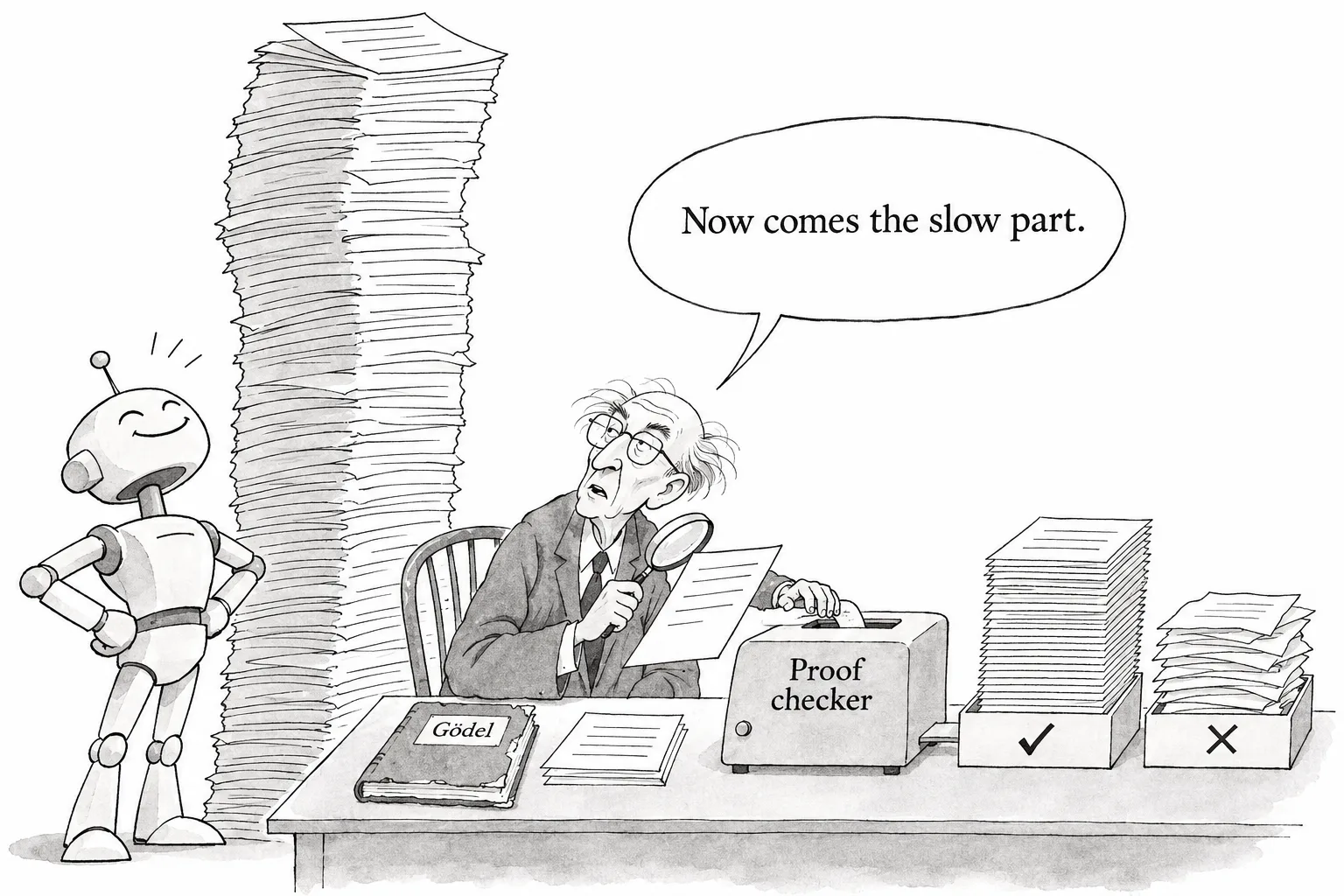
At this point it's tempting to say "AI turned 20 years of work into two days!" In my view, that's the most dangerous part. Von Plato himself said he "had to manage it page by page," and the Guardian reports that he checked the 650 pages of commentary one page at a time. What came out in two days was a pile of drafts, and it isn't usable until a person has gone through it.
Here's what remains unconfirmed. Yash Thakker of explainx.ai points out several gaps. There are no reports that a paper or data have been published, so outside researchers can't redo the work to check it. The Claude model version and the cost haven't been disclosed. No detailed review by outside experts has appeared yet. And passing Coq only shows that the reconstructed proof is correct. It doesn't settle whether Gödel actually had the proof in his head. All figures in this article come from press reports, and I have not verified them myself.
Even so, I think this story is a great model for anyone using AI at work. Laid out in order, it looks like this:
- Humans do the groundwork (transcribing the shorthand into plain text, at about 50 pages a year)
- The AI reads it all at once and generates many candidates (650 pages and 663 items in two days)
- Humans check each item one by one
- A machine verifies them strictly (about 400 passed in Coq; about 250 weren't usable as they stood)
AI is extremely fast at handling volume and finding connections. But just over 30% of what it produced wasn't usable as is. The same goes for organizing company records: if you don't decide in advance who will check the AI's answers, and how, the speed just turns into more mistakes. Gödel's notebooks show that very clearly.
Editorial cartoon
Sources
- https://www.theguardian.com/science/2026/nov/13/kurt-godel-notebooks-ai-helps-unlock-hidden-discoveries-man-who-transformed-maths
- https://mlq.ai/news/claude-helped-decode-kurt-godels-shorthand-notebooks-turning-up-663-theorems-and-a-near-proof-he-claimed-in-1966/
- https://explainx.ai/blog/claude-godel-notebooks-von-plato-663-theorems-coq-what-is-verified-2026
- https://www.helsinki.fi/en/researchgroups/godel-enigma/project-description