Products & Models · Nov 24, 2026
AI cuts the cost of quantum algorithms for fusion and drug discovery by up to 11.8 times, with machine-checked proofs
Google DeepMind used a team of Gemini 4 agents to improve quantum algorithms and cut the number of qubits they need by about 20%. Every result was formally proved in Lean. After the Riemann hypothesis proof, a second lab has now produced verified scientific results with AI
Rie Suzuki · Technology Editor

Key points
- Google DeepMind used a team of Gemini 4 agents to cut the cost of quantum algorithms used in fusion and drug discovery by up to 11.8 times and the number of qubits they need by about 20% (primary source)
- Every result was proved in Lean, so a machine guarantees the procedures are correct before any human reads through them
- After the Riemann hypothesis proof an Anthropic researcher built with Claude, a second lab has now produced new verified scientific results with AI. The approach has spread from pure mathematics to computational procedures closer to practical use
Google DeepMind said in a company blog post that it used a team of AI agents running on Gemini 4 to shorten quantum algorithms, the step-by-step procedures that quantum computers run. The algorithms are used in fusion and drug-discovery calculations. DeepMind cut their computational cost by up to 11.8 times and the number of qubits they need by about 20%. Qubits are the basic units of computation on a quantum computer. DeepMind proved every result in Lean, a language that lets a machine check whether a proof is correct. After the Riemann hypothesis proof an Anthropic researcher built with Claude, this makes a second lab to produce new verified scientific results with AI.
For Japanese companies: Most companies are not directly affected for now. The companies that are affected are the R&D units of pharmaceutical, chemical, materials, and power and energy firms that fund joint quantum computing research. At their next regular meeting with partners, they should ask whether these results change the partners' estimates of how many qubits are needed and when the machines will become usable.
What did Google DeepMind's quantum algorithm improvements change?
The work matters because AI found a way to solve problems meant for quantum computers on smaller machines, with less effort. Fusion work needs calculations of how reactions behave in inertial confinement fusion, where lasers compress and ignite hydrogen fuel. Drug discovery needs calculations of the properties of molecules, such as the enzymes that break down drugs. Today's computers struggle to solve these problems accurately, which is one reason people have high hopes for quantum computers.
According to Google DeepMind, the inertial confinement fusion calculation became 11.8 times cheaper, and the number of qubits it needs fell from 5,650 to 4,338. Cost here is a measure that combines the number of qubits and the number of operations required. In drug discovery, the calculation for cytochrome P450, an enzyme that breaks down many drugs, became 2.5 times cheaper, and its qubit count fell from 481 to 333. A calculation for a common light-sensitive molecule became 8 times cheaper. An 11.8-fold cut works out to a reduction of about 92%. In principle, needing fewer qubits means a smaller machine can run the calculation, which brings practical use closer. However, no quantum computer large enough to run these calculations for real has been built yet.
Human researchers chose the problems and tracked progress, while a "team" of Gemini 4 agents did the improvement work itself. Separate teams worked on each problem. They proposed candidates, checked them in Lean, and added them to a shared record. Every four hours, agents from each team met to swap and compare ideas. On November 13, Google also announced math and computer science results produced with "/teamwork," a feature of Antigravity that runs research with multiple agents. This time, Google applied the same approach to computational procedures in physics and chemistry.
Why the proofs matter
The biggest problem with scientific results produced by AI is deciding who checks that they are actually correct, and how. AI can produce errors that look plausible, and it takes people a long time to read every detail. That is even more true for procedures like quantum algorithms, which cannot yet be tested on real hardware.
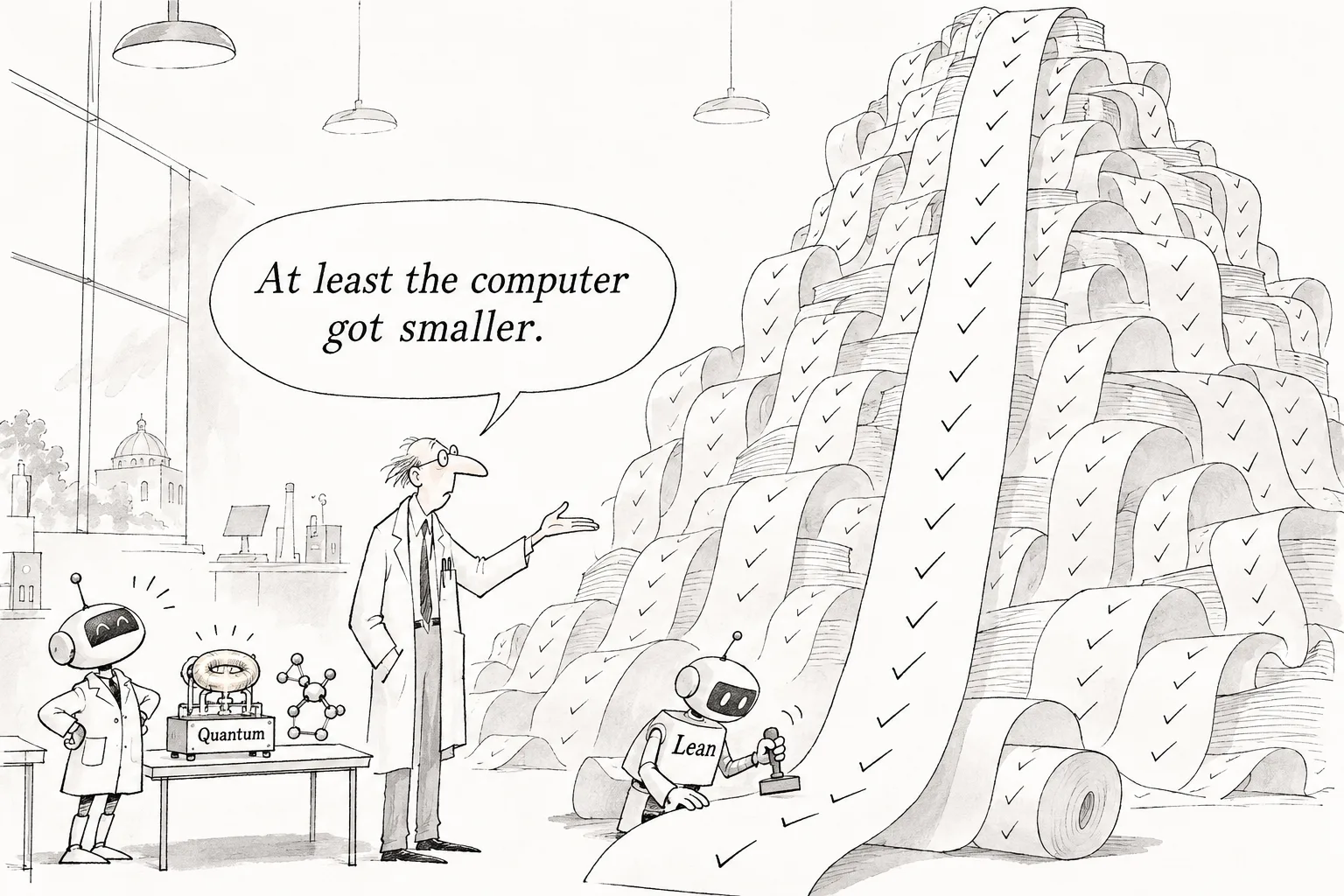
Google DeepMind's answer to this problem is Lean. It released a Lean library for quantum algorithms, the problem specifications and the verified solutions on GitHub, and posted its paper on arXiv. A proof written in Lean is checked by a computer step by step to confirm there are no gaps or errors anywhere. Even before people fully understand it, a machine can guarantee that "at least the claims as written are correct." As AI produces results in large volumes, this offers one way to deal with human review falling behind.
Lean verification is spreading inside Google DeepMind as well. In AlphaProof Code, announced on November 10, Gemini-powered agents verified the protocol used by the encrypted messaging app Signal with more than 6 million lines of Lean proofs. The quantum algorithm work brings that approach to calculations closer to practical use, in fusion and drug discovery.
After the Riemann hypothesis, verified results from another lab
Several verified scientific results from AI have appeared in the past few days. On November 20, Anthropic mathematician Levent Alpöge claimed that he and Claude had proved the Riemann hypothesis, one of the most famous unsolved problems in mathematics. In a joint statement on November 21, the organizations that maintain Lean and Mathlib, its library of mathematical building blocks, confirmed that both the statement and the proof written in Lean are correct.
The Riemann hypothesis proof by Alpöge and Claude also passed many tools in an independent check by MIT mathematician Andrew Sutherland. Meanwhile, Imperial College London mathematician Kevin Buzzard has said that no one yet understands what the proof shows. The episode also made clear that a machine's guarantee of correctness and human understanding are separate stages.
Google DeepMind's announcement shows that verified results like these are not coming from just one company. They have spread beyond mathematical proofs to quantum computing procedures, calculations that industry will eventually use. Anthropic also reported in November that it used Lean to check a bound that Claude Fable 5.2 derived for an unsolved problem in black hole physics. Major labs are making machine-checked proofs a standard part of AI scientific results.
What we could not confirm
This article has not been able to confirm the following about Google DeepMind's announcement: which specific Gemini 4 model was used, how many agents were involved, and how much compute was used; whether the Lean proofs cover only the correctness of the procedures or also how costs were counted; whether outside researchers have checked the results; and when the improved procedures might run on real hardware.
What to watch next
The next thing to watch is whether researchers in quantum chemistry and fusion agree that they can use these procedures for their own calculations. Even when a Lean proof passes, experts still need to check that it correctly represents the problem people actually want to solve. In the Riemann hypothesis case too, separate tools were used to check that the statement says what it was meant to say.
The results also matter to companies building quantum computers. If estimates of the qubits required fall, the assumptions behind each company's timeline of "how many years until practical use" may change too. Each time AI trims a computational procedure, the estimate of when quantum computers will start to be useful may be rewritten.
Editorial cartoon