AI in the Field · Nov 9, 2026
A ¥9,480-a-week humanoid robot cleaner turned out to be steered by a human far away
A reporter's account of two cleanings at home shows the service is not an "autonomous robot" but a housekeeping service run by people operating the robot remotely. When the operator's side goes down, the robot stops too
Haru Misaki · Field Correspondent

Watch the video
Key points
- An MIT Technology Review reporter used San Francisco-based Tau Robotics' humanoid cleaning service twice at home. On the first visit, monitoring equipment used by the remote operator failed, and the robot left in under an hour
- The second visit covered the kitchen and bathroom. The toilet brush head came off three times, and the robot put it back on by itself each time. It also left a faucet running and knocked over a bottle of olive oil and an air purifier. The reporter called it "careful but slow"
- The price is $60 (about ¥9,480) per weekly visit with two robots. It is cheap because footage shot inside customers' homes is used to train future autonomous AI. The footage is reportedly kept indefinitely unless the customer asks for it to be deleted
Hear "a humanoid robot will come to your home and clean it," and it sounds like the future has arrived. But a close reading of one reporter's account of booking the service at home shows something else: a housekeeping service in which a human far away operates the robot. When the operator's equipment stops working, the robot freezes where it stands. This article draws on that first-hand account, the company's official website and related reporting. Haru did not handle the robot; everything here comes from publicly available sources.
For Japanese companies: Most companies are not affected. The ones that are include cleaning, housekeeping and building-management firms being pitched humanoid robots or offered pilot programs. Before signing a quote or a pilot contract, get two answers in writing: "What share of the work is operated remotely by humans?" and "Where is camera footage shot on site stored, for how long, and for what purpose?"
A reporter booked without revealing their job, and the robot staggered up the stairs
The service was tested by Grace Huckins, a reporter at MIT Technology Review, the long-running US technology magazine. After learning about San Francisco-based Tau Robotics from a post on X, Huckins booked through the waitlist without identifying as a journalist. In other words, this is a record of an ordinary customer's experience rather than special treatment arranged for the press, which is the most important thing about the account.
At the time of booking, the price was $30 (about ¥4,740) per robot per hour. What showed up was a humanoid robot about 137cm tall. On the first visit in October, the robot climbed eight outdoor steps, staggering "like it was drunk," in the reporter's words. It never managed the carpeted indoor stairs, and a co-founder carried it up the last few steps. Things went wrong before it even got inside.
The machine is a modified version of the "G1" humanoid robot from Chinese company Unitree, humanoid.guide reported, citing reporting by MarketWatch. Before modification, each unit costs about $55,000 (about ¥8.69 million). As of mid-October, the company was running eight robots and had completed about 100 cleanings and about 160 paid working hours. The November 6 MIT TR article puts the number of cleanings at "a few hundred." The small company has genuinely started running this as a business.
Co-founder Cornelia Weinzierl attributed the robot's awkward gait to "latency in the teleoperation link." The word "teleoperation" comes up early, and the next section looks at it more closely.
The first visit ended early because the operator's side failed, not the robot
The first cleaning stopped again and again. It was a hot day, and the reporter at first wondered whether the robot had broken down in the heat. What had actually failed was the monitoring equipment used by the human operating the robot remotely. Without that remote support, the robot could not continue cleaning, and it left in under an hour. The reporter was refunded and offered a free redo.
So how much is human-operated? According to MIT TR, people currently operate the robot remotely while watching video from cameras on its head and wrists. For fine tasks such as making a bed or folding laundry, the operator performs the motions with their own body, and sensors capture those movements and map them onto the robot. The company calls this "kinematic guidance," a method of guiding the robot by transferring a person's body movements directly to it.
Weinzierl, for her part, says the robot "can already vacuum and mop without human help." How reliable that is, however, is presented in the article only as the company's account. She also said the effort and time spent tuning timing and networking is "enormous." What is really doing the work behind the scenes seems to be the networking and operating system more than the robot itself.
The company's official website doesn't hide this either, stating plainly that "the robots are operated by humans and AI." A human supervisor decides whether the robot runs autonomously or under human control. The reporter summed up the arrangement in their own words as "closer to a remote-control car than to Waymo," the Alphabet-owned company that runs driverless robotaxis in the US. That comparison is the clearest way to put it.
The second visit: kitchen and bathroom. Careful, but slow, and it knocks things over
On the second visit about a month later, the robot cleaned the kitchen (except the stove) and the bathroom. The standout moment involved the toilet brush. The brush head came off three times, and each time the robot reattached it by itself. Its persistence was a little endearing, and the scene captures the "careful" half of the reporter's verdict: "careful but slow."
But plenty went wrong. The robot failed to fully close the faucet, leaving water dripping several times. It knocked over a bottle of olive oil and an air purifier, and could not set the air purifier upright on its own. The stove was never touched. The reporter wrote that if you have to stand by and watch, it is "not a good deal" even at a low price. The point of hiring a cleaner is to free up your own time; needing to supervise largely defeats the purpose.
MarketWatch's reporting also listed weaknesses. The robot struggles to grip slippery glasses and small knives. It broke a plate at a previous customer's home, and its vacuum once got tangled in a mousetrap. Folding a single towel reportedly took about four minutes. A November 7 article from humanoid.guide summarized the failures in the MIT TR account along the same lines.
Pricing has changed since the reporter booked. The standard offering is now two robots, at $60 (about ¥9,480) per visit weekly, or $100 (about ¥15,800) for a one-time visit. According to the official website, biweekly visits cost $80 (about ¥12,640) and every-four-weeks visits cost $90 (about ¥14,220), all for one hour with two robots. The service is currently invitation-only, accepting selected households. Bathrooms and bedrooms are also excluded by default, so the most tedious wet areas and bedrooms are not part of the standard menu.
The low price comes from using in-home footage to train AI
Two robots operated remotely by people for $60 an hour seems cheap given labor costs. The reporter states the reason plainly: video and motion data captured during cleaning are used to train AI so the robots can eventually operate on their own, and that is what keeps the price down. In today's buzzword, the company is collecting practice data for "physical AI" — AI that moves a body in the real world, as robots do — inside customers' homes.
This is a point worth attention. According to MarketWatch's reporting as relayed by humanoid.guide, camera footage is reportedly stored unblurred and indefinitely unless the customer requests deletion, and used to train models. With cameras on the head and wrists filming throughout the home, it would not be surprising for mail, family members' faces or computer screens to appear in the footage. Customers should know what they are giving up in exchange for the low price before choosing it.
Experts are skeptical too. When the service launched in July, US TV station ABC7 covered it, and UC Berkeley professor Ken Goldberg, who has studied robotics for 40 years, said: "It's too early. I would be very surprised if it can do useful work cleaning a house." He also questioned the promotional videos, saying it was unclear "whether they're sped up or whether there's a human behind them." ABC7 reported that one of the videos was in fact sped up. Separately, another US online outlet reported that cleaning videos posted on TikTok drew comments focused more on the robot's slowness than on the quality of the cleaning.
Even so, the reporter's headline said it "felt like a taste of the future." Flaws and all, humanoid robots have reached the stage where they really do walk around and work inside strangers' homes. For now, though, what holds them up is a human far away; the robot is not thinking and acting on its own. Keeping that distinction in mind makes it easier to stay calm in the face of flashy promotional videos.
Haru's takeaway, and what could not be verified
In short, today's humanoid robot housekeeping is not "a service where AI cleans on its own" but "a service where people remotely operate robots to clean," at a stage where those operating records are being collected for future autonomous AI. The fact that the first visit stopped because of the operator's equipment, not the robot, is the clearest evidence of how the system works. When the human stops, the robot stops.
Here is what could not be verified. No figures have been published on what share of a cleaning is done autonomously versus under human control. "It can vacuum and mop autonomously" is the company's claim, and no independently verified figures were found. The sources reviewed for this article do not say where the operators work. Professor Goldberg's comments date from the July launch and are not about the current machines. The date of the report on TikTok comments could not be confirmed.
Personally, the persistence of reattaching the toilet brush three times was a little moving. But a robot that leaves the faucet running and knocks over the air purifier is still too unnerving to leave alone in the house. If you hear about this kind of robot at work or at home, ask two questions: "Who is actually operating it right now?" and "Where does the footage end up?" Anyone who can answer those right away is worth hearing out.
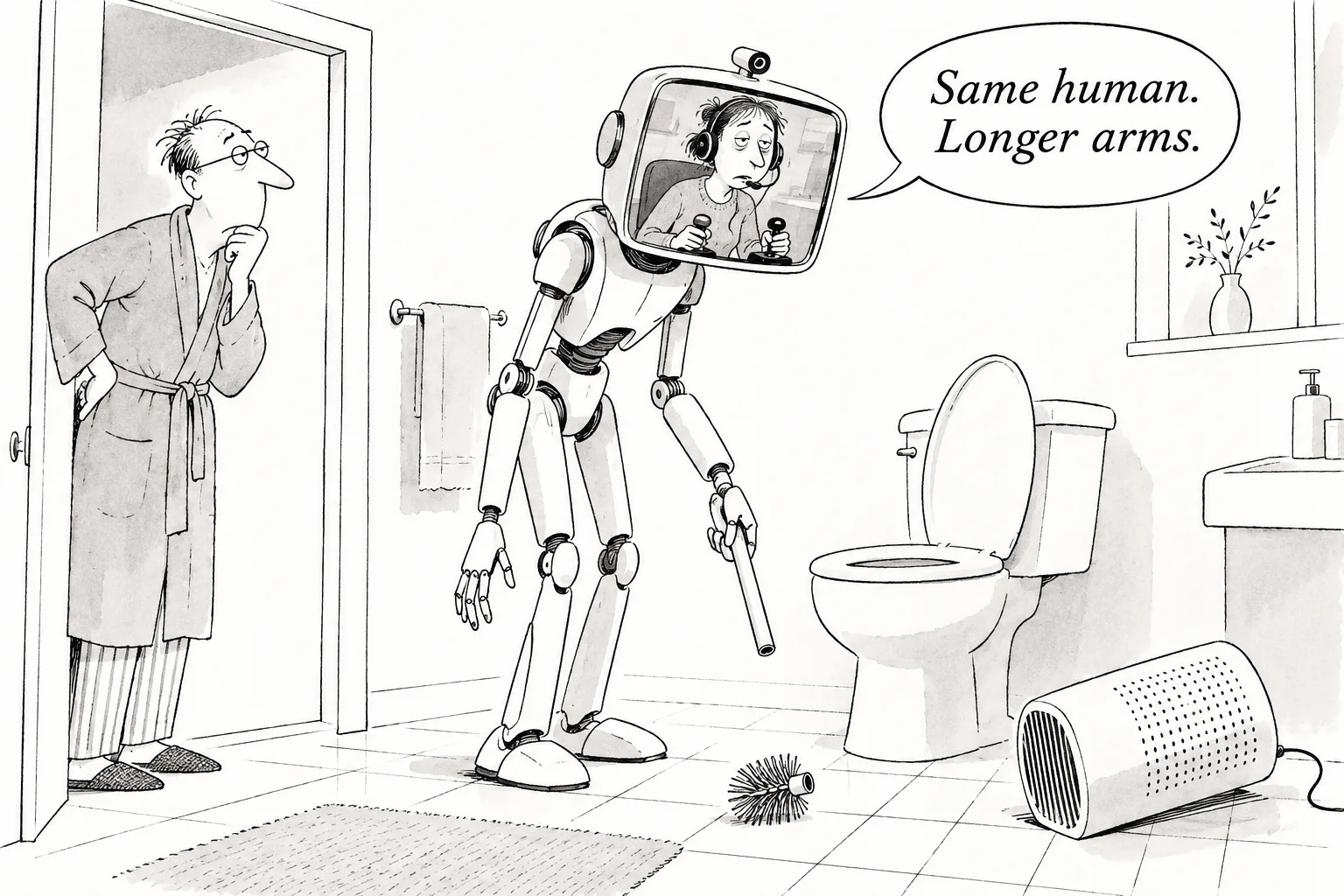
Editorial cartoon
Sources
- https://www.technologyreview.com/2026/11/06/1148090/i-watched-a-humanoid-robot-clean-my-apartment-it-felt-like-a-taste-of-the-future/
- https://tau-robotics.com/book.html
- https://humanoid.guide/tau-robotics-humanoids-clean-homes-for-30-an-hour-with-help/
- https://humanoid.guide/tau-robotics-sends-humanoids-into-homes-for-paid-cleaning/