Money · Nov 2, 2026
Credit default swaps on five hyperscalers hit highest level since 2021, WSJ reports
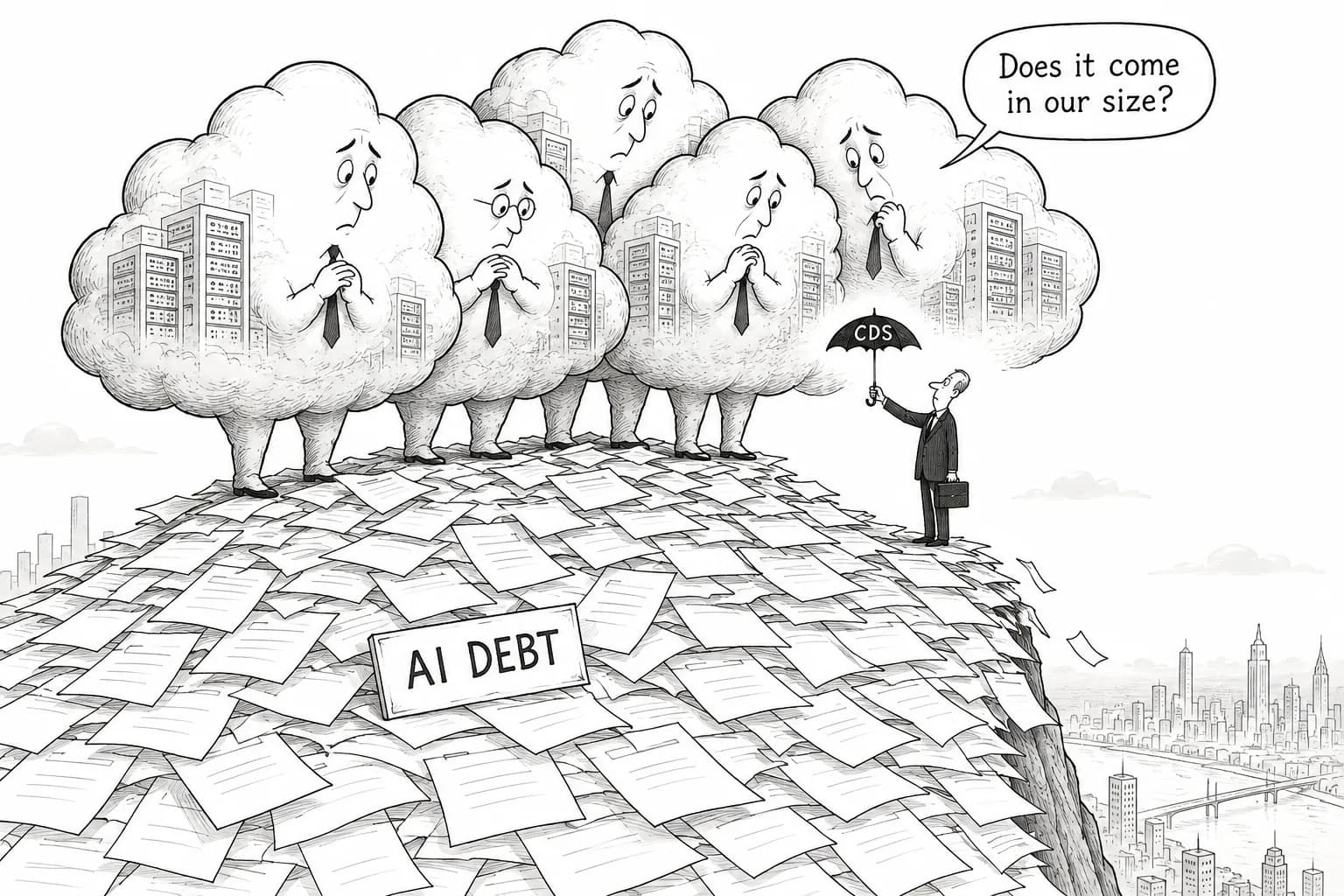
Worries about AI debt have reportedly spread from neoclouds unable to issue bonds to highly rated hyperscalers. The warning from the bond market follows the stock sell-off and S&P's cut to Meta's rating outlook
Koji Yamamoto · Economics Analyst

Key points
- Secondary sources cite a WSJ report that CDS on five hyperscalers have hit their highest level since 2021. The five are Amazon, Alphabet (Google), Microsoft, Meta and Oracle
- The WSJ reported on October 30 that CoreWeave, Nebius and Nscale have been unable to issue bonds. The concern has now moved from neoclouds to highly rated companies
- The report comes alongside S&P's cut to Meta's rating outlook to negative and a sharp drop in AI stocks. Earnings from CoreWeave (November 9) and Nebius (November 10) are the next milestones
[Update, November 2, 2026, 5:55 JST] We made the following corrections. (1) We had written that the other two of the five companies could not be named, but secondary reports did name all five. We added Amazon and Microsoft. (2) "cut its outlook on Meta's rating to negative (AA−)" mixed up the rating (AA−) and the outlook (negative); we fixed the wording. (3) We added an explanation of basis points.
Worries about the debt being poured into AI data centers have reportedly spread beyond thinly financed neoclouds to highly rated hyperscalers. According to the Wall Street Journal (WSJ), credit default swaps (CDS) on five hyperscalers have climbed to their highest level since 2021. A CDS works as insurance against a company failing to repay its bonds, and a rising price means the market sees more credit risk. The report was relayed by Crypto Briefing and FourWeekMBA, and Techmeme picked it up on October 31. The WSJ article itself has not been verified, and everything in this story is based on those reports.
What was reported
According to secondary reports, the five are Amazon, Alphabet (Google), Microsoft, Meta and Oracle. Oracle's spread reportedly widened by more than 1 percentage point over the past month. This story could not confirm how high each company's CDS went (in basis points; one basis point is 0.01%). Those figures need to be checked against the original WSJ article.
The phrase "highest since 2021" needs care. It describes a level relative to each company's own history and does not by itself mean a default is imminent. These are companies with high credit ratings whose CDS were cheap to begin with. Even so, the price of that insurance has reportedly been pushed to a multi-year high as AI-related borrowing grows. That is what gives the report its weight.
The worry started with neoclouds
The concern began with neoclouds, which rent out GPUs. The WSJ reported on October 30 that CoreWeave, Nebius and Nscale had been unable to issue bonds (that article has not been verified firsthand either). A business that buys AI compute with borrowed money and pays it back with rent from AI companies depends on whether that rent keeps coming. The latest report suggests the same doubts now reach hyperscalers, which should be able to fund themselves from their own cash.
As previously reported, there were already signs on the hyperscaler side. S&P has cut its outlook on Meta's AA− rating to negative, and conflicting figures have been reported for Meta's 2026 free cash flow: minus $22 billion and minus $39 billion. Amazon has an $80 billion credit facility for 2027–2028, and its 2026 capital spending is put at about $220 billion. Oracle is named as a company that has sharply increased its borrowing to build AI data centers. The CDS report offers the bond market's answer to questions raised earlier: whether other rating agencies will follow S&P, and whether reviews will extend to hyperscalers beyond Meta.
Coinciding with the stock sell-off
The report came right after a heavy sell-off in AI stocks. At the close on October 30, the Nasdaq was down 2.86%, the S&P 500 was down 1.82% and the SOX semiconductor index was down 7.2%. With the price of insurance on bonds reportedly rising after the stock drop, doubts about AI capital spending being funded with debt surfaced in stocks and bonds at the same time.
Money is also getting harder to come by for AI companies. As previously reported, OpenAI's fundraising target has fallen to about $20 billion, with about $11 billion committed. These AI companies are the ones who ultimately pay the rent to hyperscalers and neoclouds. Anthropic, which is preparing to go public, has reportedly received a double-B rating. The credit of those paying rent supports the credit of the lenders' debt, and the question is where that chain is weakest.
What is still unknown, and what comes next
Much remains unclear. The level of each company's CDS and how the comparison with 2021 was made all need to be checked against the original WSJ article. CDS prices can also rise simply because investors holding bonds from heavy issuers buy more protection against losses. The reports do not make it possible to tell whether the latest rise reflects a reassessment of default risk or a hedge against larger debt loads.
The next milestones are earnings. CoreWeave reports on November 9 and Nebius on November 10. Whether neoclouds can show a path to refinancing their debt will also affect hyperscaler CDS. It is also not yet known whether NVIDIA will guarantee Nscale's debt. Anthropic's S-1/A (with a price range and share count, expected around November 10), and the total compute commitments disclosed in it, will be another measure of who ultimately carries the debt behind AI infrastructure.
Editorial cartoon