Opinion · Nov 1, 2026
37 sites posing as local papers turn up as ChatGPT sources — a citation is no guarantee of trust
"There's a source, but it isn't necessarily true" — An NPR investigation reportedly found that 37 sites posing as local newspapers were being cited by ChatGPT. OpenAI said users can judge for themselves, and one commentator wrote that "being cited has become easier than being trustworthy"
Koji Yamamoto · Economics Analyst

Key points
- According to an NPR investigation, 37 sites posing as local newspapers were cited by ChatGPT. OpenAI reportedly responded that users can follow the sources and make their own judgments
- U.S. political campaigns are reportedly tailoring their messaging to the AI models voters use. Being cited is now something that can be deliberately pursued
- A source link shows only where a claim came from. With the midterm Election Day (November 3) approaching, the responsibility for disclosing who funds these sites and how they are linked lies with the AI companies
When a row of source links sits beneath an AI answer, readers tend to relax. The answer looks well-grounded. But what if those links lead to political propaganda sites dressed up as local newspapers? An NPR investigation reportedly found that 37 sites posing as local newspapers were being cited in ChatGPT's answers (republished by NPR member station WAMC, October 30). According to the article's headline, the sites were boosting Democratic candidates.
Our position is clear. In AI answers, being cited has become something that can be bought. Showing sources is not a guarantee of trust. And "it's up to users to judge" is not an answer. Note that every fact discussed here comes from news reports; we have not been able to read the body of the article or the list of 37 sites. We do not draw firm conclusions here about which candidates were being boosted or who was paying for the sites.
What was reported: 37 sites, and OpenAI's response
According to the report, the 37 sites were built to look like local news outlets and ran articles favorable to election candidates. ChatGPT reportedly cited these sites as sources when answering questions about elections and candidates. Local newspapers are disappearing, and many areas no longer have any outlet covering local elections. It is precisely in those places that a site bearing a local name is hardest to tell apart from a real local paper.
OpenAI spokesperson Nate Evans reportedly told NPR:
ChatGPT's search tools cite from a range of sources so people can explore and make their own judgements.
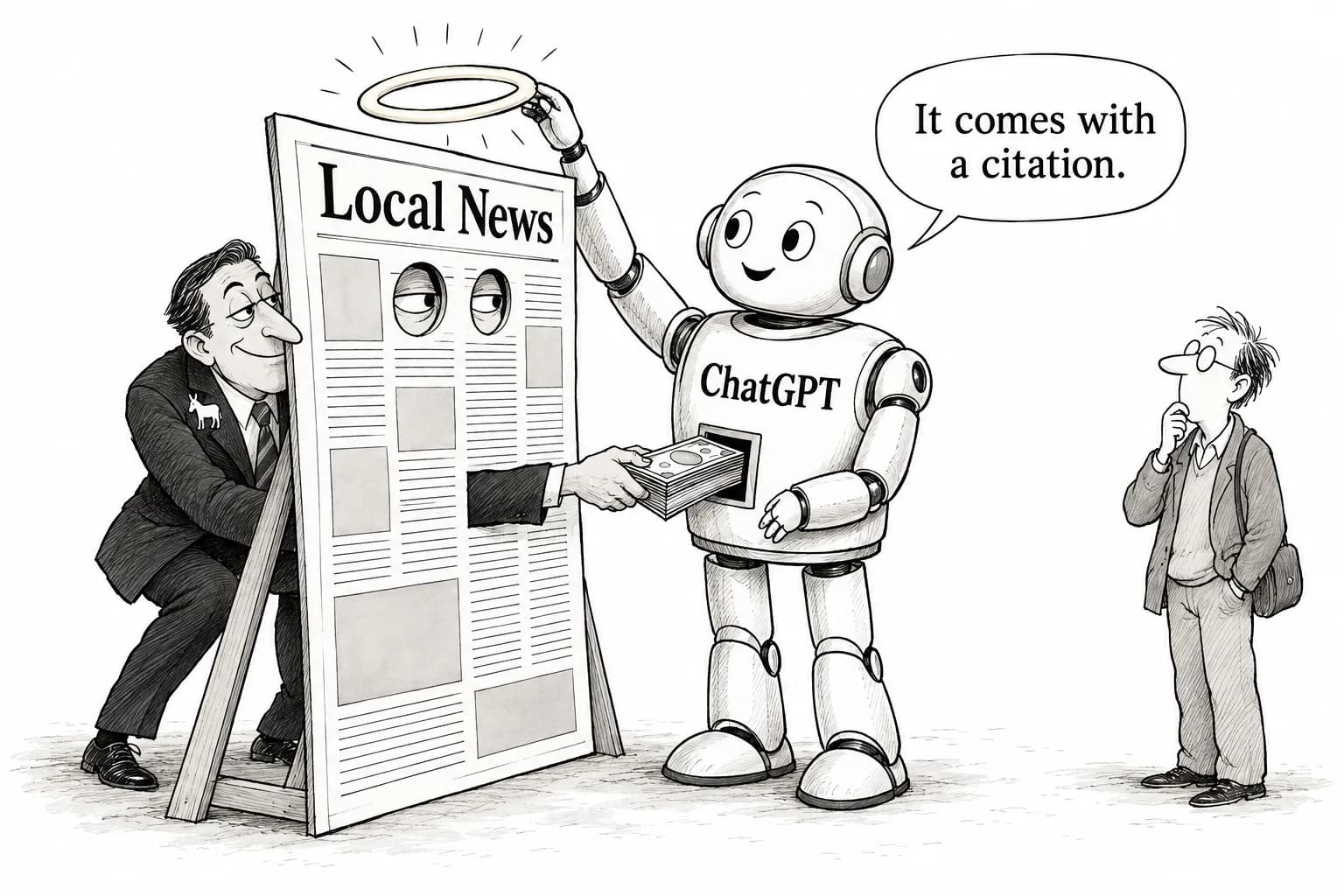
In principle, that sounds reasonable. List the sources, and users can trace claims back to their origin. But where they end up is a page that looks like a local newspaper — a page built specifically to look like one. Users are being asked to see through something designed so that users cannot see through it. This answer pushes the burden of judgment onto the party with the least information.
Renée DiResta, a researcher at Georgetown University, sees the concealment of funding as the heart of the problem.
Disclosing funding … would be obviously the ethical thing to do here, or at least indicating that this is a linked effort.
What DiResta is asking for is not the removal of the sites. It is disclosure of who is paying for them and which sites are operating together. The existence of partisan media is itself a normal feature of democracy. The problem is partisan promotion wearing the face of nonpartisan local reporting. And AI citations inherit that face wholesale and make it look even more neutral.
A citation shows provenance, not truth
Rebecca Thorburn, who advises B2B companies on how they appear in AI, drew this distinction sharply in an October 30 essay (Substack).
A citation tells us where a claim came from; it doesn't prove the claim is true.
It sounds obvious, but the look of an AI answer makes people forget the obvious. When search results were a list of links, readers chose for themselves which links to open and which to believe. In an AI answer, the model has already selected, summarized and written everything up before attaching sources at the end. The sources look less like an entry point for checking and more like a stamp saying the checking is done. That stamp is exactly where the 37 sites slipped in.
In other words, the number and appearance of citations are no longer a measure of quality. The fact that a page was cited shows only that it existed online in a form the model could easily pick up.
Being cited is now something you can go after
This is not an accidental oversight. According to an exclusive Reuters report republished by The Star, U.S. political campaigns are tailoring their messaging to the AI models voters use (October 26). If voters start asking AI rather than search engines about candidates, campaigns will aim to appear in AI answers. In the article, Joe Bonilla of the PR firm Relentless Awareness said:
The public increasingly cannot and will not be able to discern what is created by systems like Claude and ChatGPT versus human-originated content.
If the public cannot tell whether something was made by a person or a machine, then posing as a local newspaper becomes a cheap way into AI answers. Register a few domains with local names, publish articles with the same slant over and over, and have them cite one another. To the model, it looks as though several local outlets are reporting the same thing. Thorburn asked where this mechanism ultimately leads:
If AI systems reward visibility and repetition more reliably than accuracy and independent verification, are we unintentionally building an information ecosystem in which being cited becomes easier than being trustworthy?
Our answer to that question is yes. Visibility and repetition can be multiplied with money. Accuracy and independent verification are hard to multiply with money. As long as AI answers give weight to the former, citations can be bought. The 37 sites show that a market for them is already operating in elections.
The strongest objection: showing sources is itself progress
The objections have merit. First, an AI that shows its sources is better than one that doesn't. Outside researchers were able to identify the 37 sites in this case precisely because ChatGPT displayed where its citations came from. Hiding sources would only make the problem invisible.
Second, there is danger in AI companies deciding which sites count as real local newspapers. Small partisan outlets have always existed, and excluding them across the board would make companies gatekeepers of political speech. Removing only the sites boosting one party's candidates right before an election could itself be called election interference. OpenAI's "it's up to users" response can also be read as a desire to avoid that gatekeeper role.
Both objections are correct. The conclusion still stands. Showing sources is necessary but not sufficient. And not acting as a gatekeeper is different from disclosing nothing. What DiResta called for was not removal but notice. Where a site's funding is known, note it. Where a single operator runs multiple sites, show them together. Where every site carrying a given claim traces back to one operator, don't treat the number of sources as the number of independent confirmations. This is not gatekeeping. It is the minimum annotation owed by whoever chose to show sources in the first place.
What AI companies should do before the vote
Election Day for the U.S. midterms is November 3. AI companies have already published their election safeguards. On October 14, Anthropic reported that 0.01% of U.S. Claude.ai conversations asked whom to vote for, and wrote that it had deployed classifiers to detect election misuse. But fairness when directly asked whom to vote for is a separate issue from what gets cited when asked about candidates. The former has been addressed; the latter, at least at ChatGPT, is left to users.
On October 30, OpenAI, Google, Microsoft and Anthropic announced that a shared robots.txt signal would let sites treat use for training separately from use as grounding for answers. Mechanisms for sites to say "don't use this" are starting to fall into place. What's missing is a mechanism running the other way: one that reveals who is on the side that wants to be cited — the side paying to get into the answers.
There's a source. But it isn't necessarily true. What the case of the 37 sites shows is that users cannot bridge the gap between those two statements on their own. As long as AI companies present citations as a mark of trust in their products, the responsibility for explaining what that mark guarantees, and what it doesn't, lies with them.
Editorial cartoon
Sources
- https://www.wamc.org/2026-10-30/websites-pretending-to-be-local-news-are-boosting-democratic-candidates
- https://rebeccathorburn.substack.com/p/when-being-cited-becomes-easier-than
- https://www.thestar.com.my/tech/tech-news/2026/10/26/exclusive-us-political-candidates-tailor-messages-for-ai-models-used-by-voters