AI in the Field · Nov 19, 2026
A 180B-class AI on a 32GB Mac: AI-written code closes in on a dedicated app
A Hugging Face engineer rebuilt the approach inside the standard Transformers library, narrowing the gap with the dedicated software Strata from 1.5x to 1.06x. His own verdict: "still too slow" for everyday work
Haru Misaki · Field Correspondent

Key points
- Hugging Face's Tarek Ziadé rebuilt, inside Transformers, a mechanism that computes while streaming 121GB of expert weights from the SSD a piece at a time. On a 32GB MacBook Pro M5, the 180B-class Qwen3.8-Flash-Next generates 13.9 tokens per second
- The gap with the dedicated software Strata (14.8 tokens) narrowed from 1.5x to 1.06x, and on 4K-token prompt processing it pulled ahead, 228 to 220. The code is written only in Python and Metal, and claude is listed as a co-author on the commits
- The author himself writes that it is "too slow" for his use case, and he still does his daily work on a home PC with two RTX 4090s. Memory is at its limit, the Transformers changes have not been merged, and no independent reproductions have been found
Running a huge AI model whose experts alone take up 121GB on a MacBook with 32GB of memory — fitting in something that shouldn't fit — is the subject of a report Hugging Face (the company that runs a platform for sharing AI models) engineer Tarek Ziadé published on the company's official blog on November 18. What's more, the code was written mostly by AI. The speed gap with Strata, a dedicated piece of software that had already done the same thing, narrowed from 1.5x to 1.06x. Yet the author's own conclusion is that it is "still too slow" for everyday work. We went through the official blog post, the published code repository and the release notes of the software it is compared against.
For companies in Japan: For most companies, this is not immediately relevant. IT staff at companies that want to have a large AI model read documents that cannot leave the building, using only a local computer, should check one thing before submitting a hardware purchase request: even on a 32GB Mac with the latest M5 chip, about 14 tokens per second (a token is the unit into which AI splits text) is currently the ceiling, and the author himself writes that this is too slow for work. It has no bearing on Copilot or ChatGPT enterprise contracts.
The "swapping" mechanism that pushes a 121GB model through a 32GB Mac
The model Tarek Ziadé ran is Qwen3.8-Flash-Next, a 180B-class model (roughly 180 billion parameters). It uses a so-called MoE (mixture-of-experts) architecture, containing many "experts" specialized in different areas. Each time it generates a token, it calls on only a subset of them for computation. The experts alone total 121GB (in FP8, a format that stores each number in 8 bits), so there is no way they fit in 32GB of memory.
The solution Ziadé described on Hugging Face's official blog is to read only the experts needed for the current token from the SSD and swap them into a fixed-size buffer set up on the GPU, computing as it goes. It is like a library where you bring out from the stacks only as many books as fit on your desk, then return them when you're done. Because every layer of the model shares this buffer, the computation itself can use the standard components unchanged. That, he says, is the key.
What matters about Ziadé's work is that rather than building new dedicated software, he rebuilt the approach inside Transformers (Hugging Face's widely used library for running AI models). Working within Transformers means developers who already use it can try huge models with their usual tools. For reference, before the rebuild, Transformers combined with Accelerate (a helper library that splits large models across multiple devices) managed only 0.16 tokens per second in a comparison running a different model, Qwen3.6-35B-A3B, on a single GPU (A10G). That works out to more than six seconds per token — far too slow to wait on.
Ziadé's code uses no C++ and is written only in Python and Metal (Apple's framework for driving its GPUs). By his own account, the code was "built with AI." In the published GitHub repository moe-expert-streaming, recent commits list tarekziade and claude as co-authors, and all 60 commits are concentrated in the three days from November 16 to 18. The record of a human and an AI working in tandem to finish it in three days is preserved as is.
By the numbers: generation gap narrows from 1.5x to 1.06x, prompt processing overtakes
Ziadé's test machine was a MacBook Pro M5 with 32GB of memory. According to the measurements in the official blog post, the speed of generating 200 tokens rose from 10.0 tokens per second in the first version to 13.9. Strata, under the same conditions, managed 14.8 tokens, meaning the gap narrowed from 1.5x to 1.06x.
The most interesting of Ziadé's measurements is the speed of processing long inputs. Processing a 4K-token input (roughly several pages of Japanese text) more than tripled, from 68 tokens per second to 228, overtaking Strata's 220. Generation after feeding in a 6K-token document also rose from 7.3 tokens per second to 12.4 (Strata: 13.7). The gap is closing considerably for the use case of having the model read a long document and then answer.
Ziadé's optimizations were fairly painstaking. He wrote his own compute kernels for the Mac and sent compute commands to the GPU slightly earlier. Sending commands earlier alone raised speed by 10%, he says. Switching the expert storage format to GGUF (a file format commonly used by software that runs AI locally), the same one Strata uses, cut the data read for the shared computation per token from 5.4GB to 3.9GB. A sensible strategy of simply copying what the competition does well.
Ziadé's report also details memory usage. GPU memory use right after loading the model is about 18GiB, rising to a maximum of 25.4GiB with a 6K-token input. Quantizing the experts to 3 bits (coarsening each number to 3 bits) shrinks the size on the SSD to 49GB and the buffer on the GPU to 12GiB. According to the repository, the 3-bit version runs at about 11.6 tokens per second, and 8.7 tokens after reading a 6K-token document. It is lighter, but, surprisingly, slower than the 8-bit version.
What speed alone doesn't tell you: accuracy
According to the accuracy figures in Ziadé's repository, the next-token predictions matched 94.5% of the time compared with using the original weights as is. Perplexity (a measure of how naturally a model predicts text; lower is better) went from 3.3558 to 3.4088, keeping degradation within 0.8–1.4%. That supports the claim that the speedup did not come from heavily cutting the model's contents.
Using Ziadé's approach requires preparation. The repository says it involves downloading about 130GB and a conversion step that writes out about 105GB and takes about five hours. Anyone trying it should be prepared with free SSD space and about half a day.
Strata, the dedicated software it is compared against, is a popular project with 45,600 stars and 5,100 forks on GitHub. Strata's v0.2.16 release notes, published November 18, describe an unsettling fix. The previous version, 0.2.15, had been computing only a quarter of the columns in some layers on M1–M4 Macs. Even so, the text it produced read perfectly naturally. The notes also candidly state that because the developers "don't have M1–M4 Macs on hand," the fix was verified on an M5 Max by forcing it to use the old computation path.
The Strata episode is a good example of how "fast" and "produces plausible text" do not tell you whether the output is actually correct. Separately, Strata's 0.2.14 release on November 15 saw generation on a 32GB Mac mini M4 drop from 12.73 tokens per second to 11.92, and processing of a 7,715-token input lengthen from 54.2 seconds to 57.3 seconds. In addition, a ModelFit summary (published around October 22) reportedly found that running the same model in Strata's Q2_0 (coarsening each number to about 2 bits) lowered the next-token match rate to 80.60% compared with Q8_0 (about 8 bits). Speed figures cannot be compared without accuracy figures such as match rates alongside them.
What didn't work: why the author himself says it's "still too slow"
Ziadé's own conclusion is very candid. His blog post says that about 14 tokens per second is "too slow for how I use coding agents." When an AI reads and writes repeatedly over the course of a task, the waits add up. In fact, he still does his day-to-day work on a home PC with two RTX 4090s (high-end gaming GPUs).
On a 32GB Mac, Ziadé's approach pushes memory to its limit. Leaving a browser open makes macOS start swapping (using the SSD in place of insufficient memory, which slows things down), costing 0.7 tokens per second. A gap of about 6% with Strata also remains for short-text generation. The cause is a wait of about 10 milliseconds between the CPU and GPU on every token; fixing it would require changes inside PyTorch (the underlying software used for AI computation), but he has not touched it because of the risk of hangs. He tried another approach too, but it failed because the GPU took "anywhere from one second to forever" to notice a signal written by the CPU — a line we found genuinely funny.
Ziadé's work is not yet an official feature. The proposed changes to Transformers (PR #50717) have not been merged, and the API is still being discussed with the maintainers. It works only with MoE models of a standard architecture, and the custom kernels run only on the Mac. He also admits that when the experts fit entirely in memory, it is "hard to beat" llama.cpp (the go-to software for running AI locally). On Hacker News (a forum popular with engineers) on November 13, one commenter said Strata is "much slower" on the Mac and that "if you want it fast, you need at least a 128GB Mac."
Here is what we were unable to verify about this report. As of one day after publication, we found no reports of anyone else reproducing the figures. The repository has zero stars, and the blog post has a single comment that appears to be a test post. All of the figures here are the author's own measurements.
Still, what makes Ziadé's report exciting is that in just three days, a single developer working with AI came within 6% of dedicated software starred by more than 40,000 people. His willingness to say plainly that "slow is slow" and to lay out even the approaches that failed makes it trustworthy. The day a 180B-class model runs at practical speed on a 32GB laptop is still some way off, but this report honestly shows, in numbers, how far off it is.
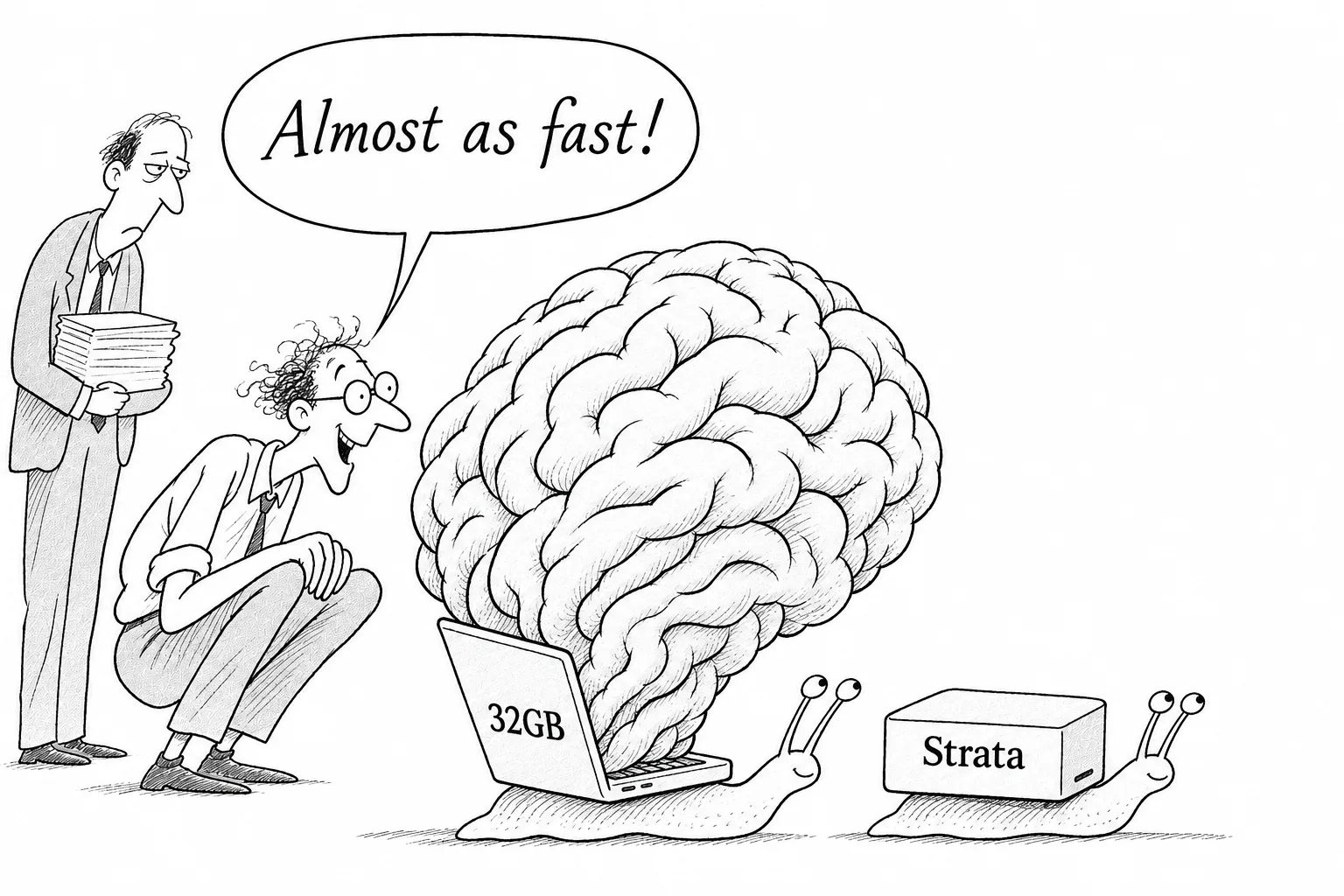
Editorial cartoon