Work & Society · Nov 13, 2026
Welsh council hands 230,000 resident calls a year to AI
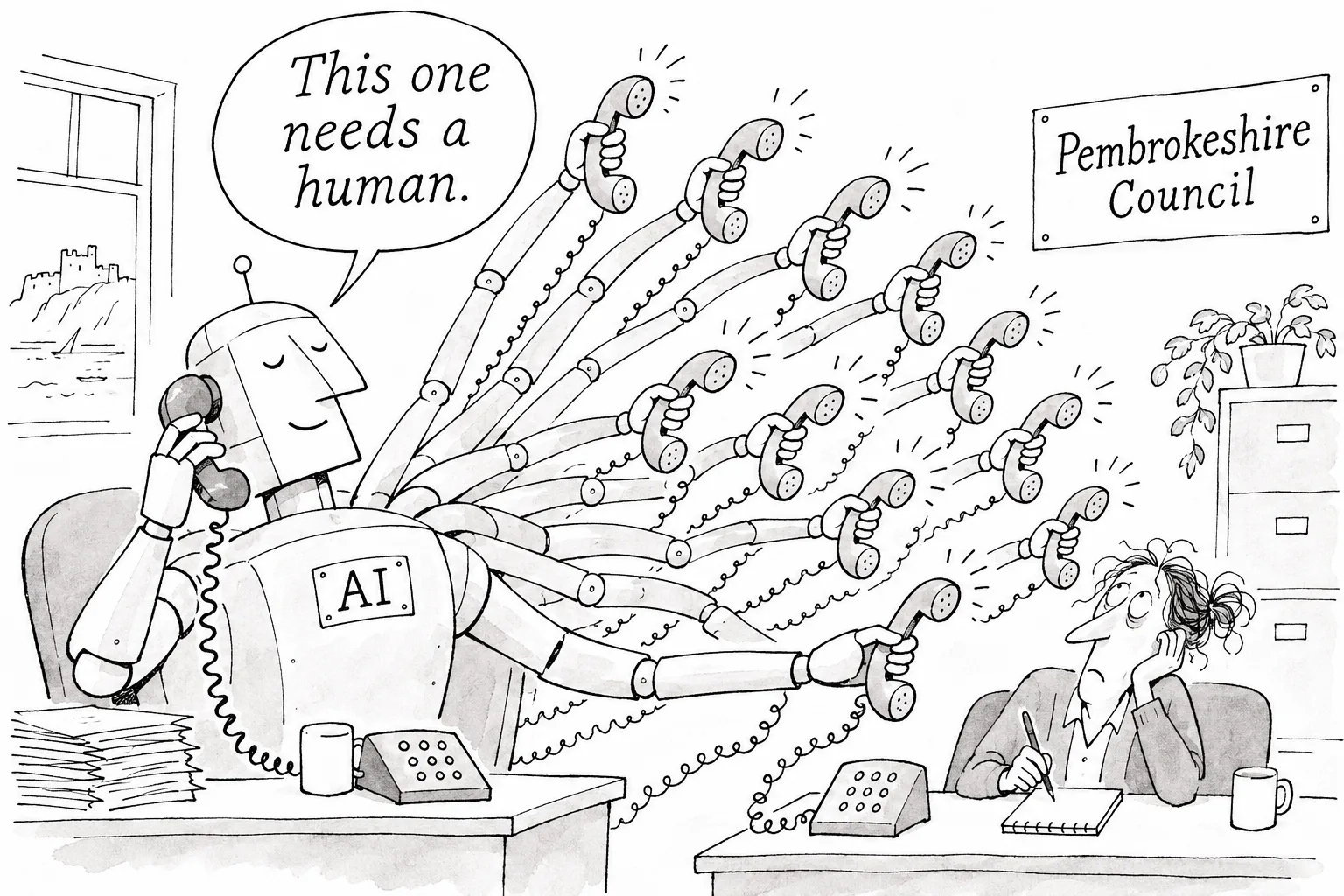
Pembrokeshire County Council has launched a £4.94 million programme. The AI will take calls in both Welsh and English, and contractor ICS.AI has made a conditional promise of at least £2.5 million in savings
Koji Yamamoto · Economics Analyst

Key points
- Pembrokeshire County Council will have AI answer more than 230,000 resident calls a year, in both Welsh and English
- The £4.94 million programme is billed as the largest AI project in Welsh local government. It puts AI for residents, AI for staff and AI agents on a single platform
- Contractor ICS.AI has promised savings of at least £2.5 million. The promise is conditional, and the announcement does not say what the conditions are
Pembrokeshire County Council, the local authority for a county in southwest Wales, has launched a plan to have AI answer the more than 230,000 calls it receives from residents each year. The AI will take calls in either Welsh or English. The programme is worth £4.94 million, and the contractor, UK company ICS.AI, has made a conditional promise to deliver at least £2.5 million in savings. A cash-strapped council is handing its entire phone service to AI and moving the staff time it frees up to cases that need more support. It has also made the contractor commit to a specific savings figure. That is what is new here.
For Japanese companies: Most companies are not directly affected. The ones that are include companies that run phone lines or call centres for local governments, and companies that run their own customer enquiry lines. Before their next contract review, the people in charge of those lines should work out what share of enquiries AI could likely handle. Companies selling AI should be asked to set out in writing the conditions under which they can guarantee a savings figure.
What was decided
The council has appointed ICS.AI to deliver a programme it describes as the most comprehensive AI programme in Welsh local government. The council and ICS.AI announced it on or around November 11 (press release). UK technology outlets also reported it as the largest AI project in Welsh local government (CFOtech, Compare the Cloud).
Phone calls are at the centre of the programme. AI will be the first to answer the more than 230,000 calls residents make each year. Public bodies in Wales are required to provide services in both English and Welsh, so the AI has to be able to handle calls in Welsh too. That means using a language with far less data than English in a setting, council phone lines, where there is little room for error.
Some reports put the programme at £4.94 million and others at £4.95 million. The gap appears to come from rounding, and this article uses £4.94 million.
Why a council is handing its phones to AI
The reason is plainly money. Will Bramble, the council's Chief Executive, said:
Like councils across the UK, we are facing increasing demand for services at a time of significant financial pressure.
Demand on UK councils for social care, welfare and waste collection keeps rising, while their budgets barely grow. Council phone lines get the same questions over and over, such as changes of address or when the bins go out. Letting AI take those calls frees up staff. Bramble stresses that the aim is to change how staff are used, not to cut their numbers.
this is about giving our staff better tools so they can focus on delivering support where it matters most
Tessa Hodgson, Leader of the Council, also focused on the benefits for residents.
This investment in AI is about improving how residents interact with the Council
The council is also saying this to head off a feeling among residents that they are being passed to an AI and cannot reach a person. If calls are answered straight away and residents can get things done in the evening or at weekends, they benefit too. The project's success, though, will depend on how it decides when a complicated case gets passed to a person.
What else is included beyond phone calls
The programme goes beyond phones. Martin Neale, founder and CEO of ICS.AI, described its scope:
This programme brings together AI for residents, AI for staff and AI agents within a single platform
AI for residents answers their enquiries by phone and on the web. AI for staff helps council employees write documents and research. AI agents go beyond answering questions and carry out tasks such as processing requests. Instead of bringing in three separate tools, the council will run all three on one platform. Whichever channel an enquiry comes through, the answers draw on the same information, and conversations are less likely to break down when staff take over. For a Japanese company, it would be like getting phone-line AI, an internal AI assistant and task-handling agents all from one vendor on one system.
Making the vendor promise savings
The most striking part is ICS.AI's promise of at least £2.5 million in savings, roughly half the £4.94 million cost of the programme. AI rollouts often end with buyers unsure whether they gained anything. Making the vendor commit to a minimum result is meant to reduce the council's risk.
The promise comes with conditions, however. The announcement does not say which conditions must be met for the £2.5 million to be guaranteed, over how many years the savings will be counted, or who pays what if the target is missed. The guarantee could be written so that it no longer applies if, for example, the council does not change how it handles calls or residents do not use the AI. How much the promise is worth depends heavily on those conditions.
In Japan, too, AI vendors often claim their products cut labour costs by a certain percentage. But it is rare for buyers to write that figure into a contract and agree on what happens if it is not met. Pembrokeshire's approach offers a model for organisations buying AI.
What is still unknown
The announcement tells us only what is described above. The following points have not appeared in the announcement or in reports and remain unconfirmed.
The conditions attached to the savings promise and the period over which savings will be counted. The length of the contract and how the £4.94 million breaks down between payments to ICS.AI and the council's own costs. What share of the 230,000 calls a year the AI is expected to resolve on its own, and the criteria for handing a call to a person. Who will check the quality of the AI's Welsh-language responses, and how. How staff numbers will change. When the AI will start answering residents' calls.
Will a plan that hands a council's entire phone service to AI deliver the promised savings? Will other UK councils follow its approach to buying AI? The figures from the first year should start to answer those questions.
Editorial cartoon
Sources
- https://einpresswire.com/article/956001297/pembrokeshire-county-council-appoints-ics-ai-to-deliver-welsh-local-government-s-most-comprehensive-ai-programme
- https://cfotech.co.uk/story/pembrokeshire-council-launches-gbp-4-95m-ai-rollout
- https://comparethecloud.net/news/pembrokeshire-council-appoints-icsai-for-495m-programme-the-largest-ai-project-in-welsh-local-govern