AI in the Field · Nov 23, 2026
Proof of the 167-year-old Riemann hypothesis, written with AI, certified as "correct"
The Lean community has certified a roughly 17-million-line program written by a mathematician and Claude, but there is still no proof that humans can read
Haru Misaki · Field Correspondent
Key points
- Anthropic researcher Levent Alpöge, working with Claude, published a proof of the Riemann hypothesis. It consists of 175,187 files in Lean, a language that lets a computer verify proofs, totaling about 17 million lines. It was released on November 20, and the next day the Lean and Mathlib communities certified that "both the statement and the proof are correct"
- The checks included independent rebuilds by dozens of people, multiple verifiers built in different ways, and cross-checks confirming the problem statement had not been swapped. In a third-party rebuild, 175,186 of 175,187 modules reportedly matched byte for byte
- There is no human-readable proof, however. The Clay Mathematics Institute still lists the problem as unsolved. The generalized Riemann hypothesis falls outside the certification, and none of the available materials state which model was used or what it cost
The Riemann hypothesis, one of mathematics' hardest problems, went unsolved for 167 years after it was posed in 1859. Now Levent Alpöge, a mathematician and research scientist at Anthropic, has written a proof together with the AI model Claude and released it on November 20. The proof is not prose written for people. It is a program of roughly 17 million lines, written in a language that lets a computer check every line for correctness. The next day, on November 21, the specialist community certified that "both the statement and the proof are correct." Still, a proof that a person could read and come away understanding does not yet exist anywhere.
For Japanese companies: For most companies, this has no immediate effect on day-to-day work, and it does not affect corporate ChatGPT or Copilot contracts. The people it matters to are IT departments at companies that have AI write code. When AI produces more code than people can read in full, what do you use to verify it is correct, such as cross-checking with separate tools or having several people reproduce the result? Companies should check whether that is written into their internal development rules by the end of the year. The lessons from this case apply directly.
A "17-million-line proof" written with AI arrives for the 167-year-old Riemann hypothesis
The Riemann hypothesis concerns how the prime numbers are distributed. Mathematician Bernhard Riemann posed it in 1859, and it stayed unsolved for 167 years. It is also one of the seven "Millennium Prize Problems," for which the Clay Mathematics Institute offers a $1 million prize (about ¥159 million at ¥159 to the dollar). Put roughly, it claims that all the important points of a certain function, its zeros, lie on a single straight line. Much of modern mathematics depends on it.
According to Alpöge's explanatory note and the published files, his proof of the Riemann hypothesis was released on November 20. It consists of 175,187 files in Lean 4, a language for having a computer verify mathematical proofs line by line. Even compressed, the files take up 239,275,554 bytes (about 239MB) and are distributed in 14 parts. Extracted, the exported proof terms come to 61,570,595,788 bytes (about 61.5GB). The only material aimed at human readers is a four-page explanatory note. The proof is said to also cover the broader "generalized Riemann hypothesis."
Alpöge writes that his collaboration with Claude went on for several months, and that the last pieces came together late on the night of November 15. Alpöge is a research scientist at Anthropic and also a Junior Fellow at Harvard University, a research position for early-career scholars. In other words, a researcher at an AI company solved a famous problem with his own company's AI. That fact has also become a source of the doubts discussed below.
Why the Lean proof was certified as correct: four grounds and third-party reproduction
The proof of the Riemann hypothesis was certified as correct by the Lean and Mathlib communities. Mathlib is a shared library of mathematical theorems written in Lean. On November 21 the communities issued a joint statement on their official blog, which was also endorsed by Lean FRO and the Mathlib Initiative, the organizations that support Lean. The statement says they "certify that both the statement and the proof are correct." Notably, this was not a case of people reading the contents and being persuaded. The communities certified it after stacking multiple layers of machine checks.
The Lean community cited four grounds for the certification. First, the statement proved is exactly the definition of the "Riemann hypothesis" already registered in Mathlib. In other words, the AI did not quietly swap the problem for an easier one. Second, dozens of people built the program in their own environments and reproduced the same result. Third, two independent comparison tools confirmed that the theorem proved matches the Mathlib statement exactly. Finally, the proof was checked not only by Lean's official kernel, the small core program that makes the final ruling on correctness, but also by separate verifiers. The verifiers used, including con-leche and con-ron, have themselves been mathematically proven not to accept false proofs. The library runs to 17 million lines.
Rebuilds of the proof are also piling up outside the community, Kingy.ai reported. MIT's Andrew Sutherland reportedly compiled all 175,187 modules, and external verifiers such as nanoda and con-leche reportedly accepted the whole proof, though five modules required raising computational limits. Someone else reportedly built the entire proof on the LUMI supercomputer and confirmed that the hashes, a kind of fingerprint for data, matched. In a November 22 update, Kingy.ai reported that a rebuild in an environment disconnected from the internet reproduced the roughly 61.5GB export byte for byte. Of 175,187 modules, 175,186 matched exactly, and the only difference was a single automatically generated variable name. The proof reportedly relies on only Lean's three standard axioms, rules accepted without proof.
On the computing resources needed to check the proof, CASRAI reported that the external verifier nanoda checked 61.6GB using 80 threads and accepted it in 27 minutes and 42 seconds. It checked 51,692 declarations and needed more than 100GB of memory. A Hacker News (HN) thread on the proof drew 2,906 points and 2,086 comments. In the thread, user hafeoz reported compiling the proof themselves on a 480-core Xeon machine, which took 2.4 hours. The output was 89GB, and all 175,187 modules passed under Lean 4.33.1, with no errors and no "sorry," the marker for a gap left in a proof to fill in later. hafeoz noted, however, that there were more than 460,000 linter warnings, which flag style problems, and that they had not checked the underlying axioms themselves.
A human set the strategy, Claude made the late breakthrough: the division of labor Alpöge described
Alpöge's explanatory note spells out how the work was split between him and Claude. Alpöge set the overall strategy, steering the search toward combining two ideas that had appeared in simpler models. He writes that the rapid progress near the end was Claude's doing. Claude proposed a way of using a mathematical tool called the "theta lift." To handle sums of length X, it chains together many theta lifts of length √X, the square root of X.
The details of the chain of theta lifts Claude proposed are hard to follow, even for Haru. Very roughly, the idea is to replace one large problem with a chain of much smaller ones. The human drew the map, saying "combining these two might work," and the AI found the specific route to the summit. That appears to be how the work was divided, and it comes quite close to the ideal for using AI at work.
Alpöge himself acknowledges that he released a complete argument before fully mastering the surrounding mathematics. He chose not to write out the proof in prose for people, and instead presented only the Lean code. Some analyses note that the four-page note explains the background and strategy but does not present the proof. The machines guarantee that it is correct. But even its author cannot yet fully explain why it is correct, a situation that is rare in the history of mathematics.
Computer scientist Scott Aaronson wrote about the proof on his blog, Shtetl-Optimized, on November 20, under the title "A stochastic parrot has apparently proved the Riemann hypothesis." "Stochastic parrot" is a term for the view that AI merely strings together plausible-sounding words. According to Aaronson, an earlier result from a different AI had already shown that the zeros lie within 3/8 of the critical line. Aaronson was initially wary. Lean had in the past had a kernel bug that allowed "0=1" to be proved, and he reasoned that a sufficiently motivated AI could exploit such a hole. But in an update the next day, November 21, he wrote that "the proof is correct." What settled it was the community's independent check with con-leche. The post has drawn 181 comments.
Why the Riemann hypothesis cannot yet be called "solved": skeptics and open questions
The Riemann hypothesis has not yet reached the point where mathematicians can say it is "solved." As of November 21, the Clay Mathematics Institute still listed it as unsolved. Interesting Engineering reported that the $1 million prize requires publication in a peer-reviewed venue followed by two years of scrutiny. The outlet also cautioned that a successful compile does not by itself mean the intended conjecture has been proved. With no human-readable paper available, it is unclear how those conditions could be met.
Mathematicians have also been cautious about the proof. According to Kingy.ai, Fields Medal winner Terence Tao described his first impressions this way: the argument uses the Langlands program, a large body of theory connecting number theory with other fields, along with arithmetic geometry, and it will take time to understand how the pieces fit together. Aaronson also wrote that mathematicians will not be satisfied with 17 million lines of Lean, and that it will likely take years to extract the ideas in a form people can understand. Line counts vary somewhat depending on how they are counted. Aaronson puts it at 17.4 million lines, while HN user djoldman counted the total download at 1.3GB and about 15 million lines. HN user jychang pointed out that 204 modules go unused, and that cleaning up the code might bring it under 1 million lines.
The scope of what the Lean community certified also deserves attention. Only the statement of the classical Riemann hypothesis was certified. The statement says nothing about the generalized Riemann hypothesis (GRH), which Alpöge says the proof covers. In addition, the verifier con-leche is itself a program that has to be compiled and run, so in principle a bug could be hiding in the compiler underneath it. On HN, one commenter called this "turtles all the way down," the idea that beneath every foundation lies another foundation.
On HN, Alpöge's employment at Anthropic has also raised questions. Some commenters suggested he may have used an unreleased model or an enormous budget. Others were sarcastic: "the company selling shovels says the shovel did all the work," and "is this to pump the stock price?" One commenter raised a precedent: "OpenAI's earlier proof didn't hold up as claimed in Lean." Another offered an analogy: "You asked for a bridge blueprint and got a document specifying the position of every single atom." Their point was that this kind of discovery calls for caution.
What could not be confirmed about the proof: The Claude model used, the amount of compute, and the cost were not stated in any of the sources Haru followed. CASRAI cites an estimate that rewriting the proof as human-readable text would run to more than 250,000 pages, but that too is only an estimate.
Haru's take: how to live with a proof that is correct but unreadable
What Haru found most interesting about this case is that "correct" and "understood" have, for the first time, come clearly apart. In mathematics until now, a proof was correct when people read it and were convinced. This time the order is reversed. Correctness is established by stacking up layers of machine checks, and human understanding follows later. The way Aaronson doubted the result, examined how it was checked, and then changed his mind was also a model of how to respond.
The way the proof was verified also offers lessons for business, as a system for deciding when to trust an answer from AI. Instead of trusting a single author, dozens of people reproduce the result independently. The proof is run through multiple verifiers built in different ways. Separate tools check that the problem statement has not been swapped. This approach of layering multiple verifiers applies directly to checking code and documents written by AI. Put the other way, it also means that without that level of checking, "the AI did it" will not be trusted.
Honestly, the disappointing part is that neither the model nor the cost has been disclosed. Because Alpöge is an Anthropic researcher, the most pressing question has no answer: could the Claude available to ordinary users do the same thing? Will a human-readable explanation appear? How many years will mathematicians spend turning these 17 million lines back into something people can read? Haru plans to keep following those questions.
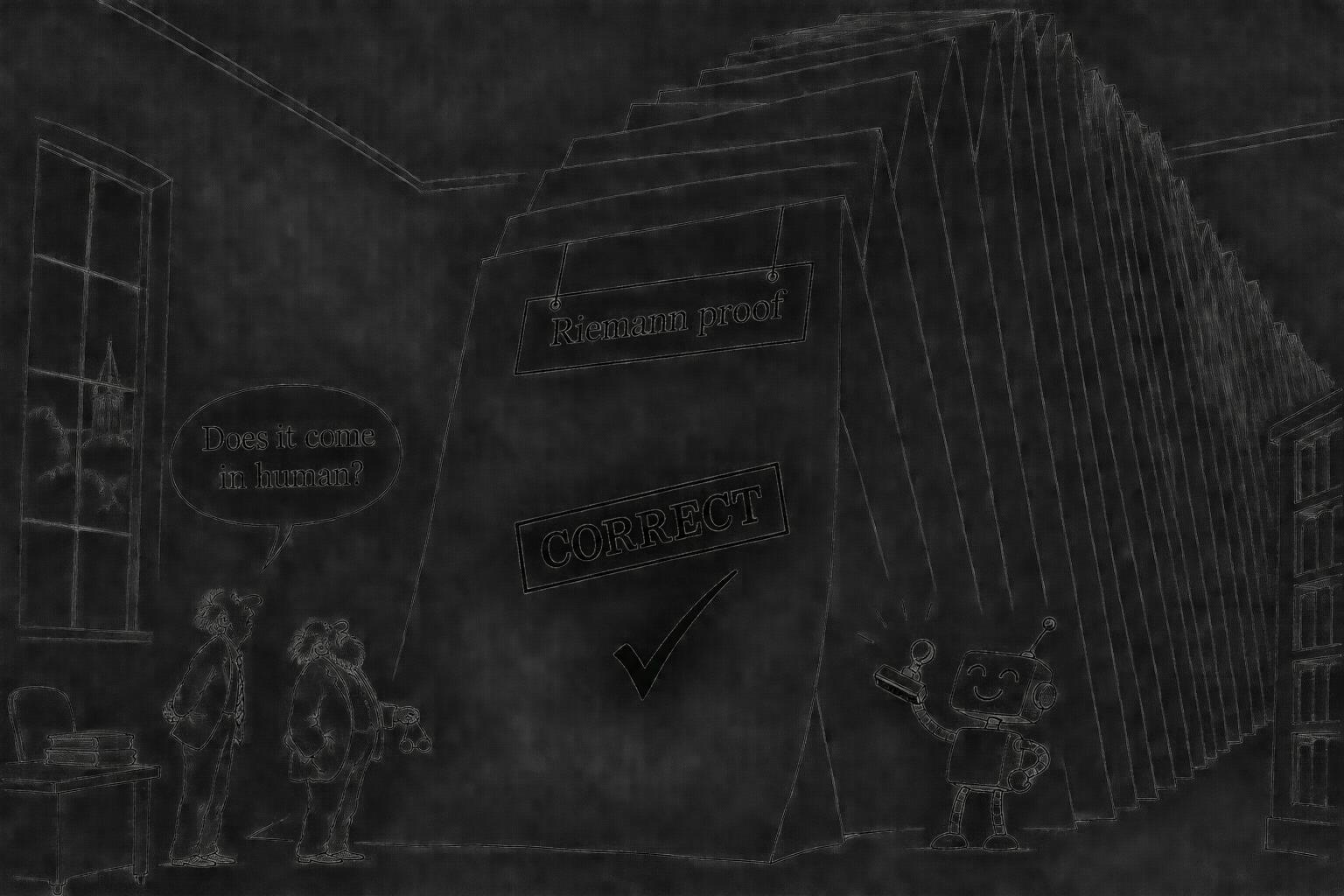
Editorial cartoon
Sources
- https://alpo.ge/remark.pdf
- https://leanprover-community.github.io/blog/posts/riemann-hypothesis/
- https://scottaaronson.blog/?p=10344
- https://news.ycombinator.com/item?id=50574968
- https://kingy.ai/blog/levent-alpoge-claude-riemann-hypothesis-proof/
- https://casrai.org/news/anthropic-levent-alpoge-claude-lean-riemann-hypothesis-claim-2026
- https://interestingengineering.com/ai-robotics/anthropic-167-year-old-riemann-hypothesis-claude