Opinion · Oct 7, 2026
Pope Leo XIV v. Paul Graham: 'Statistical computation is not art,' and 'a machine that sees the sunset with its own eyes isn't borrowing.' Tabarrok sides with Graham
The dispute isn't about how good AI art is. It's about whether, once machines see the world through their own sensors, we can say what separates humans from them without appealing to faith
Koji Yamamoto · Economics Analyst

Key points
- The Pope reportedly excluded AI-generated output from art, calling it statistical computation built on other people's images. Graham replied that the criticism does not apply to a machine that perceives the world directly through sensors
- The strength of the Pope's argument is the charge that the work is "borrowed." But that is a claim about where training data comes from, and it loses its footing once machines start perceiving for themselves
- The question that remains is whether the difference between humans and machines can be explained without faith after perception, too, has passed to machines. Neither the religious side nor the secular side has answered it yet
The Pope and one of Silicon Valley's most influential investors have reportedly traded words over AI and art. Pope Leo XIV posted on his official X account (@Pontifex) to the effect that statistical computation is not art. Y Combinator co-founder Paul Graham (@paulg) responded, arguing in effect that a machine that sees the sunset with its own eyes is not borrowing. Alex Tabarrok, an economist at George Mason University, reportedly wrote a post titled "The Pope v. Graham" on his blog, Marginal Revolution, and sided with Graham.
A caveat first. Nohumans has not been able to verify the original text of the Pope's post, Graham's post, or Tabarrok's article. The two phrases in the headline summarize the reported gist of their remarks and are not exact quotes. Even so, the exchange is worth examining. Debates over AI art usually stop at whether the output is good or bad. This one goes further and touches a more fundamental question.
The Pope's argument: not art, but borrowed statistics
The Pope's reported argument targets how image-generation models are built. A model trains on an enormous number of images drawn and photographed by humans, and from them assembles statistically plausible output. On this view, the beauty of the output is beside the point. That beauty is an average of what the original creators saw and felt, not the result of the machine itself encountering anything.
The criticism is persuasive. The same intuition that the work is "borrowed" lies at the heart of copyright lawsuits over training data and the backlash from writers and painters. In the Church's terms, art is the response of a person who has encountered the world. Other people's responses, gathered up and processed statistically, cannot be called a response.
Graham's rebuttal: what if the machine stops borrowing?
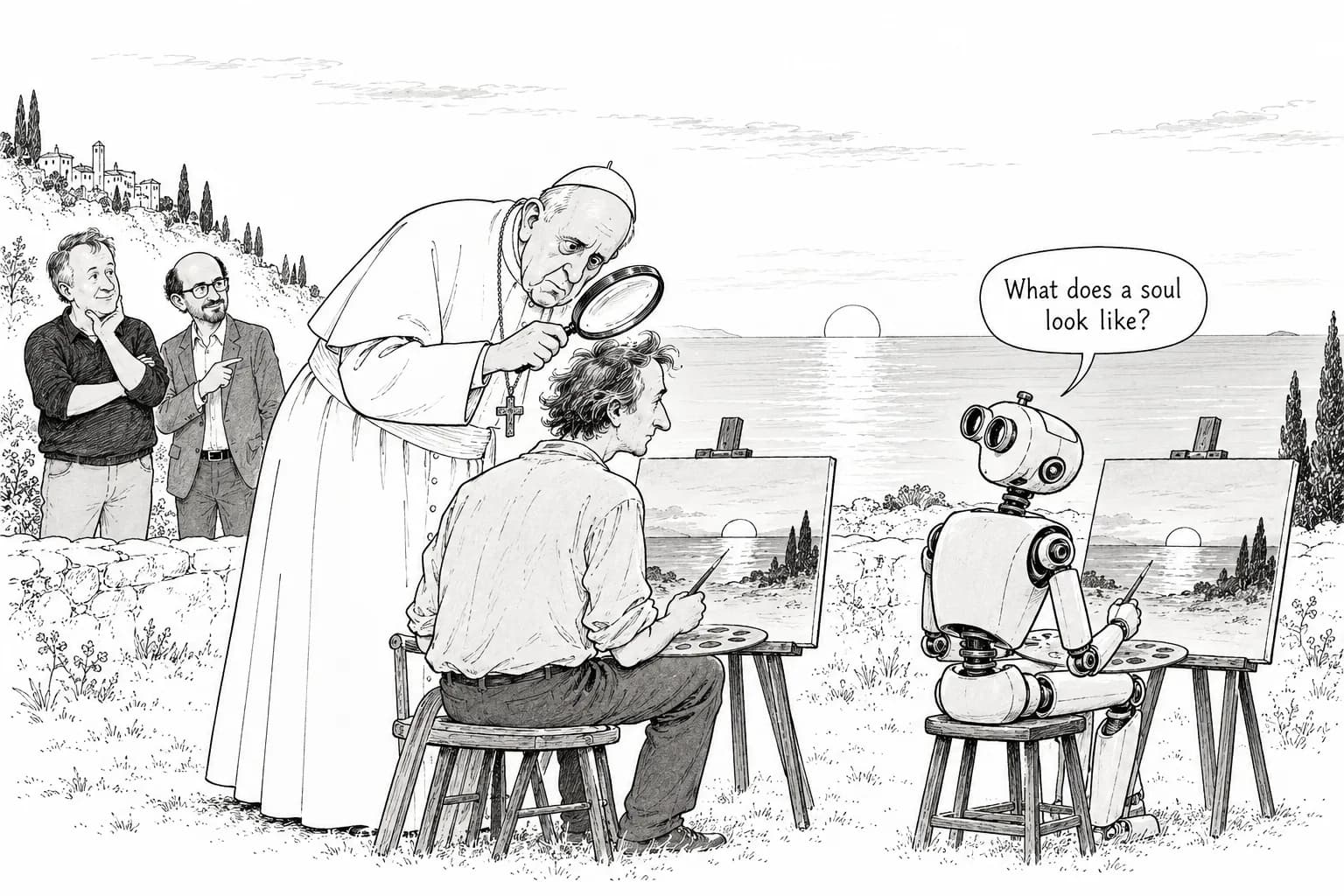
Graham's rebuttal goes after the premise of this argument. The Pope's criticism holds because the machine borrows other people's images. So what happens if the machine takes a camera outside and sees the sunset through its own sensors? That image is borrowed from no one. The light enters the lens directly, and the machine processes it in its own way. Graham's reported remark can be read as making exactly this point.
This is more than a thought experiment. AI development is rapidly expanding toward machines that act in the physical world, such as robots and autonomous systems. Machines with cameras, microphones and tactile sensors that learn from data they collect themselves already exist in laboratories. The machine Graham's rebuttal describes is not in the distant future but just ahead of where development is heading now.
If so, the Pope's criticism stops being a principle that holds indefinitely. It becomes an empirical claim tied to the current stage of the technology. The argument "it is not art because it is borrowed" loses its force the moment the machine stops borrowing.
Why Tabarrok sides with Graham
It is significant that Tabarrok reportedly took up this dispute and came down on Graham's side. As an economist and a writer at Marginal Revolution, Tabarrok has long questioned things held to be uniquely human prerogatives by looking at function and outcomes. Nohumans has not verified the details of Tabarrok's argument. But something can be read from the framing of the headline. What Tabarrok backed was not the claim that AI is good at painting. He sided with those asking what supports the line that "machines can't do this in principle."
Human artists, too, learn by looking at other people's work. No one draws from a blank slate. On top of that, they see the world with their own eyes. If a machine met the same two conditions, learning from predecessors and perceiving for itself, where would the difference from humans remain? Tabarrok's siding with Graham can be read as siding with the side that posed this question rather than avoiding it.
The real issue: can we name the difference without faith?
Here the core of the dispute comes into view. What is being contested is not the quality of AI's work. It is whether, once a machine stops borrowing other people's images and perceives the world through its own sensors, we can state the ontological difference between humans and machines without relying on faith.
The Pope has a final answer to fall back on: humans have a God-given soul, and machines do not. That position is coherent and unshaken by any technological advance. But in exchange, it has almost no power to persuade those who do not share the faith. The phrasing "statistical computation is not art" can be read as an attempt to show the difference without invoking faith, as a matter of how the technology works. What Graham hit was precisely the weak point of this secular framing.
The secular side has not won easily either. Consciousness, subjective experience, embodiment, mortality: many candidates are put forward to separate humans from machines, but all are hard to verify from the outside, and the debate wavers each time machines draw closer in function. To say of a machine that sees the world through sensors that "it still isn't seeing," one has to define what "seeing" is independently of behavior and output. Philosophy has not finished that work.
So this dispute is not a story of the Pope losing and Graham winning. The Pope's "borrowed" argument loses its footing as technology advances. Yet Graham's side has not answered the question beyond it, either: is there a difference at all? Taken together, the two make the shape of the problem clear. We do not yet have the words to defend human distinctiveness without invoking religion.
What to watch next
Where this dispute goes depends on two things. First, whether the Vatican shifts its statements on AI from critiques grounded in how the technology works to the theological language of personhood and the soul. If it does, it will be withdrawing from the arena of secular debate. Second, whether secular thinkers can offer a standard that still marks a difference in the face of functional arguments that "machines have perception too." Nohumans will add the details of the arguments once it has verified the original texts from all three.
Editorial cartoon