Rules & Policy · Nov 24, 2026
Trump says he "persuaded the board"; Senate to question Huang in public on December 3
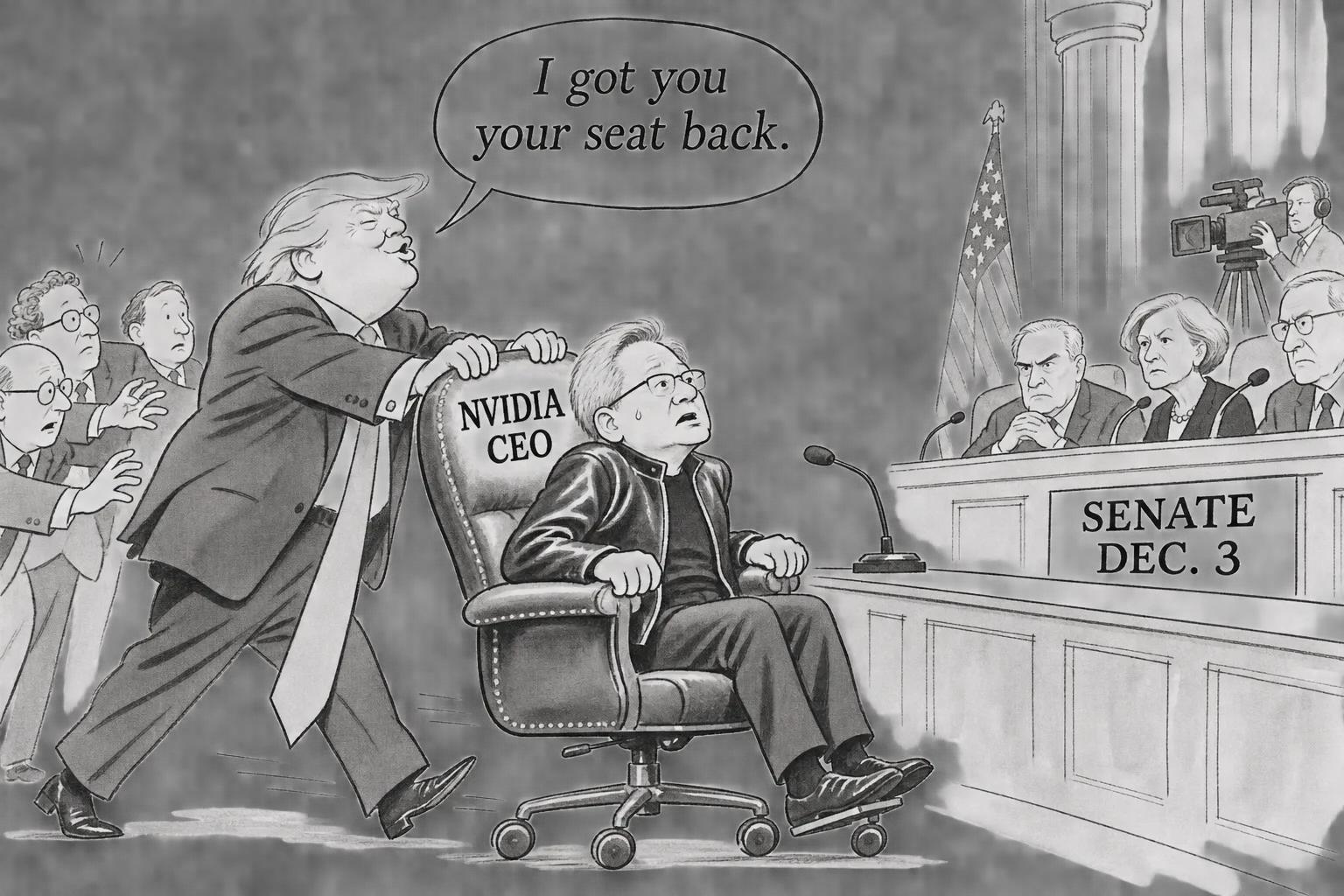
The president reportedly admitted he persuaded NVIDIA's board to reinstate its CEO. The company is under investigation by authorities, and lawmakers from both parties are pushing back. The Senate will question Huang at a public hearing on December 3, and there is a growing push to add legislation restricting chip sales to China to this year's defense bill.
Koji Yamamoto · Economics Analyst

Key points
- Trump reportedly admitted he personally persuaded NVIDIA's board to reinstate Huang as CEO. Accounts differ on whether Commerce Secretary Lutnick was involved
- NVIDIA is under investigation, so the White House has in effect stepped directly into a personnel decision at the company. Criticism has reportedly come from both Republicans and Democrats
- The Senate will reportedly call Huang to a public hearing on December 3. There is also a growing push to add legislation restricting chip sales to China to the defense bill due to pass by year-end
[Update, November 24, 2026, 4:51] We have corrected our description of the Treasury Department's deadline for NVIDIA to respond. It previously said the deadline had "already passed"; it is November 25 and has likely not yet passed. On Commerce Secretary Lutnick's involvement, Trump has said he consulted him, so we no longer state only that Lutnick was "not involved" and instead note that accounts conflict. We no longer state flatly that Commerce Secretary Lutnick's involvement has been denied; we now note that Trump has said he consulted him and that accounts conflict.
U.S. President Donald Trump has reportedly admitted that he personally persuaded NVIDIA's board to reinstate Jensen Huang as CEO. NVIDIA is currently under investigation by authorities. If the president's account is accurate, the White House stepped directly into a personnel decision at a company under investigation. Lawmakers from both the Republican and Democratic parties are reportedly pushing back. The Senate is reported to be calling Huang to a public hearing on December 3. There is also a growing push to add legislation restricting chip sales to China to the defense bill due to pass by year-end.
What it means for Japanese companies: Most companies will see no immediate impact. Those affected are manufacturers, trading companies and IT departments that plan to buy NVIDIA GPUs (the chips used for AI computing), or servers equipped with them, for their China operations. Before the contents of the defense bill are settled later this year, they should check next year's China procurement and delivery terms with their distributors this month.
What Trump admitted: the president personally backed NVIDIA's CEO decision
According to reports, President Trump admitted that he was the one who persuaded NVIDIA's board to reinstate Huang as CEO. CBS News has reported separately on NVIDIA's reinstatement of Huang and on concerns that Trump's comments about the decision raise national security issues (CBS News: Reinstatement as CEO, CBS News: Trump's comments).
As for who was involved in the NVIDIA decision, market news service Newsquawk reported, citing a source familiar with the matter, that Commerce Secretary Howard Lutnick played no part in the board's decision to reinstate Huang (Newsquawk). According to CNN, however, Trump said he consulted Lutnick, leaving conflicting accounts of the commerce secretary's role.
Why both parties objected: the government intervened in a company under investigation
The backlash centers on timing. NVIDIA has been reported to be under investigation, including an accounting probe by the Securities and Exchange Commission (SEC). Treasury Secretary Scott Bessent had asked the board for an explanation, with a deadline reported as November 25, which has likely not yet passed. The head of the government doing the investigating has, in effect, backed the leadership of the company being investigated, raising doubts about the fairness of oversight.
U.S. lawmakers have criticized NVIDIA's reinstatement of its CEO, Canada's The Globe and Mail reported (The Globe and Mail). The criticism reportedly comes not only from Democrats but also from the president's own Republican Party. For lawmakers who take a hard line on chips flowing to China, the appearance that the government protected NVIDIA's management has intensified the backlash.
The December 3 Senate hearing: Huang to answer questions in public
The Senate will call Huang to testify on December 3, Investing.com reported (Investing.com). The hearing is expected to be public rather than closed, and questions are likely to cover how the CEO was reinstated, his exchanges with the president and controls on sales to China.
On NVIDIA's calendar, December 4, the day after the hearing, is the deadline to file its quarterly report (10-Q). What the company says about the SEC investigation will be watched alongside Huang's testimony.
Bills restricting chip sales to China: push intensifies to add them to this year's defense bill
There is reportedly a growing push to attach legislation restricting chip sales to China to the annual year-end defense bill (the National Defense Authorization Act, which sets the military's budget and policy). Because the defense bill passes almost every year, other measures attached to it are more likely to become law. The president's involvement in NVIDIA's CEO decision has pushed Congress toward restricting sales through legislation rather than leaving the matter to the executive branch.
If the China chip legislation is included in the defense bill, decisions on whether to allow exports would be harder to change through the judgment of the president and the Commerce Department alone. That would affect both NVIDIA's revenue and the global flow of AI servers.
What we could not confirm
Everything in this NVIDIA story is based on media reports; we were unable to check primary documents. President Trump said in a phone interview with CNBC that he spoke with the board and persuaded it. Huang had resigned as CEO on November 12 over an affair with a woman suspected of being a Chinese spy. The December 3 hearing will be held by the Senate Banking Committee. We could not confirm the exact timing of the lobbying, nor the names of the bills. The proposals being pushed for the defense bill include halting sales of NVIDIA's Blackwell chips to China for 18 months or more and requiring location-tracking mechanisms on chips shipped overseas. NVIDIA's board said the reinstatement serves shareholders' interests, and Trump said in a post that the government has no reason to believe the reinstatement poses a national security risk.
Editorial cartoon
Sources
- https://www.cbsnews.com/news/nvidia-jensen-huang-trump-comment-national-security-risk/
- https://www.cbsnews.com/news/nvidia-reinstates-jensen-huang-ceo/
- https://www.newsquawk.com/headlines/us-commerce-secretary-lutnick-played-no-part-in-the-nvidia-nvda-boards-decision-to-reinstate-jensen-huang-as-ceo-according-to-a-source-familiar-with-the-matter
- https://www.investing.com/news/stock-market-news/nvidias-huang-to-testify-before-us-senate-on-dec-3-5046191
- https://www.theglobeandmail.com/world/us-politics/article-us-lawmakers-criticize-nvidia-decision-to-reinstate-jensen-huang/