Infrastructure & Security · Oct 18, 2026
Indiana judge overturns data center rezoning as more than 36 localities head to November votes — compute expansion begins to stall on local process and voters
A rezoning of Wolcott farmland was voided over procedural defects, and $86.5 million has gone into anti-data center ads in the midterms. New Mexico's Project Jupiter is also reportedly stalled over its air permit
Seiichi Tanaka · Editor-in-Chief

Key points
- A judge has reportedly overturned the decision to rezone farmland in Wolcott, Indiana, for a data center, citing procedural defects, halting the project
- Bisnow reports that $86.5 million has been spent on midterm ads casting data centers as the villain, and that data center-related referendums will be held in more than 36 localities in November
- At New Mexico's Project Jupiter, a hearing officer has reportedly reversed course on an air quality permit application, showing that the permitting process itself is driving the timeline
What will halt the expansion of AI computing capacity: grid capacity, transformer lead times, or chip supply? That is how the debate has been framed over the past year. But this week's reporting points to a different set of brakes that kick in much earlier: county zoning procedures, state air permits and voters at the ballot box.
All of the following is based on media reports; we have not obtained the primary sources, such as the court ruling, the permit records or tallies of campaign ad spending. Figures and details should be read as reported.
Indiana: Judge overturns farmland rezoning
According to a report, a judge has overturned a decision to rezone farmland around Wolcott, Indiana, for a multibillion-dollar data center. The ruling reportedly turned not on the merits of the project but on defects in the procedure used to approve the rezoning. The project has been halted as a result, according to the report.
The key point is that the ruling rests on procedure. A project may have secured a power contract and lined up financing, but if a single step in the local land-use process breaks down, the project stops there. Steps usually treated as formalities, such as public notice, hearings and the order of votes, became the legal footing for halting a multibillion-dollar investment.
Because the problem was procedural, the locality could redo the process and arrive at the same outcome. Even so, a do-over takes time, and that gives opposing residents time to organize. For the developer, the cost of that delay may be greater than the ruling itself.
Midterms: Data centers become the "villain" of TV ads
Bisnow reports that data centers have become a villain in TV ads on the midterm campaign trail. Ads opposing data centers or using them to attack opponents have reportedly drawn $86.5 million in spending. In addition, data center-related referendums are scheduled in more than 36 localities in November, according to the report.
The $86.5 million figure shows that data centers have moved from a source of scattered local opposition to an issue candidates can use to win votes. Electricity bills, water, noise and tax breaks resonate with voters as matters affecting their own lives more readily than abstract issues such as AI safety. Advertisers are spending money there because they believe it works.
If referendums spread to more than 36 localities, the outcome will go beyond yes-or-no votes on individual projects. The map of which states and counties can host construction will be redrawn on a single night in November. Developers will have to read not only spare grid capacity but also the local political climate as a siting factor.
New Mexico: Project Jupiter stalls on air permit
The same thing is happening to projects that generate their own power. At Project Jupiter, a large data center project in New Mexico, a hearing officer reversed course on an air quality permit application, Searchlight New Mexico reports. Earlier, the Albuquerque Journal had reported that the air quality hearing date had moved to September. A new hearing date has not yet been set, as far as Nohumans has been able to confirm.
The air permit is an issue because the project places power generation on site. Working around grid shortfalls with self-generation means the power plant itself becomes subject to the state's environmental process. A project that thought it had solved its power constraint has run into a different local process.
A brake that came before power
The plans of AI labs and cloud providers keep growing by orders of magnitude. Microsoft has said it will deploy Maia 300 at gigawatt scale, and Anthropic has been reported to be pressing partners to accelerate roughly $530 billion worth of data center leases. These figures rest on the assumption that there will be somewhere to build.
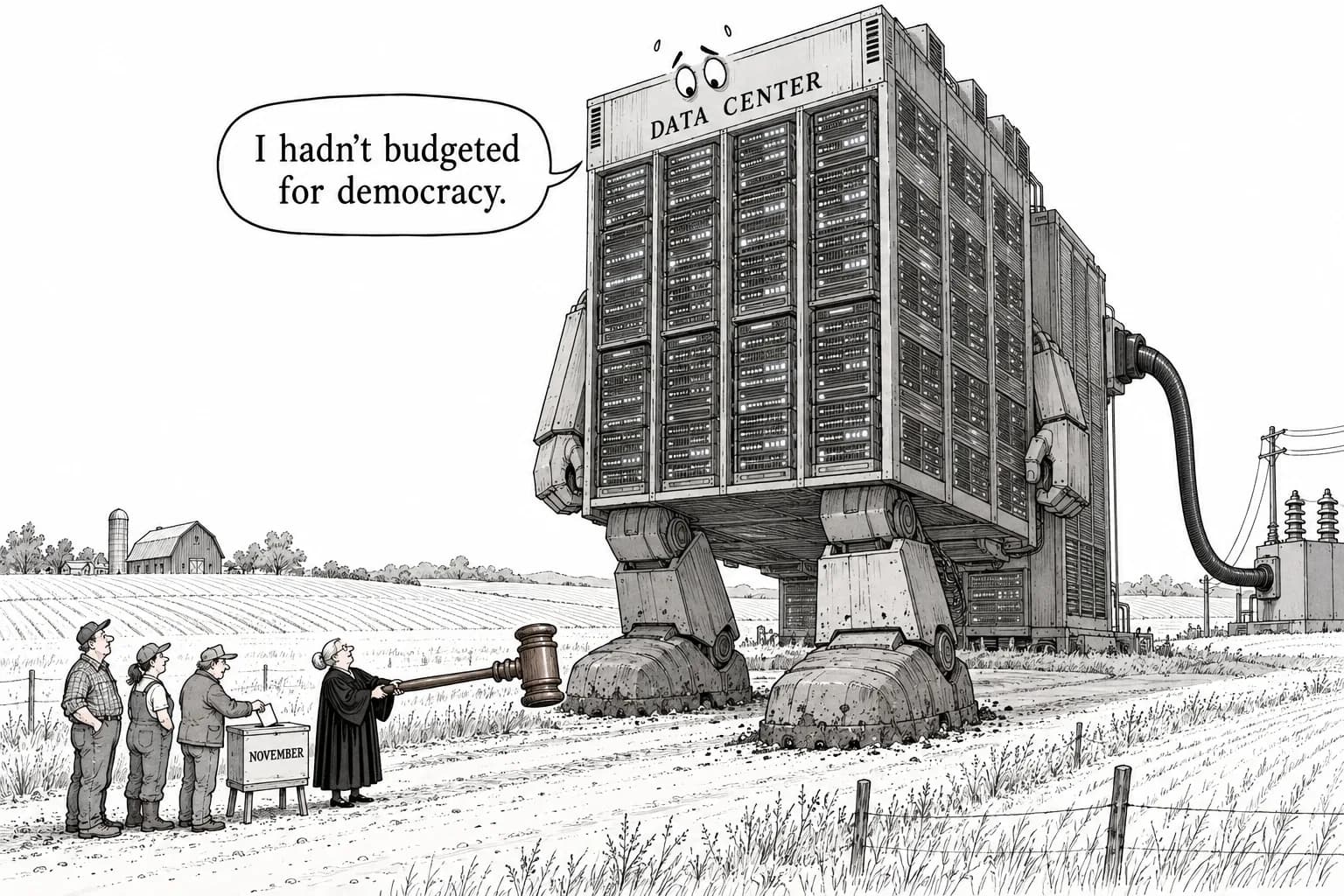
This week's three developments show that assumption can break down at the local level. In Indiana, a court overturned a rezoning over procedural defects; on the campaign trail, $86.5 million in ads cast data centers as the villain; and in New Mexico, an air permit is dictating the timeline. None of these stopped because of a shortage of power. The veto tools held by localities — land use, environmental permits and the judgment of voters — are taking effect first.
This brake is hard to overcome with technology or money. Chips can be bought, and power plants can be built. But redoing a process takes legally mandated time, and referendum results cannot be overturned. County meeting minutes and polling places have joined the variables that set the pace of compute expansion.
What to watch next
Upcoming dates include a special meeting in Aurora (October 19), Memphis and Loudoun County (October 20), Charlotte (October 26) and a vote in Guilford County. In Indiana, will the locality redo the process or appeal? In New Mexico, when will the new date for Project Jupiter's air quality hearing be set? And in November's referendums, how many of the more than 36 localities will reject projects? Before power, this is where the destination of computing capacity will be decided first.
Note: This article is based on media reports; we have not been able to verify primary sources such as the court ruling, permit records or tallies of ad spending. The judge's name, the developer, the details of the procedure on which the ruling was based and the methodology behind the $86.5 million figure need to be confirmed against primary sources.
Editorial cartoon
Sources
- https://www.yahoo.com/news/us/articles/rezone-wolcott-farmland-overturned-halting-201711044.html
- https://www.bisnow.com/news/national/data-center-community-relations/data-centers-have-become-a-tv-villain-on-the-midterm-campaign-trail
- https://searchlightnm.org/project-jupiter-hearing-officer-reverses-course-on-air-quality-permit-application/
- https://www.abqjournal.com/news/project-jupiter-air-quality-hearing-date-changes-to-september/3094091